
Every crystal, mineral, fossil, meteorite, and handcrafted piece is selected with purpose. Whether you’re building a museum-worthy mineral collection, searching for a meaningful gift, decorating your home with natural beauty, or beginning your journey into the world of geology, you’ll discover authentic specimens with stories worth sharing.
Over 15 shows a year throughout the Southwest. Check to see if we are coming to a show near you!
Home > Blog > Minerals Blog | Crystal Guides, Geology & Metaphysical Meaning > Staurolite Fannin County, Georgia
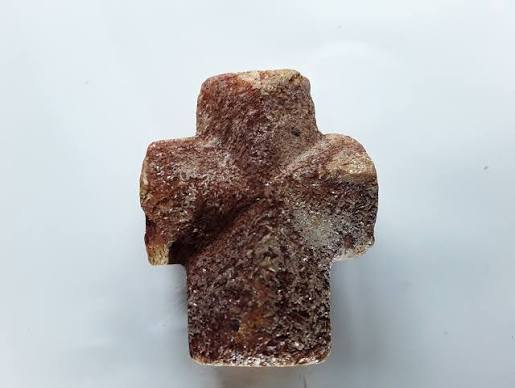
Donald Wininger Collection
“Some minerals are admired for their color. Others are treasured for their rarity. Staurolite earned its place in mineral collections for an entirely different reason. It records one of the most violent chapters in North America’s geological history. Long before the Appalachian Mountains became the worn blue ridges we know today, unimaginable heat and pressure transformed ordinary mud into one of nature’s most recognizable crystal twins. The specimen preserved in the Donald Wininger Collection is more than a beautiful cross-shaped crystal—it is evidence that mountains once rose where an ancient ocean had disappeared.”
Every mineral tells a story- some begin in volcanoes and others grow in caves. Others crystallize from evaporating lakes or ancient seas. Staurolite begins with mud. That simple fact surprises many collectors.
The sharply defined crystal in the Donald Wininger Collection appears strong, solid, and permanent. It seems impossible that something so geometrically precise could trace its origins to fine sediment settling quietly onto the floor of an ancient ocean. Yet that is exactly where the story begins. Layer after layer of clay deposited hundreds of millions of years before the Appalachian Mountains even existed.
Those tiny clay particles would eventually become buried so deeply that they entered one of the most extraordinary natural laboratories on Earth where heat increased and pressure climbed where the entire continents collided. Resulting in mountains rising, rocks flowing like warm wax. Atoms reorganized themselves into completely new minerals. Among those minerals was staurolite.
Travel through Fannin County today and it is difficult to imagine the violence hidden beneath its peaceful forests and rolling ridges. The Blue Ridge Mountains appear gentle. Streams wind quietly through valleys. Wildflowers bloom beneath hardwood forests. Nothing suggests that these rocks once lay buried beneath mountains rivaling the Himalayas.
More than 500 million years ago, northeastern Georgia occupied the edge of an ancient continent. Beyond that shoreline stretched an ocean geologists call the Iapetus Ocean. Rivers flowing from older landmasses carried enormous quantities of mud into the basin.
Year after year…Century after century…Millions of years passed. Thin layers accumulated one upon another. Eventually thousands of feet of sediment blanketed the seafloor. Those sediments would become shale. Still, there was no hint of staurolite. Nature was only gathering ingredients.
The calm did not last. Slowly—far too slowly for any human to witness—tectonic plates continued moving. The ocean separating continents became narrower. Eventually it disappeared altogether. One continent collided with another. The impact did not resemble two cars striking head-on. It unfolded over tens of millions of years.
Entire crustal plates compressed. Rock folded into enormous arches. Faults carried layers of stone for miles. Sedimentary basins disappeared beneath rising mountain belts. The collision that ultimately produced much of the Appalachian Mountain system subjected these buried sediments to extraordinary temperatures and pressures. The shale descended deeper and deeper into Earth’s crust. Perhaps even twenty miles beneath the surface. At those depths, rock no longer behaves as brittle stone. It begins to flow. Minerals become unstable. Atoms migrate. Old minerals disappear. New minerals grow. This process is called metamorphism. It is among geology’s most remarkable transformations.
The original clay minerals could not survive these new conditions. Their crystal structures became unstable. Silica combined with aluminum. Iron entered new mineral lattices. Water escaped. One mineral replaced another. Layer by layer, shale transformed into mica-rich schist. The rock became filled with glittering muscovite and biotite. Quartz recrystallized. Garnets began appearing. Eventually the conditions became exactly right for something far less common. Staurolite.
This is why geologists become excited when they find staurolite. The mineral serves as an index mineral. To collectors, that phrase may sound unremarkable. To metamorphic geologists, it is enormously important. An index mineral is one that forms only under a relatively narrow range of pressure and temperature. Its presence immediately reveals something about the geological conditions experienced by the surrounding rock.
Finding staurolite is like discovering a thermometer frozen in time.
Without measuring anything directly, geologists know the host rock reached approximately 500–650°C under moderate to high metamorphic pressures. That realization changes everything. It means the rocks of Fannin County were once buried miles beneath the surface. It means continental collision became powerful enough to completely reorganize mineral structures.
It means today’s Appalachian Mountains are merely the worn roots of a mountain system that once rivaled the world’s greatest ranges.
Ask almost anyone about staurolite and they will mention crosses. Children call them fairy crosses. Collectors call them penetration twins. Mineralogists simply call them twins.
Regardless of terminology, they remain among nature’s most recognizable crystal habits. Many people assume the cross develops because one crystal bends however it doesn’t. Something much more remarkable occurs. Two completely separate crystals begin growing. Instead of remaining independent, they intersect according to precise crystallographic rules.
Their atomic lattices become interlocked. The result is a single specimen composed of two crystals sharing part of their internal structure. Nature does not choose the angle randomly. Most twins intersect near sixty degrees. Others develop close to ninety degrees. The ninety-degree twins became famous because they resemble perfect crosses. Yet they are actually less common than the sixty-degree variety.
Every twin therefore reflects extraordinary precision. Atomic architecture determines the final geometry. Chance plays almost no role.
One of the biggest misconceptions surrounding staurolite is that every crystal forms a cross. Many grow as ordinary single crystals while others become partially twinned. Some develop irregular penetration angles.
Perfect, symmetrical twins represent only a fraction of total production. This distinction explains why experienced collectors carefully examine every specimen. Symmetry , sharp crystal faces and balance matters.
Well-developed twins possessing attractive proportions remain significantly more desirable than broken or incomplete examples.
The finest Fannin County specimens combine excellent crystal form with rich reddish-brown coloration and minimal weathering. These are the specimens that advanced collectors seek.
Staurolite occurs in numerous locations around the world.
Virginia.
North Carolina.
Switzerland.
Russia.
France.
Brazil.
Austria.
Portugal.
Yet Fannin County developed a reputation that far exceeds its size. The reason lies in consistency.
The metamorphic rocks surrounding Blue Ridge and Mineral Bluff repeatedly produced well-formed crystals, many displaying attractive penetration twins.
Collectors visiting northeastern Georgia during the twentieth century discovered that the area yielded remarkably aesthetic specimens compared with many other American localities. Dark chocolate-brown crystals contrasted beautifully against shimmering mica schist. Twin after twin emerged from weathered outcrops.
Word spread quickly through mineral clubs. Soon Fannin County became synonymous with quality American staurolite.
Even today, many experienced collectors consider northeastern Georgia among the finest domestic sources for display-quality specimens.
Geologists rarely study staurolite in isolation. Its true significance becomes apparent when it appears alongside other metamorphic minerals. In Fannin County, staurolite commonly occurs with garnet, kyanite, sillimanite, biotite, muscovite, and quartz. Each mineral forms under slightly different conditions. Together they create what geologists call a metamorphic assemblage.
This assemblage acts almost like a geological fingerprint. A garnet alone tells part of the story. Add staurolite, and the pressure-temperature conditions become much more constrained. Introduce kyanite or sillimanite, and the history becomes even clearer.
Instead of guessing how deeply the rock was buried, geologists can reconstruct its metamorphic journey with remarkable confidence. For collectors, these associated minerals add another layer of appreciation.
A staurolite specimen with garnet and shimmering mica tells a richer geological story than an isolated crystal alone.
It preserves an entire mineral community born during the same mountain-building event.
In 1976, Georgia officially designated staurolite as the State Mineral. The choice reflected more than local pride. Few minerals are so closely associated with a single region’s geological history and cultural identity. Visitors to northeast Georgia quickly discover that the fairy cross has become part of local heritage. Gift shops sell polished specimens. Museums explain the geology. Rock clubs organize collecting trips. Schools teach students about the state’s remarkable mineral resources.
Unlike many official state symbols that remain largely unnoticed, staurolite continues to inspire curiosity.
It serves as both a geological ambassador and a reminder of the mountains’ ancient past.
For many people, their first introduction to metamorphic geology begins with a simple brown cross found in Georgia.
Although staurolite is considerably harder than many collector minerals, proper care remains important. With a Mohs hardness of approximately 7 to 7.5, it resists ordinary scratching quite well. However, the surrounding mica schist matrix is often much softer and more fragile.
Collectors should avoid dropping specimens, as impacts may fracture either the crystal or the host rock. Dust can usually be removed with a soft brush. Compressed air may be used cautiously to clean between mica plates.
Water is generally safe for brief cleaning, provided the specimen is dried thoroughly afterward. Acidic cleaners should never be used on specimens containing associated carbonate minerals.
Many collectors prefer leaving a small amount of natural matrix attached because it preserves locality information and provides geological context. A crystal separated completely from its host rock may appear attractive, but much of its story disappears.
Donald understood that preserving context often adds as much value as preserving the crystal itself.
Mineral: Staurolite
Chemical Formula: Fe₂Al₉Si₄O₂₃(OH)
Mineral Class: Nesosilicates
Crystal System: Monoclinic
Hardness: 7–7.5
Color: Reddish brown to dark brown
Luster: Vitreous to resinous
Transparency: Opaque to translucent on thin edges
Host Rock: Mica schist
Metamorphic Grade: Medium to high
Common Associated Minerals:
Locality: Fannin County, Georgia
Why Collectors Prize It
Every staurolite crystal forms a perfect cross.
Fact
Most crystals are single individuals or incomplete twins. Well-balanced penetration twins are significantly less common.
The cross shape developed through weathering.
Fact
The twin formed during crystal growth deep underground. Weathering merely exposed the crystal millions of years later.
Staurolite is unique to Georgia.
Fact
Staurolite occurs worldwide, but Fannin County is famous for producing exceptionally attractive collector specimens.
The fairy cross legend explains how the crystals formed.
Fact
The folklore represents an important part of Appalachian culture, while geology explains the crystal’s formation through metamorphism and crystal twinning.
In modern crystal traditions, staurolite is frequently associated with grounding, resilience, protection, and spiritual balance.
Because of its naturally twinned form, many practitioners view it as a symbol of harmony between opposing forces or the integration of life’s challenges.
It is often carried as a protective talisman or used during meditation to encourage stability and perseverance.
These beliefs arise from cultural and spiritual traditions rather than scientific evidence.
From a geological perspective, staurolite carries a different—but equally meaningful—message.
It reminds us that tremendous pressure does not merely destroy.
Sometimes it creates something entirely new.
The mineral itself is moderately common in metamorphic rocks, but large, well-formed penetration twins from classic localities such as Fannin County are much less common and highly collectible.
Appalachian folklore tells of woodland fairies whose tears crystallized into stone crosses. The name reflects regional tradition rather than geology.
Its presence indicates a specific range of temperature and pressure during metamorphism, helping geologists reconstruct the history of mountain-building events.
Value depends on crystal size, symmetry, condition, locality, and aesthetics. Perfect twins from classic localities generally command the strongest collector interest.
Yes. Garnet and staurolite commonly occur together in medium- to high-grade metamorphic schists and provide important information about metamorphic conditions.
Yes. Historic collecting around Blue Ridge, Mineral Bluff, and surrounding areas established Fannin County as one of America’s best-known staurolite localities, although access to collecting sites varies and permission is essential.
Iron content, weathering, and slight differences in crystal chemistry contribute to variations from reddish brown to nearly black.
Staurolite is just one chapter in the remarkable story of Earth’s mineral treasures. We invite you to continue exploring the Mine to Mind series, where each article follows a specimen from its geological origins to its place in a collector’s cabinet. Enjoy more from the Donald Wininger Collection: North Vernon Calcite, Realgar, dolomite, fluoro-richterite, zircon crystal, hexagonite, sand calcite, uranophane, Native Silver from Cobalt, Blue and Orange Celestite, Apatite, Calcite Pugh Quarry and more. Along the way you’ll discover the science, history and human stories that make every mineral unique.
If you’re attending one of the upcoming gem and mineral shows, stop by the Grounded Lifestyles booth to see selections from the Donald Wininger Collection in person.
The Donald Wininger Collection spans decades of careful collecting and includes minerals from many of North America’s most celebrated localities.
Future installments of Mine to Mind will continue to explore these remarkable specimens, uncovering the geology, mining history and collector appeal behind each one. Every label tells a story. Every specimen preserves a moment in Earth’s history. And every collection helps ensure those stories continue to inspire future generations of collectors.

At Grounded Lifestyles, our love for crystals began in the peaceful flow of Reiki and energy healing sessions — where we saw how natural stones could amplify intentions, restore balance, and bring comfort. But the more time we spent with these treasures, the more curious we became about their origins. That curiosity led us into the fascinating world of geology and mineral specimen collecting. We fell in love not just with the energy of crystals, but with the science and artistry of their creation — the intricate crystal structures, the vibrant mineral hues, and the wonder of holding a piece of Earth’s history in our hands.