
Every crystal, mineral, fossil, meteorite, and handcrafted piece is selected with purpose. Whether you’re building a museum-worthy mineral collection, searching for a meaningful gift, decorating your home with natural beauty, or beginning your journey into the world of geology, you’ll discover authentic specimens with stories worth sharing.
Over 15 shows a year throughout the Southwest. Check to see if we are coming to a show near you!
Home > Blog > Minerals Blog | Crystal Guides, Geology & Metaphysical Meaning > Uranophane from the Yates Uranium Mine Quebec
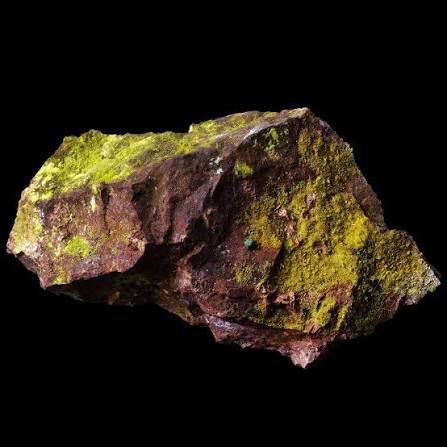
Donald Wininger Collection
There are few minerals that can stop a collector in mid-stride. Uranophane is one of them.
Its brilliant lemon-yellow sprays seem almost too vivid to be natural, coating fractures and cavities with silky crystals that sparkle in ordinary light and often burst into brilliant fluorescence beneath ultraviolet lamps.
Yet the beauty of uranophane hides an extraordinary story. Unlike minerals that crystallized directly from molten rock deep within the Earth, uranophane is a survivor. It is born only after another mineral dies.
Every crystal of uranophane began with the slow breakdown of older uranium minerals that formed more than one billion years ago during the Grenville mountain-building event. Rainwater, oxygen, groundwater chemistry, and time gradually dismantled those original crystals before nature rebuilt them into something entirely new.
The specimens featured in the Donald Wininger Collection capture that final chapter perfectly. They remind us that geology is not simply about creation. It is equally about transformation.
Mineral: Uranophane
Chemical Formula: Ca(UO₂)₂Si₂O₇·6H₂O
Mineral Group: Uranyl Silicates
Crystal System: Monoclinic
Typical Crystal Habit
Color
Hardness
2–3
Luster
Silky to vitreous
Transparency
Transparent to translucent
Radioactivity
Naturally radioactive
Fluorescence
Many specimens fluoresce bright yellow to yellow-green under ultraviolet light.
Few specimens demonstrate the beauty hidden within radioactive mineral deposits better than uranophane.
Collected decades ago from the historic Yates Uranium Mine near Otter Lake, Québec, these specimens preserve an important chapter in Canadian mineral collecting. During the uranium exploration boom of the 1950s, prospectors searched the Grenville Province for economically valuable uranium deposits. While the mines themselves enjoyed only brief periods of activity, they exposed an extraordinary variety of rare minerals that today are appreciated more by collectors and museums than by the mining industry.
The uranophane specimens preserved in the Donald Wininger Collection represent this transformation beautifully. Originally sought for uranium. Today admired for their elegance.
That evolution mirrors the changing relationship between people and minerals—from economic resources to scientific treasures and works of natural art.
Uranophane is a secondary uranium silicate mineral. The word secondary is important. Unlike minerals that crystallized directly from molten rock deep underground, uranophane forms later as groundwater slowly alters older uranium-bearing minerals.
Its chemical formula,
Ca(UO₂)₂Si₂O₇·6H₂O
reveals the ingredients required for its formation:
If any one of those ingredients is missing, uranophane cannot develop. This dependence on groundwater explains why uranophane almost always occurs near the Earth’s surface within fractures, cavities, and weathered portions of uranium deposits.
The first thing nearly every collector notices is the color. Few naturally occurring minerals display such an intense yellow. The secret lies within the uranyl ion (UO₂²⁺). When uranium is exposed to oxygen-rich groundwater, it changes from the relatively insoluble uranium(IV) state into uranium(VI), forming the uranyl ion.
This molecular structure strongly absorbs blue and violet wavelengths of visible light. The remaining reflected light appears brilliant yellow to yellow-green. It is this same uranyl ion that gives many secondary uranium minerals their vivid colors.
Nature has essentially painted these crystals using the chemistry of uranium itself.
Understanding uranophane begins with understanding the difference between primary and secondary minerals.
Primary uranium minerals formed deep underground during the Grenville Orogeny over one billion years ago.
These include minerals such as:
They crystallized directly from hot geological fluids and remained stable for immense periods of time.
Secondary uranium minerals tell a different story. They formed much later. As groundwater slowly entered fractures within the rocks, oxygen transformed the original uranium minerals into soluble compounds. That dissolved uranium traveled short distances before combining with silica and calcium.
The result was a completely new mineral. Uranophane. In many ways, uranophane represents the final chapter in the life of an ancient uranium crystal.
The Yates Uranium Mine lies within the remarkable Grenville Province, one of the oldest and most mineralogically diverse geological regions in North America.
Approximately 1.06 billion years ago, enormous continental collisions produced mountain ranges that may have rivaled today’s Himalayas.
Deep beneath those mountains:
These geological processes created an extraordinary environment capable of producing some of Canada’s finest radioactive mineral localities. Among them was the Yates Uranium Mine.
Located near Otter Lake, Québec, only a short distance from the Ontario border, the Yates Uranium Mine became one of numerous exploration properties developed during the uranium boom of the 1950s.
Although commercial uranium production proved limited, exploration exposed an impressive suite of radioactive minerals preserved within Grenville marbles and calc-silicate rocks.
Collectors soon recognized that the locality offered something even more valuable than uranium ore. It produced exceptional mineral specimens. Among the most striking were the brilliant yellow sprays of uranophane that developed naturally as the original uranium minerals slowly weathered over geological time.
These delicate crystals transformed what had once been ordinary ore into specimens admired in museums and private collections around the world.
The story of the Yates Uranium Mine is inseparable from one of the most exciting chapters in North American mining history. Following the Second World War, the world entered the Atomic Age. Nuclear power promised a new source of energy. Governments sought uranium for research, medicine, and defense. Almost overnight, uranium became one of the most sought-after elements on Earth.
Across Canada, thousands of prospectors took to the field carrying Geiger counters instead of gold pans. Areas showing even slight radioactive anomalies suddenly attracted enormous interest.
The ancient rocks of the Grenville Province were among those investigated. Near the small community of Otter Lake, Québec, prospectors discovered uranium-bearing mineralization that would become known as the Yates Uranium Mine. Although the deposit never developed into a major producer, it revealed something that has become even more valuable with time. An extraordinary suite of collectible radioactive minerals.
Today, the Yates Mine is remembered far more for its beautiful mineral specimens than for the uranium it produced.
To understand uranophane, we first have to understand what came before it. More than 1.06 billion years ago, hot mineral-rich fluids circulated through fractures in the rocks of the Grenville Province. These fluids contained uranium, thorium, silica, calcium, iron, and many other elements.
As temperatures slowly decreased, uranium combined with oxygen in low-oxygen environments to form primary uranium minerals such as:
These minerals crystallized deep underground where little oxygen was present. For hundreds of millions of years they remained stable. Hidden. Undisturbed. Waiting. Then the Earth changed. Mountains eroded. Rock layers were stripped away. Groundwater slowly penetrated fractures that had once been buried miles beneath the surface. That is when the transformation began.
Most minerals simply weather away. Uranium minerals evolve. Imagine a crystal of uraninite that formed over one billion years ago. For countless ages it remained unchanged. Eventually oxygen-rich groundwater reached the crystal. The oxygen attacked the uranium atoms. The once-stable uranium(IV) became uranium(VI), forming the highly soluble uranyl ion (UO₂²⁺).
The crystal literally began dissolving. Atom by atom. The uranium was carried away in groundwater. At first glance, this seems like destruction. In reality, it was the beginning of something entirely new.
As the uranium-rich water migrated through tiny fractures, it encountered dissolved calcium released from nearby marble and silica derived from surrounding rocks. When the chemistry became just right, the dissolved ingredients began assembling themselves into delicate yellow needles. Those tiny needles were uranophane.
The original uranium crystal had disappeared. Yet its atoms lived on in another mineral. Nature had recycled one crystal into another.
Nothing in geology is truly wasted. One mineral becomes another. One rock becomes sediment. Sediment becomes stone. Stone becomes magma. The story of uranophane perfectly illustrates this endless cycle.
Primary Uranium Minerals
Deep burial
Mountain uplift
Groundwater enters fractures
Oxidation
Uranium dissolves
Calcium and silica combine with dissolved uranium
Brilliant Yellow Uranophane
Collectors often admire uranophane for its color. Geologists admire it because every crystal represents an ongoing chemical transformation that may have taken hundreds of thousands—or even millions—of years to complete.
One of uranophane’s defining characteristics is its delicate crystal habit. Rather than forming blocky crystals, uranophane usually develops as:
The reason lies in its crystal structure. The uranyl ion bonds with silica tetrahedra to form long, repeating chains. Calcium ions and water molecules help hold these chains together, but the structure grows much more readily in one direction than in others. As a result, the crystals elongate into slender needles instead of broad prisms.
Thousands of these tiny crystals often grow together, producing the soft, silky appearance collectors immediately recognize. Viewed under magnification, these sprays resemble miniature sunbursts radiating across the rock.
Most minerals reveal their beauty in daylight. Uranophane has another surprise waiting in the dark. Place many specimens beneath an ultraviolet lamp and they seem to awaken. The brilliant yellow crystals often glow vivid yellow-green, creating one of the most striking fluorescent displays found among secondary uranium minerals.
For many collectors, the first time they see uranophane under UV light is unforgettable. A specimen that appeared attractive under normal lighting suddenly seems alive with color. The effect is not magic. It is physics.
Ultraviolet light carries more energy than visible light. When those invisible UV photons strike the crystal, they excite electrons associated with the uranyl ion (UO₂²⁺). As those electrons quickly return to their normal energy state, they release part of that energy as visible light. That emitted light is the fluorescence we see.
Because the uranyl ion is responsible for both the mineral’s vivid yellow color and much of its fluorescence, uranophane possesses a visual brilliance unlike almost any other mineral.
Collectors quickly discover that fluorescence is not identical from one specimen to another. Some uranophane specimens blaze with intense yellow-green light. Others produce only a soft glow.
Several factors influence the fluorescent response, including:
Many specimens respond best under shortwave ultraviolet (SWUV) illumination, while others fluoresce well under longwave ultraviolet (LWUV). Experienced fluorescent mineral collectors often examine specimens under both wavelengths to fully appreciate their characteristics. This hidden personality adds another dimension to collecting. It is almost like owning two specimens in one.
One of the most common misconceptions is that radioactive minerals glow because they are radioactive. They do not. Radioactivity and fluorescence are two completely different phenomena.
Radioactivity is the spontaneous release of particles or energy from unstable atomic nuclei. It occurs continuously whether the lights are on or off.
Fluorescence occurs only when ultraviolet light shines on the mineral. The UV light excites electrons within the crystal. When those electrons return to their normal energy state, visible light is emitted almost instantly.
Turn off the ultraviolet lamp. The glow disappears. No ultraviolet light. No fluorescence.
Understanding this distinction helps collectors appreciate both phenomena without confusing one for the other.
Although uranophane often receives the most attention, it formed alongside an impressive suite of minerals that make the Yates Uranium Mine one of Canada’s classic radioactive localities.
Among the most notable associated minerals are:
The original primary uranium mineral from which much of the uranophane ultimately formed.
A uranium- and thorium-rich silicate that records the earliest stages of mineralization within the Grenville rocks.
An important thorium mineral commonly associated with radioactive pegmatites and skarns throughout the Bancroft–Otter Lake district.
A complex rare-earth mineral enriched in cerium, lanthanum, uranium, and thorium that reflects the unusual chemistry of Grenville magmatic systems.
One of Bancroft’s signature minerals, fluorapatite commonly occurs with radioactive minerals throughout the Grenville Province.
Calcium released from surrounding marble helped provide one of the essential ingredients required for the formation of uranophane.
Silica dissolved from quartz-bearing rocks supplied another critical ingredient, allowing uranophane crystals to grow.
Together these minerals tell the complete story of a geological system that evolved over more than a billion years—from deep magmatic activity to weathering at Earth’s surface—ultimately producing one of the most visually striking secondary uranium minerals known.
There are minerals that impress because they are rare. Others because they are beautiful. Uranophane is remarkable because it is both.
Its brilliant yellow color immediately attracts attention, but its true significance lies in what it represents. Every spray of uranophane marks the final stage in a geological journey that began more than one billion years ago during the Grenville Orogeny.
It is not simply another uranium mineral. It is the visible evidence that nature is constantly rebuilding itself.
Collectors often speak about “secondary minerals” as if they are somehow less important than the primary minerals from which they formed. The opposite is often true. Secondary minerals record Earth’s ongoing chemistry. They reveal how oxygen, groundwater, dissolved minerals, temperature, and time continue to reshape the planet long after mountains have formed and volcanoes have cooled.
Uranophane is one of the finest examples of that process. The specimens preserved in the Donald Wininger Collection are reminders that even as one mineral disappears, another is quietly being created. Their delicate sprays, brilliant fluorescence, and remarkable story make them among the most educational specimens in the collection.
Sometimes the most beautiful minerals are not those born first. They are the ones that emerge from transformation.
Unlike many minerals, uranophane is judged as much by its delicacy as by its size. Experienced collectors evaluate several characteristics together.
The finest specimens display:
Because the crystals are extremely fragile, complete undisturbed sprays are highly prized.
Collectors generally prefer specimens displaying vivid:
The richest colors often indicate fresh secondary mineralization with minimal staining.
One of the most desirable characteristics is a strong fluorescent response.
High-quality specimens often display brilliant:
under ultraviolet illumination.
Many collectors now routinely examine uranium minerals under both longwave (LWUV) and shortwave (SWUV) ultraviolet lamps because fluorescence can vary significantly from one specimen to another.
Specimens that are attractive in daylight and spectacular under ultraviolet light are especially sought after.
Matrix tells the geological story.
Collectors appreciate specimens that preserve uranophane naturally attached to:
Matrix specimens provide important geological context while making the delicate crystals easier to preserve.
Specimens associated with classic Grenville minerals are particularly desirable.
Common companions include:
These mineral associations tell the complete story of how the deposit evolved over geological time.
As with every specimen in the Donald Wininger Collection, provenance greatly enhances collector interest.
Historic locality labels from the Yates Uranium Mine connect these specimens directly to the uranium exploration era of the 1950s and preserve an important chapter in Canadian mineral collecting history.
Few minerals reward thoughtful display more than uranophane. Most collectors enjoy the specimens under normal lighting. Experienced collectors know there is another way.
Many museums and advanced collectors include ultraviolet lighting in their displays, allowing visitors to experience both personalities of the mineral.
Daylight reveals:
Ultraviolet light reveals:
Displaying both views reminds visitors that minerals often possess characteristics invisible to the naked eye.
Although uranophane is stable in a collection, it deserves thoughtful handling. Because of its softness and fibrous crystal habit:
As a naturally radioactive mineral, uranophane should also be displayed responsibly. For most collector specimens, the greatest concern is not external radiation but preventing unnecessary exposure to dust created by damaged crystals. Avoid cutting, grinding, or polishing radioactive minerals, and wash your hands after handling specimens, particularly before eating or drinking.
These simple practices allow collectors to safely enjoy specimens for generations.
Fact: Most collector specimens emit relatively low levels of radiation and can be safely collected and displayed using common-sense precautions. Like all naturally radioactive minerals, they should be handled responsibly and stored where they are unlikely to be damaged.
Fact: Radioactivity and fluorescence are completely different phenomena. Uranophane fluoresces only when exposed to ultraviolet light. The glow results from excited electrons within the uranyl ion—not from radioactive decay itself.
Fact: Uranophane is a secondary mineral. It forms much later when groundwater alters older uranium minerals through oxidation and chemical weathering.
Fact: The intensity of the yellow color is related primarily to the chemistry of the uranyl ion, not directly to the amount of uranium present or the specimen’s radioactivity.
Fact: Secondary minerals provide valuable evidence of weathering, groundwater movement, and ongoing geological processes. They often reveal environmental conditions that primary minerals cannot.
For centuries, bright yellow minerals have symbolized light, renewal, and transformation. Uranophane is no exception. While these traditions are cultural and spiritual beliefs rather than scientific conclusions, they remain meaningful to many collectors.
Traditionally, uranophane has been associated with:
It is fitting that a mineral born through geological transformation has become associated with personal transformation as well.
Yes. Because uranium is an essential part of its chemical composition, every uranophane specimen is naturally radioactive. The level varies from specimen to specimen depending on composition and size.
The bright yellow color is produced by the uranyl ion (UO₂²⁺), which selectively absorbs blue and violet wavelengths of visible light.
No. Many specimens fluoresce brilliantly, while others display only a weak response or none at all. Fluorescence depends on crystal chemistry, weathering, hydration, impurities, and the wavelength of ultraviolet light.
Many Yates Mine specimens respond especially well to shortwave UV, although some fluoresce strongly under longwave UV as well. Collectors often use both to fully appreciate the specimen’s characteristics.
Yes, when handled responsibly. Displaying specimens in a cabinet, minimizing unnecessary handling, avoiding the creation of dust, and practicing good hygiene are generally sufficient precautions for most collector specimens.
Yes. Because it forms under specific near-surface conditions, changes in groundwater chemistry can eventually dissolve uranophane and contribute to the formation of other secondary uranium minerals over geological time.
Although it was never a major uranium producer, the Yates Mine became one of the classic Grenville Province localities for beautifully crystallized secondary uranium minerals, particularly uranophane.
Uranophane reminds us that geology is not a series of isolated events. It is a continuous cycle of creation, destruction, and renewal. The uranium atoms within these delicate yellow crystals were once part of entirely different minerals that formed deep beneath ancient mountains more than one billion years ago. Over immense spans of time, groundwater dissolved those original crystals and carried their essential ingredients through tiny fractures until new minerals began to grow.
The result was not simply another uranium mineral. It was a masterpiece of geological recycling.
The specimens preserved in the Donald Wininger Collection capture that transformation with remarkable beauty. Their vivid color, delicate sprays, and brilliant fluorescence tell a story that extends from the depths of the Grenville Orogeny to the hands of today’s collectors.
Perhaps that is uranophane’s greatest lesson. Nothing in nature is ever truly finished. Even after a crystal dies, its atoms continue the journey. Over time, they become something entirely new. For collectors, that makes uranophane more than an attractive fluorescent mineral. It is living evidence that Earth’s greatest artist is time itself.
Every specimen in the Treasures from the Donald Wininger Collection reveals another chapter in Earth’s remarkable history. Dolomite, Hexagonite, Serpentine, Sand Calcite, Zircon Crystal Herkimer Diamonds, Realgar, and more! Explore the Mine to Mind educational blog to discover classic mineral localities, learn how geological processes create extraordinary minerals, browse our educational eBooks, and visit us at upcoming gem and mineral shows to experience many of these fascinating specimens firsthand.
This uranophane specimen is part of the Donald Wininger Collection, a three-generation mineral collection spanning specimens acquired from the 1940s through the 2000s. The collection includes minerals from historic localities across the United States, Canada, Mexico and beyond, with many specimens dating from the height of American mineral collecting in the 1950s and 1960s.
Explore available specimens from the Donald Wininger Collection and discover historic minerals, classic localities and pieces that preserve decades of collecting history.

At Grounded Lifestyles, our love for crystals began in the peaceful flow of Reiki and energy healing sessions — where we saw how natural stones could amplify intentions, restore balance, and bring comfort. But the more time we spent with these treasures, the more curious we became about their origins. That curiosity led us into the fascinating world of geology and mineral specimen collecting. We fell in love not just with the energy of crystals, but with the science and artistry of their creation — the intricate crystal structures, the vibrant mineral hues, and the wonder of holding a piece of Earth’s history in our hands.