
Every crystal, mineral, fossil, meteorite, and handcrafted piece is selected with purpose. Whether you’re building a museum-worthy mineral collection, searching for a meaningful gift, decorating your home with natural beauty, or beginning your journey into the world of geology, you’ll discover authentic specimens with stories worth sharing.
Over 15 shows a year throughout the Southwest. Check to see if we are coming to a show near you!
Home > Blog > Minerals Blog | Crystal Guides, Geology & Metaphysical Meaning > Calcite from Pugh Quarry, Wood County, Ohio
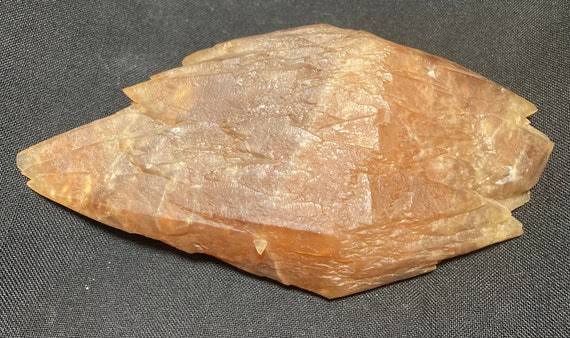
Donald Wininger Collection
Calcite is not difficult to find in Ohio. Much of the state is underlain by limestone and dolostone, rocks composed largely of carbonate minerals. Calcite occurs in roadcuts, quarries, fossils, veins and cavities throughout the region. Its abundance can make it easy to overlook. Pugh Quarry changed that perception.
The quarry exposed calcite not merely as a component of limestone, but as sharply formed crystals projecting into open cavities. Many developed as elongated scalenohedrons—the pointed form commonly called dogtooth spar. Their colors ranged from nearly colorless and pale yellow to warm brown, honey and amber. Some grew as isolated crystals on a thin limestone plate. Others formed crowded groups, rose from beds of smaller crystals or shared the matrix with barite, celestine, fluorite and metallic sulfides.
A geological study published in 1979 described calcite as by far the most abundant mineral in the Devonian rocks at Pugh Quarry. Larger crystals ranged from several millimeters to approximately 10 or 15 centimeters in length and were predominantly brown, although the shade and intensity varied considerably. Smaller crystals tended to be colorless, gray-yellow or pale yellow. Both size groups were dominated by scalenohedral forms. That combination became the quarry’s signature. Calcite itself was ordinary. The way it occurred at Pugh was not.
The specimen in the Donald Wininger Collection belongs to a locality remembered for turning a familiar mineral into something collectors could identify across a room. A pointed golden or brown calcite on gray limestone may resemble material from several Midwestern quarries, but a reliable Pugh Quarry label places it within one of the best-documented mineral occurrences in northwestern Ohio.
The label is essential because attractive brown calcites were produced at other regional quarries. Locality attributions have sometimes been applied too casually to unlabeled specimens, and knowledgeable collectors recognize that appearance alone may not be enough to prove a Pugh origin.
Donald’s specimen therefore preserves two related things: a crystal and the record of where it came from.
Pugh Quarry is in Milton Township, Wood County, near the Wood–Henry county line and several miles from Weston. Specimen labels often place it at Custar because that community became closely associated with the quarry’s business operations, although the quarry itself was not located within the village.
The operation quarried carbonate rocks of Middle Devonian age, principally units assigned to the Dundee Limestone and Detroit River Group. These rocks originated more than 380 million years ago, when the region lay beneath a warm, shallow sea.
Lime mud, shell debris and the remains of marine organisms accumulated across the seafloor. With burial and cementation, those sediments became limestone. Some beds were later altered to dolostone when magnesium-bearing waters changed part of the original carbonate material.
The quarry exposed approximately 85 feet of rock in one historical measured section. The upper portions included buff, massive and sugary-textured dolostone containing numerous vugs and stylolites. Lower intervals became more thinly bedded, gray and highly fractured. Those fractures and cavities were critical because they provided the open spaces into which later crystals could grow.
This is the first important distinction in the Pugh calcite story.
The limestone and the display crystals did not necessarily form at the same time.
The limestone began as Devonian marine sediment. The recognizable dogtooth crystals developed later, after the sediment had hardened and openings existed within the rock. Mineral-bearing water circulated through joints, fractures and cavities, carrying calcium, carbonate and other dissolved components. When conditions changed, calcite crystallized on the cavity walls.
Ohio Geological Survey research describes northwestern Ohio’s calcite, celestine, fluorite and sulfide minerals as secondary material occupying vugs, fissures, joints and other open spaces within Paleozoic carbonate rocks. In some locations, similar mineralization also replaced fossil material.
The Pugh crystals are therefore younger than the rock surrounding them.
A specimen records at least two events separated by a substantial interval: first, the creation of limestone in a Devonian sea; later, the movement of mineralized water through that hardened rock.
The quarry brought both events into view.
A limestone quarry is built around repetition. Bench after bench exposes similar-looking rock, and most of it is removed, crushed and processed for industrial use. From the collector’s perspective, however, the important feature is not the broad wall of limestone. It is the interruption; a fracture opens, a vug appears and the solid rock gives way to a hollow space lined with crystals.
At Pugh Quarry, these openings were not evenly distributed. Historical work documented vertical mineral zoning, meaning that different minerals and crystal habits were concentrated at different levels within the exposed sequence. Fluorite and small dolomite crystals, for example, were reported from shallow vugs near the upper part of the quarry, while other mineral associations occupied different horizons.
Calcite was much more widespread, but its appearance also changed.
Large brown scalenohedrons represented the most familiar collector pieces. Their elongated, sharply pointed form differs from the blockier rhombohedral habit many people first associate with calcite. A scalenohedron is enclosed by triangular faces arranged around the crystal, creating a tapered shape that can resemble a canine tooth.
The crystals sometimes display twinning, in which two parts grow according to a shared crystallographic relationship. The 1979 Pugh study identified twinning on the basal plane as the most readily recognized type among the larger crystals.
Twinning can produce changes in symmetry, reentrant angles or subtle differences in the orientation of crystal faces. On weathered or heavily coated specimens, it may be difficult to recognize without close inspection. On better-formed examples, it adds structural interest that extends beyond color or size.
The brown coloration also varies from specimen to specimen. Some crystals are pale golden and translucent, while others are dark brown or nearly opaque except along their edges. The color may be distributed through the crystal, concentrated in zones or affected by inclusions and coatings.
It is tempting to assign every variation to a single impurity, but locality calcite rarely offers such a simple explanation. Iron-bearing material, hydrocarbons, microscopic inclusions and changes during crystal growth can all influence appearance. Without analysis of the specific specimen, the safest description is visual rather than chemical: golden-brown, honey, amber, smoky brown or pale yellow.
Color is only one part of what collectors examine.
A good Pugh calcite may show a complete termination, strong luster and clear separation between the main crystal and its matrix. Others gain character from stepped faces, frosted growth, internal zoning or the contrast between one large scalenohedron and a carpet of smaller calcites. Doubly terminated crystals—those ending naturally at both ends—are particularly desirable when they are well exposed.
The limestone matrix matters because it preserves the crystal’s context. A loose scalenohedron can still be attractive, but a matrix specimen shows how the crystal occupied a cavity. The base may include smaller calcites that marked the cavity wall before a larger crystal projected into the remaining space.
Some specimens preserve additional mineral relationships. White to pale blue barite may coat or rest on calcite. Tabular celestine can appear beside the pointed scalenohedrons. Purple or brown fluorite introduces a cubic form that contrasts sharply with calcite’s tapered geometry. Pyrite, marcasite and sphalerite may add metallic grains or crystal groups.
These associations help establish the sequence in which the minerals formed. A barite coating on calcite must be younger than the surface it covers. A calcite crystal wrapping around part of an earlier fluorite records the opposite relationship. When several generations occur on one matrix, the specimen becomes a small record of changing fluid chemistry.
That is why the most informative piece is not always the largest or cleanest. A modest cluster with two or three clearly related minerals may explain more about the quarry than an isolated crystal with no matrix.
Pugh Quarry lies within a broader mineralized region of northwestern Ohio associated with the Findlay Arch and nearby structural features. The Paleozoic rocks in this part of the state are nearly flat lying, but they were not completely undisturbed. Faults, joints, fractures and subtle folds created pathways through otherwise solid carbonate strata.
The Bowling Green structure, a faulted monocline crossing parts of Lucas, Wood, Hancock and Hardin counties, is one of the significant regional features described in Ohio Geological Survey studies. The same research noted that calcite, celestine and fluorite were the principal non-sulfide minerals accompanying relatively simple pyrite, marcasite, sphalerite and galena mineralization in northwestern Ohio.
The deposits resemble low-temperature Mississippi Valley-type mineralization in several respects. They occur in carbonate host rocks, occupy open spaces and include combinations of calcite, fluorite, barite or celestine with zinc, iron and lead sulfides.
This does not mean Pugh Quarry was a major metallic ore deposit. The sulfides were generally too limited and irregular for that. Their importance is geological: they reveal that mineralized fluids moved through the rock.
Research on northwestern Ohio sulfides estimated formation temperatures of approximately 43° to 63°C for some sphalerite and galena occurrences. These were warm fluids rather than molten rock or the extreme hydrothermal systems associated with volcanic regions.
Warm, saline groundwater moving through buried carbonate formations could dissolve and transport mineral components over long distances. When the fluid entered a cavity, mixed with another water source, cooled, lost pressure or reacted with the surrounding rock, its dissolved load began to precipitate.
Calcite formed readily because both calcium and carbonate were abundant in the host environment. The more unusual minerals required additional components:
Changes in fluid chemistry determined which mineral formed at a particular moment. A cavity could remain open through several episodes, allowing one mineral to be followed by another.
This is what made Pugh Quarry exceptional for collectors. It was not simply a place with calcite-filled cracks. It exposed a mineral system with enough variation to produce distinct crystal habits, colors and associations across different levels of the quarry.
The calcite is the most abundant expression of that system, but it is not separate from the rarer minerals. Together they show how the fluids evolved.
Pugh Quarry was an industrial operation first. Mineral specimens were an incidental result of removing limestone and dolostone. That distinction shaped the collecting experience.
Unlike a mine developed specifically for gem or specimen material, productive pockets appeared only when quarrying reached the correct bed or fracture zone. Blasting could expose a cavity and destroy much of it at the same time. Heavy equipment might remove a section before collectors knew what had been uncovered. A productive wall could disappear as normal operations advanced.
Collectors depended on permission, timing and cooperation with quarry personnel. When access was available, the chance to examine freshly exposed rock produced material that would otherwise have gone through the crusher.
This relationship between industrial quarrying and mineral collecting created many of the Midwest’s classic localities. The quarry provided access to rock that natural erosion had not exposed, while collectors preserved unusual crystals that had no value in the crushed-stone business.
Pugh eventually became one of Ohio’s best-known collecting sites. Its reputation rested on more than a few exceptional discoveries. Enough characteristic material entered private collections that “Pugh Quarry calcite” became a recognizable category among regional collectors.
The quarry is now closed to collecting. Accounts of the locality indicate that insurance and access concerns ended visits, while the active workings moved below the principal specimen-producing horizons.
Those two facts should be kept separate.
The absence of collecting permission does not automatically mean that all mineralization has vanished. Likewise, an operating quarry may continue producing stone without exposing collectible pockets. At Pugh, the combination of restricted access and mining below the best-known mineralized levels sharply reduced the possibility of new material reaching collectors.
As a result, the supply now comes largely from older collections. That makes specimens like Donald Wininger’s part of a finite historical record.
Collectors assessing Pugh Quarry calcite should begin with the entire specimen rather than immediately focusing on crystal size. The most desirable piece is not determined by one measurement. Form, condition, color, matrix, associations and provenance work together.
A long scalenohedron with a complete point can be impressive, but a smaller crystal may have better transparency or luster. A cluster may contain minor edge damage yet preserve an important association with celestine or barite. A darker crystal may appear nearly opaque in room light but reveal warm internal zoning when backlit. Condition must be judged in context.
Calcite has a Mohs hardness of 3 and perfect rhombohedral cleavage. It scratches easily and can split along internal planes when struck. Quarry extraction, blasting, trimming, decades of storage and repeated handling all create opportunities for damage.
Fresh breaks often appear brighter and smoother than weathered or naturally contacted surfaces. A crystal that grew against the cavity wall will have an incomplete area where no free face could develop. That is a growth contact, not necessarily later damage.
Older repairs may also be present. Large scalenohedrons sometimes detached from the matrix during extraction and were reattached. A repaired specimen is not automatically without collector value, especially when the crystal and matrix unquestionably belong together, but the repair should be identified and disclosed.
Color deserves similar caution. Brown calcite from several Ohio and Michigan Basin quarries can resemble Pugh material. A confident locality assignment should be supported by an old label, collection record or credible chain of ownership rather than by appearance alone.
This is especially important because Pugh became famous enough that its name can increase interest in an otherwise anonymous Midwestern calcite. Once an incorrect label is added, it may be repeated through later sales until speculation begins to resemble provenance.
The Donald Wininger Collection provides a more meaningful context. The collection contains multiple specimens acquired and retained during a period when classic North American quarry localities were more accessible and their material circulated through mineral clubs, shows and personal exchanges. An original or early label tied to that history should remain with the specimen.
Even a plain handwritten tag can be more important than a new printed card.
Calcite occurs throughout the Donald Wininger Collection in several forms and from several localities. Keeping a Pugh Quarry example was therefore unlikely to have been simply an attempt to represent the mineral species.
It represented the locality.
For a collector working through the middle decades of the twentieth century, Pugh Quarry stood among the places that defined Ohio collecting. Its specimens were recognizable, obtainable through regional networks and varied enough that one example did not make another unnecessary.
A collector might keep one piece for a large brown scalenohedron and another for celestine or barite on calcite. A smaller specimen could remain because its original label recorded the collecting date or the person who recovered it. Another might have been exchanged at a club meeting and retained as a reminder of the collector who supplied it.
Without Donald’s own notes, the exact reason cannot be known. The specimen itself may provide clues.
If it carries an especially sharp crystal, then crystal form may have been the attraction. If associated minerals are present, the relationship between them may have mattered. If the piece is modest but accompanied by an old field label, Donald may have valued the documentation as much as the calcite.
That uncertainty should remain part of the story rather than being filled with invented detail.
What can be said is that Donald preserved a specimen from a locality whose best collecting years are now past. The decision allowed the crystal to survive after quarry access ended and after many comparable pieces became separated from their labels or damaged through handling.
Estate collections often reveal this quieter form of preservation. A specimen may have remained in one drawer for half a century, attracting little attention because it was neither the rarest nor the most colorful piece in the cabinet. Yet when the locality is no longer available, its importance becomes clearer. Donald’s calcite is not significant because calcite has become scarce. It matters because Pugh Quarry calcite has become historical.
Calcite requires conservative care. Its softness, cleavage and reaction with acids make aggressive cleaning especially risky.
A soft artist’s brush is usually sufficient for routine dust. Compressed air can be used carefully, but the pressure should remain low and the nozzle should not be placed close to small crystals or fragile barite blades.
Acid should never be used on a calcite specimen. Vinegar, muriatic acid and commercial rust removers will attack the calcium carbonate itself. Even brief contact can dull crystal faces, round sharp edges and permanently alter the surface.
Water may be safe for some clean, stable calcite specimens, but the matrix and associated minerals must be considered first. Marcasite can deteriorate when exposed to moisture, and porous limestone may retain water within cracks. Old adhesives may soften, turn cloudy or release. A specimen showing metallic sulfides, repairs or friable matrix should not be soaked.
Ultrasonic cleaners are also unsuitable. Vibration may open cleavage fractures, detach crystals or disrupt old repairs.
Pugh specimens with celestine or barite need additional protection because those sulfate minerals can be brittle and may occur as thin, projecting blades. The specimen should be lifted by a solid portion of the limestone matrix rather than by its calcite crystal.
Long-term display away from direct sunlight, vibration and repeated handling is usually sufficient. Calcite’s brown color is generally stable, but dust and surface abrasion can reduce luster over time.
Original labels should be stored in an archival envelope or protected sleeve. When an old label uses “Custar” rather than Milton Township or Wood County, it should not be discarded as inaccurate. Custar is part of the historical labeling tradition associated with the quarry.
A modern catalogue can clarify the location while preserving the old wording.
Mineral: Calcite
Formula: CaCO₃
Crystal system: Trigonal
Characteristic Pugh habit: Elongated scalenohedral crystals commonly called dogtooth spar
Typical colors: Colorless, gray-yellow, pale yellow, golden brown, amber and dark brown
Reported crystal size: From crystals smaller than 5 millimeters to large individuals approximately 10–15 centimeters long
Host rocks: Devonian limestone and dolostone associated with the Dundee Limestone and Detroit River Group
Mode of occurrence: Crystals lining or filling vugs, fractures and other open spaces
Documented associations: Barite, celestine, fluorite, dolomite, sphalerite, pyrite, marcasite and other minor minerals
Locality: Pugh Quarry, Milton Township, Wood County, Ohio, near the Wood–Henry county line
Historic label variation: Custar, Ohio
Primary collecting interest: Classic Ohio locality, golden-brown dogtooth crystals, mineral associations and older documented specimens
Care: Avoid acids, soaking, ultrasonic cleaning, abrasion and handling by projecting crystals
Most important collector caution: Brown Midwestern calcite should not be attributed to Pugh Quarry without reliable provenance
Calcite has traditionally been associated with clarity, renewal and the movement of stagnant energy. Brown and golden varieties are often connected with grounding, confidence and steady personal growth.
These interpretations belong to spiritual and cultural traditions and are not scientifically demonstrated effects. They should not replace professional medical or mental-health care.
The geological story of Pugh calcite offers a fitting non-metaphysical parallel. The crystals formed when mineral-bearing water found open space within an old and apparently solid rock. What looked like an ordinary bed of limestone contained room for something new to grow.
Most of the quarry’s larger and smaller collector crystals developed in the scalenohedral habit. Their narrow, pointed shape resembles a canine tooth, giving rise to the traditional name dogtooth spar.
No. The host limestone formed from marine sediment during the Devonian Period. The display crystals formed later when mineral-bearing fluids moved through cavities and fractures in the hardened carbonate rock.
The color varies considerably and may reflect different combinations of trace elements, microscopic inclusions, hydrocarbons or growth-related features. The cause should not be assigned to one impurity without analysis of the specific crystal.
The detailed 1979 study reported large crystals ranging from about 5 millimeters to approximately 10–15 centimeters long. Smaller crystals below 5 millimeters were also abundant.
Documented associations include barite, celestine, fluorite, dolomite, sphalerite, pyrite and marcasite. The exact combination depends on the mineralized horizon and the sequence of crystal growth.
Most Pugh calcite reportedly shows little or no ultraviolet response, although unusual fluorescent examples are known. A specimen should be tested rather than assumed to fluoresce based solely on its locality.
Historic and collector labels commonly use Custar, but the quarry itself is in Milton Township, Wood County, several miles from Weston and near the Wood–Henry county line. The Custar attribution is connected to the quarry company’s office and long-standing labeling convention.
The site is reported closed to mineral collecting because of access and insurance restrictions. Its active workings also moved below the principal specimen-producing area. Current conditions should always be confirmed with the property owner rather than inferred from older field guides.
Similar brown scalenohedral calcites occur at other Midwestern quarries. An original label or documented ownership history provides stronger evidence of a Pugh Quarry origin than crystal appearance alone.
Yes, provided the repair is stable, appropriately performed and disclosed. An unrepaired specimen in comparable condition is generally preferred, but a repaired historical piece may still be important because of its crystal quality, associations or provenance.
Pugh Quarry was not opened to produce mineral specimens. It was opened for limestone.
That practical purpose makes its collecting history more significant. The crystals existed inside the rock for millions of years, but they entered human collections only because quarrying exposed the cavities that held them. A blast that revealed one pocket could destroy another. A productive ledge might remain accessible briefly before the operation advanced. Collectors worked within those narrow opportunities.
They recognized that some sections of ordinary-looking gray or buff rock contained complete crystals worth saving from the crusher. Through their efforts, Pugh Quarry became known beyond the crushed-stone industry as one of Ohio’s classic mineral localities.
Calcite was the quarry’s most abundant mineral, yet it became the clearest symbol of that transformation. The scalenohedral crystals turned the substance of the host rock into something distinct. Limestone composed largely of calcium carbonate enclosed open spaces where calcium carbonate had crystallized again—this time as sharp, individual forms.
The specimen in the Donald Wininger Collection preserves that contrast. Its matrix began in a Devonian sea. Its crystal grew later from mineralized water moving through the hardened rock. The quarry exposed it, a collector saved it, and its label kept the crystal attached to the place where those events came together.
Today the quarry’s best-known specimen horizons are no longer available to collectors. New examples cannot simply be obtained by returning to the same ledge and opening another pocket. What remains is distributed through museums, club collections, dealer inventories and family estates. That makes provenance part of the mineral.
Without its label, Donald’s piece would still be calcite. With its label, it becomes evidence of a quarry, a geological process and a period in Midwestern collecting when working limestone operations occasionally opened their gates to people willing to look more carefully at the rock. Pugh Quarry taught collectors that an abundant mineral does not have to be ordinary.
Sometimes the difference is the cavity in which it grew—and the person who decided not to let it disappear.
Calcite is just one chapter in the remarkable story of Earth’s mineral treasures. We invite you to continue exploring the Mine to Mind series, where each article follows a specimen from its geological origins to its place in a collector’s cabinet. Enjoy more from the Donald Wininger Collection: dolomite, fluoro-richterite, zircon crystal, hexagonite, sand calcite, uranophane, Orange Celestite, Blue Celestite, Apatite and more. Along the way you’ll discover the science, history and human stories that make every mineral unique.
If you’re attending one of the upcoming gem and mineral shows, stop by the Grounded Lifestyles booth to see selections from the Donald Wininger Collection in person.
This Pugh Quarry calcite is part of the Donald Wininger Collection, a three-generation mineral collection spanning specimens acquired from the 1940s through the 2000s. The collection includes minerals from historic localities across the United States, Canada, Mexico and beyond, with many specimens dating from the height of American mineral collecting in the 1950s and 1960s.
Explore available specimens from the Donald Wininger Collection and discover historic minerals, classic localities and pieces that preserve decades of collecting history.

At Grounded Lifestyles, our love for crystals began in the peaceful flow of Reiki and energy healing sessions — where we saw how natural stones could amplify intentions, restore balance, and bring comfort. But the more time we spent with these treasures, the more curious we became about their origins. That curiosity led us into the fascinating world of geology and mineral specimen collecting. We fell in love not just with the energy of crystals, but with the science and artistry of their creation — the intricate crystal structures, the vibrant mineral hues, and the wonder of holding a piece of Earth’s history in our hands.