
Every crystal, mineral, fossil, meteorite, and handcrafted piece is selected with purpose. Whether you’re building a museum-worthy mineral collection, searching for a meaningful gift, decorating your home with natural beauty, or beginning your journey into the world of geology, you’ll discover authentic specimens with stories worth sharing.
Over 15 shows a year throughout the Southwest. Check to see if we are coming to a show near you!
Home > Blog > Minerals Blog | Crystal Guides, Geology & Metaphysical Meaning > Calcite North Vernon, Indiana
The Donald Wininger Collection
Every mineral collection contains specimens that remind us why certain localities become legendary. Some mines produce rare minerals found almost nowhere else. Others transform an ordinary mineral into something so beautiful and distinctive that experienced collectors can identify its origin at first glance. The calcite preserved in the Donald Wininger Collection belongs to that second group.
Walk into almost any mineral show in America and you’ll see calcite. There will be dogtooth spar from Ohio. Sharp scalenohedral crystals from Tennessee. Massive white calcite from Mexico. Orange calcite from Morocco. Clear Iceland spar from China.
Calcite is everywhere.
It is one of the most abundant minerals on Earth, making up vast mountain ranges of limestone, countless caves, hot spring deposits, coral reefs, marble, and thousands of hydrothermal veins. It forms under conditions ranging from deep oceans to geothermal springs, from ancient reefs to modern cave systems. Entire landscapes owe their existence to calcite. Because it is so common, many collectors eventually overlook it.
Then they encounter a specimen from North Vernon, Indiana. Everything changes.
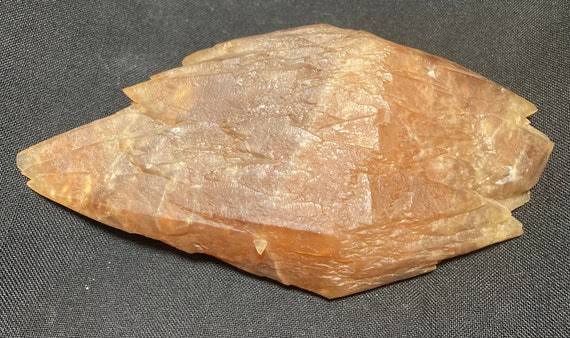
Instead of the familiar dogtooth crystals seen in many Midwestern quarries, these crystals appear almost sculpted. Their warm honey color seems to glow from within. Their crystal faces create forms that scarcely resemble ordinary calcite. Some collectors mistake them for garnet at first glance, while others assume they must be a much rarer carbonate mineral.
Experienced collectors usually smile. They know exactly what they’re looking at. A classic North Vernon calcite.
For decades these specimens have quietly occupied an honored place in advanced American mineral collections. Although calcite itself is common, exceptional North Vernon specimens have become increasingly difficult to acquire. Production of world-class specimens largely belongs to the past, and the finest examples now circulate primarily through established collections, museums, and specialized dealers.
Their rarity today is not geological. It is historical.
The Donald Wininger Collection preserves one of these remarkable examples—a reminder that a common mineral can become extraordinary when nature provides exactly the right conditions for crystal growth.
To understand why these crystals exist, we have to travel nearly 390 million years into the past. The Indiana we know today did not exist. There were no forests, no cornfields, no Ohio River and no Midwest.
Instead, the region lay beneath a warm tropical sea positioned much closer to the equator than it is today. The water was shallow, clear, and rich in marine life. Corals built reefs. Brachiopods covered the seafloor. Crinoids waved in gentle currents. Trilobites crawled across carbonate mud.
Shells accumulated for millions of years, slowly creating thick beds of calcium carbonate that would eventually become the Jeffersonville Limestone and related Devonian formations exposed around North Vernon. Each generation of marine organisms contributed another thin layer. Storms broke apart coral colonies. Shell fragments accumulated. Calcium carbonate settled continuously onto the seafloor. Over immense spans of time these sediments compacted into limestone hundreds of feet thick.
The future crystal had not yet begun to form. Nature was merely preparing its raw material.
One of the remarkable aspects of mineral collecting is realizing that crystal growth often occurs long after the host rock forms. Many people assume the crystals formed at the same time as the limestone. The limestone had already become solid rock before hydrothermal fluids ever entered it. This distinction is essential.
The Devonian sea produced the limestone. Later geological events produced the crystals.
For millions of years the limestone remained relatively unchanged beneath younger sediments. Then tectonic forces, subtle faulting, deep burial, groundwater circulation, and changing pressures created pathways through the rock. Tiny fractures developed and some widened into cavities. Others remained hairline cracks invisible to the eye. These openings became highways for mineral-rich fluids. Unlike ordinary groundwater, hydrothermal fluids are chemically active. They dissolve minerals and transport ions. They continuously change composition as they move through different rocks.
When these fluids entered the limestone beneath what is now North Vernon, something remarkable happened.
People often imagine crystals growing like plants, however they do not. A crystal grows one atom at a time.
Every calcium ion and every carbonate ion carried by the hydrothermal fluid must find precisely the correct position within the crystal lattice.
If the chemistry remains stable…
growth continues.
If temperature changes…
different crystal faces grow faster.
If impurities enter the solution…
new crystal habits develop.
If available space changes…
the crystal changes shape.
Crystal growth is therefore not random. Every face represents a balance between chemistry, temperature, pressure, impurities, and time. Calcite possesses one of the richest collections of crystal forms in mineralogy. Mineralogists have identified well over three hundred possible crystal forms. Yet collectors usually encounter only a handful.
Dogtooth crystals.
Scalenohedra.
Simple rhombohedra.
Occasionally tabular forms.
North Vernon ignored those expectations.
This is where the locality becomes scientifically fascinating. Most calcite localities favor one dominant crystal habit. Pugh Quarry in Ohio became famous for elegant dogtooth spar. Elmwood Mine in Tennessee is celebrated for elongated scalenohedral crystals often associated with fluorite and sphalerite. Sweetwater Mine in Missouri commonly produces sharp scalenohedra perched upon brilliant galena. North Vernon chose another path.
Instead of emphasizing long scalenohedral growth, the hydrothermal chemistry favored a complex combination of rhombohedral and prism faces. Growth slowed along certain directions while continuing along others. Rather than producing spear-like crystals, the calcite developed blocky forms with softened edges and multiple intersecting faces. Many crystals appear almost dodecahedral. At first glance they scarcely resemble calcite at all. Their geometry seems almost architectural.
Collectors frequently compare them to garnets because the overall shape creates an illusion of higher symmetry.
In reality, the crystals remain entirely consistent with calcite’s trigonal crystal system. Nature simply emphasized a different set of faces. That subtle difference transformed an ordinary carbonate into one of America’s most recognizable collector specimens. An experienced collector often needs only a single glance. The crystal habit immediately suggests North Vernon. Few calcite localities possess such an unmistakable identity.
Shape alone did not make North Vernon famous. Color completed the masterpiece. Many calcites are colorless. Others appear white because microscopic fractures scatter light. Iron may produce pale yellows. Organic material may darken the crystal. Yet North Vernon specimens possess something more subtle.
Collectors often describe them as Honey, Amber, Golden or even caramel. The color seems alive rather than merely stained. Hold one beneath strong illumination and something unexpected happens. Instead of simply becoming transparent, light penetrates the crystal and begins to glow. The outer portions often become luminous while cloudy internal zones scatter light in complex ways. It creates an internal warmth unlike most calcite localities.
Several factors contribute to this appearance. Minute hydrocarbon inclusions inherited from the surrounding Devonian limestones. Microscopic fluid inclusions trapped during growth. Trace iron. Growth zoning. Tiny imperfections within the crystal lattice. Together they create depth rather than simple coloration.
The crystal appears illuminated from within. This “internal fire” became one of the signatures collectors sought. Two North Vernon specimens may possess identical crystal habits. The one displaying that warm internal glow is usually the one remembered.
For much of the twentieth century, North Vernon was simply another active Indiana limestone quarry and the rock itself was the product. Crystals were incidental.
Workers blasted and removed thousands of tons of Devonian limestone destined for construction aggregate, road material, and industrial use. The beautiful calcite crystals hidden within fractures and solution cavities were often destroyed before anyone realized they existed. Fortunately, quarry employees, local rockhounds, and mineral collectors began recognizing something unusual.
Freshly blasted rock occasionally revealed cavities lined with translucent amber crystals unlike anything commonly seen from the Midwest. Word spread quietly through mineral clubs. Soon collectors were making regular trips to the quarry whenever permission could be obtained.
Unlike famous western mines producing spectacular specimens by the thousands, North Vernon never yielded enormous quantities of collector-quality material. Finding an exceptional crystal required timing, patience, and more than a little luck.
Many crystal pockets were shattered by blasting. Others remained inaccessible behind quarry walls. Still others were discovered only briefly before commercial operations removed the surrounding rock. The finest specimens therefore became treasured almost immediately.
One question naturally follows. If calcite is one of the world’s most common minerals, why are North Vernon specimens considered highly desirable today? The answer has very little to do with mineral abundance but has everything to do with opportunity.
Classic specimens were produced during relatively short periods when quarry operations exposed favorable crystal-bearing zones. As mining progressed, those zones were exhausted, buried beneath new benches, or removed entirely. Unlike active mines that continue producing collector specimens year after year, North Vernon no longer regularly supplies the market with the remarkable crystals that established its reputation. Consequently, the finest examples have slowly disappeared into private collections.
Many now reside in museums. Others have remained with the same families for decades.
When exceptional pieces appear at auction today, experienced collectors immediately recognize the opportunity. Auction records consistently demonstrate strong demand for classic North Vernon specimens, particularly those displaying excellent crystal form, rich honey coloration, and minimal damage. Provenance from well-known historical collections often increases desirability even further. In mineral collecting, rarity is often measured by availability rather than by absolute numbers.
North Vernon illustrates this perfectly. There may have been thousands of crystals produced over decades. Very few outstanding examples remain available for purchase and those that do appear seldom remain unsold for long.
Every famous calcite locality developed its own personality. That personality reflects the chemistry of the fluids, the surrounding rock, and the conditions under which the crystals grew.
Understanding North Vernon becomes easier when compared with several of America’s classic calcite-producing districts.
Pugh Quarry is celebrated for magnificent dogtooth spar. Long scalenohedral crystals dominate many specimens, creating dramatic radiating groups and sparkling cavities. The emphasis is elegance through elongation. North Vernon followed a completely different path. Instead of producing long spear-like crystals, the hydrothermal environment encouraged broader crystal faces and more equidimensional growth.
The result feels architectural rather than delicate.
Elmwood remains one of the world’s premier calcite localities. Its crystals commonly occur with fluorite, sphalerite, barite, and other sulfide minerals. Large transparent scalenohedra dominate many specimens. Their beauty comes from clarity and size.
North Vernon emphasizes geometry. Even relatively modest crystals possess remarkable visual impact because of their unusual combination of crystal faces.
Sweetwater calcite often occurs alongside brilliant galena and colorful chalcopyrite. The contrast between metallic sulfides and transparent carbonate creates spectacular cabinet specimens. North Vernon rarely relies on associated minerals for its appeal. The calcite itself becomes the centerpiece. It requires no supporting cast.
Fortunately, calcite is considerably easier to preserve than minerals such as realgar because it contains no arsenic, is not light sensitive and it does not slowly transform into another mineral.
Nevertheless, collector-quality specimens deserve thoughtful care. Calcite possesses a Mohs hardness of only 3. Quartz dust can scratch it. Improper wrapping can dull crystal faces. Stacking specimens directly together may chip delicate edges. The mineral also reacts readily with weak acids. Even household vinegar will slowly dissolve calcite. Acid-based cleaning products should never contact collector specimens. Likewise, ultrasonic cleaners should be avoided.
Internal fractures and fluid inclusions may cause otherwise beautiful crystals to crack unexpectedly under ultrasonic vibration. Cleaning is usually as simple as a soft artist’s brush removes loose dust. Compressed air used cautiously can clean inaccessible corners.
Distilled water is generally safe for brief rinsing when absolutely necessary, provided the specimen is dried thoroughly afterward.
The finest North Vernon specimens have survived for decades because generations of collectors treated them with respect.
Mineral: Calcite
Chemical Formula: CaCO₃
Crystal System: Trigonal
Mineral Class: Carbonates
Color: Honey, amber, golden yellow, pale yellow, colorless
Luster: Vitreous
Transparency: Transparent to translucent
Hardness: 3
Cleavage: Perfect rhombohedral in three directions
Host Formation: Jeffersonville Limestone and related Devonian carbonate units
Age of Host Rock: Approximately 385 million years
Formation Environment: Low-temperature hydrothermal fluids moving through fractures and cavities within Devonian limestone
Associated Minerals: Dolomite, marcasite, sphalerite, silicified corals, pyrite, fluorite (rare)
Why Collectors Prize It:
• Distinctive crystal morphology
• Warm honey coloration
• Internal glow
• Classic American locality
• Limited availability today
Calcite is common, so North Vernon specimens cannot be valuable.
Fact
Mineral value depends on quality, locality, rarity, and collector demand—not simply how common the mineral species is.
The honey color means the crystals are stained.
Fact
Most coloration developed during crystal growth through inclusions, trace elements, and internal zoning rather than simple surface staining.
North Vernon crystals are just ordinary calcite.
Fact
Their unique crystal morphology immediately distinguishes them from calcite produced at most other localities.
Large crystals are always more valuable.
Fact
Collectors often prefer smaller crystals with perfect form, exceptional transparency, and excellent color over much larger damaged specimens.
Throughout modern crystal traditions, calcite is associated with clarity, learning, emotional balance, and personal growth.
Golden calcite is often connected with confidence, optimism, creativity, and intellectual development.
Some practitioners believe it encourages positive thinking while helping organize scattered thoughts into practical action.
These associations represent spiritual traditions rather than scientific conclusions.
From a geological perspective, the crystal tells an equally inspiring story.
Its ordered atomic structure developed one ion at a time over immense spans of geological history.
Perhaps that patience is its greatest lesson.
Nature never rushed.
Neither did the crystal.
Yes.
Among collectors, North Vernon is widely regarded as one of the premier Midwestern calcite localities because of its distinctive crystal habit and beautiful amber coloration.
The combination of unusual crystal faces, warm honey color, and internal translucency creates a distinctive appearance rarely duplicated elsewhere.
Only occasionally.
The locality no longer regularly produces the exceptional collector specimens responsible for its reputation, making older examples increasingly desirable.
Microscopic fluid inclusions, growth zoning, and tiny internal imperfections scatter light and create the soft internal glow characteristic of many North Vernon specimens.
Their unusual combination of rhombohedral and prism faces produces a more equidimensional appearance than the elongated scalenohedra familiar from many calcite localities.
Some specimens display weak fluorescence depending upon trace impurities, although fluorescence is not considered one of the locality’s defining characteristics.
Yes.
Even mild household acids gradually dissolve calcite surfaces.
Collectors should never use acidic cleaners on these specimens.
Exceptional historic specimens from classic American localities have generally appreciated over time because supply is fixed while collector demand remains strong. Like all collectibles, however, values depend upon quality, condition, provenance, and market interest.
North Vernon Calcite is just one chapter in the remarkable story of Earth’s mineral treasures. We invite you to continue exploring the Mine to Mind series, where each article follows a specimen from its geological origins to its place in a collector’s cabinet. Enjoy more from the Donald Wininger Collection: dolomite, fluoro-richterite, zircon crystal, hexagonite, sand calcite, uranophane, Native Silver from Cobalt, Blue and Orange Celestite, Apatite and more. Along the way you’ll discover the science, history and human stories that make every mineral unique.
If you’re attending one of the upcoming gem and mineral shows, stop by the Grounded Lifestyles booth to see selections from the Donald Wininger Collection in person.
The Donald Wininger Collection spans decades of careful collecting and includes minerals from many of North America’s most celebrated localities.
Future installments of Mine to Mind will continue to explore these remarkable specimens, uncovering the geology, mining history and collector appeal behind each one. Every label tells a story. Every specimen preserves a moment in Earth’s history. And every collection helps ensure those stories continue to inspire future generations of collectors.

At Grounded Lifestyles, our love for crystals began in the peaceful flow of Reiki and energy healing sessions — where we saw how natural stones could amplify intentions, restore balance, and bring comfort. But the more time we spent with these treasures, the more curious we became about their origins. That curiosity led us into the fascinating world of geology and mineral specimen collecting. We fell in love not just with the energy of crystals, but with the science and artistry of their creation — the intricate crystal structures, the vibrant mineral hues, and the wonder of holding a piece of Earth’s history in our hands.