
Every crystal, mineral, fossil, meteorite, and handcrafted piece is selected with purpose. Whether you’re building a museum-worthy mineral collection, searching for a meaningful gift, decorating your home with natural beauty, or beginning your journey into the world of geology, you’ll discover authentic specimens with stories worth sharing.
Over 15 shows a year throughout the Southwest. Check to see if we are coming to a show near you!
Home > Blog > Minerals Blog | Crystal Guides, Geology & Metaphysical Meaning > Hexagonite from Fowler, New York: The Violet Amphibole
The Donald Wininger Collection
There are minerals that attract attention because of brilliant color. Others because of extraordinary crystal size.
Hexagonite earns admiration for a different reason. It quietly challenges assumptions.
Most collectors encountering it for the first time assume it is a purple variety of quartz, fluorite, or perhaps even kunzite. Few expect it to belong to the amphibole family, a group more commonly associated with dark green, black, or gray minerals.
Yet tucked within the ancient metamorphic rocks of northern New York lies one of the most beautiful amphiboles ever discovered.
The specimen featured in this article comes from the Donald Wininger Collection, a remarkable three-generation family collection assembled by Donald Wininger, his father, and his grandfather. Through this series, we are honored to preserve not only the specimens themselves but also the remarkable stories behind the localities, the geology, and the collectors who recognized their importance long before many became classic minerals.
Hexagonite is one of those specimens that rewards careful observation. Its beauty is subtle. Its history is remarkable. Its geology is extraordinary.
Mineral: Tremolite
Historic Variety Name: Hexagonite
Mineral Group: Amphibole
Chemical Formula: Ca₂Mg₅Si₈O₂₂(OH)₂
Crystal System: Monoclinic
Classic Locality: Fowler, St. Lawrence County, New York
Geologic Province: Grenville Province
Age of Host Rocks: Approximately 1.1 billion years
Collector Appeal: ★★★★★
Difficulty to Replace: High
Historic Significance: Exceptional
The Donald Wininger Collection represents more than decades of mineral collecting—it represents generations of curiosity.
Built over much of the twentieth century by Donald Wininger, his father, and his grandfather, the collection preserves specimens gathered during a period when many of North America’s classic localities were still actively producing remarkable material.
Many of the labels accompanying these specimens were handwritten. Many came from obtqaining the material directly. Some localities have since closed. Others have become inaccessible. Together they form an irreplaceable snapshot of mineral collecting during one of its most exciting eras.
Among these treasures are several beautiful examples of hexagonite from Fowler, New York, a locality recognized worldwide by collectors for producing some of the finest lavender amphibole crystals ever discovered.
Today these specimens continue their journey, carrying both geological history and collecting history into the hands of a new generation.
One of the first surprises awaiting new collectors is that hexagonite is not a separate mineral species.
Instead, it is the historic varietal name given to unusually colored tremolite, a member of the amphibole supergroup. That distinction is important.
Throughout the nineteenth and early twentieth centuries, many minerals received separate names based upon unusual color or appearance before mineral chemistry became fully understood.
As analytical techniques improved, mineralogists recognized that hexagonite shared the same crystal structure and chemistry as tremolite. The only significant difference was its remarkable lavender to violet coloration.
Although “hexagonite” is no longer recognized as an official mineral species, the name remains firmly established within the collecting community.
Collectors still use it today because it immediately conveys something specific: A beautiful violet tremolite from the classic New York locality.
Ironically, the name “hexagonite” has confused collectors for more than a century. Many assume it refers to a hexagonal crystal system. It does not. Hexagonite crystallizes in the monoclinic crystal system, just like ordinary tremolite. The name originated during a period when mineral identification relied heavily on external appearance rather than detailed crystallographic analysis.
Although the name is scientifically outdated, it has become part of mineral collecting history and remains deeply rooted in museum catalogs, old dealer labels, and classic collections.
For historic specimens like those preserved in the Donald Wininger Collection, retaining the original varietal name is itself part of the specimen’s story.
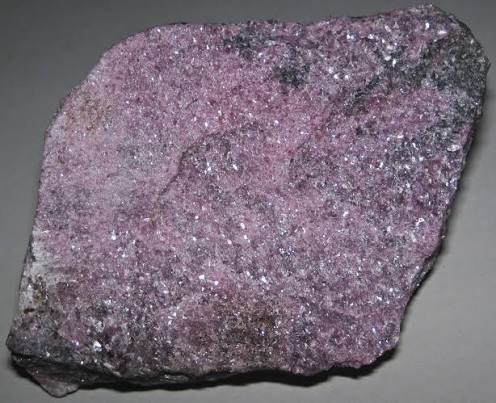
Perhaps the most captivating feature of hexagonite is its color. Unlike the greens of actinolite or the whites and creams typical of tremolite, Fowler specimens display delicate shades ranging from pale lilac to rich violet.
For decades, collectors wondered what caused this remarkable coloration. Modern research indicates that trace amounts of manganese, combined with the complex crystal chemistry of tremolite and the metamorphic conditions under which it formed, contribute to these distinctive hues.
Even slight variations in trace element concentration can dramatically affect color. Some crystals appear almost translucent lavender. Others display deep royal purple interiors fading toward lighter crystal edges.
The subtle variations make every specimen unique.
Few places in North America possess geological history as extraordinary as northern New York.
More than one billion years ago, the rocks of what is now St. Lawrence County lay buried beneath enormous mountain ranges formed during the Grenville Orogeny. Temperatures exceeded several hundred degrees Celsius. Pressures were immense. Limestone, dolostone, and other sedimentary rocks slowly recrystallized into marble.
Fluids rich in silica, magnesium, calcium, and other elements migrated through fractures and bedding planes. Within this chemically active environment, amphibole minerals began to crystallize. Occasionally, conditions aligned perfectly to produce tremolite crystals enriched with just enough manganese to develop their now-famous violet color. Those rare crystals would eventually become known around the world as hexagonite.
The Grenville Province stretches across portions of New York, Ontario, Quebec, and beyond, representing one of Earth’s oldest exposed mountain belts. Its rocks preserve evidence of continental collisions that occurred approximately 1.1 billion years ago, long before complex life existed on land. To mineral collectors, however, the Grenville Province is famous for something else.
It has produced an astonishing diversity of collectible minerals.
Apatite.
Titanite.
Scapolite.
Diopside.
And, of course, hexagonite.
Each formed through unique combinations of heat, pressure, fluid chemistry, and geological time. Hexagonite remains one of the most elegant expressions of those ancient processes.
Although tremolite occurs worldwide, very few localities have produced crystals matching the color, transparency, and collector appeal of Fowler. Throughout the late nineteenth and early twentieth centuries, quarries and mines near Fowler exposed remarkable metamorphosed marbles rich in unusual calcium-magnesium silicate minerals.
Collectors quickly recognized that the lavender amphiboles from this district were unlike anything else being recovered elsewhere. Museums acquired specimens. Private collectors sought them. Mineral dealers proudly advertised “Hexagonite—Fowler, New York.” Over time, Fowler became inseparable from the mineral itself.
Even today, when collectors hear the word hexagonite, the locality that immediately comes to mind is Fowler.
Few American mineral localities have earned the respect of collectors quite like Fowler, New York. Located in the northwestern portion of St. Lawrence County, the town sits within the Adirondack Lowlands, a region internationally recognized for its extraordinary mineral diversity. While the nearby High Peaks are famous for rugged mountains and ancient anorthosite, the Lowlands tell a different geological story—one written in marble, zinc deposits, skarns, and some of the finest metamorphic minerals ever discovered in North America.
For more than a century, Fowler has been synonymous with hexagonite. Although the mineral itself is simply a violet variety of tremolite, specimens from this locality established the standard by which all others are judged. Their delicate color, attractive crystal habit, and historical significance have secured Fowler’s place among America’s classic mineral localities.
To understand why hexagonite formed here, we must travel back more than 1.2 billion years, when this region lay beneath a shallow tropical sea.
Layers of lime-rich mud accumulated on the seafloor over millions of years. Mixed with these carbonates were volcanic ash, silica-rich sediments, clay, and magnesium-bearing materials carried from nearby volcanic islands and eroding landmasses. At the time, there was nothing unusual about these deposits.
Only after hundreds of millions of years—and an event of unimaginable scale—would they become the marble and calc-silicate rocks that define the region today.
During the Grenville Orogeny, continents collided to build a mountain chain rivaling the modern Himalayas. The tremendous heat and pressure transformed limestone into coarse crystalline marble while mobilizing mineral-rich fluids through fractures and bedding planes.
These fluids carried calcium, magnesium, silica, fluorine, manganese, iron, and dozens of other elements. As temperatures slowly declined, those elements combined to form an astonishing suite of minerals that today attracts collectors from around the world.
Hexagonite represents one of the most beautiful products of that billion-year geological journey.
St. Lawrence County is remarkable not because it produced one famous mineral, but because it produced hundreds.
Within only a few miles of Fowler, collectors have found:
This incredible diversity reflects the complex chemistry of the Grenville rocks. Slight changes in the composition of the original sediments—or the chemistry of later hydrothermal fluids—produced entirely different mineral assemblages. For mineralogists, the region is an outdoor laboratory. For collectors, it is one of North America’s great treasure troves.
While many classic hexagonite specimens were recovered from surface exposures and small quarries during the nineteenth century, larger numbers became available through mining.
The marble belts surrounding Fowler contained valuable deposits of talc, zinc, graphite, and industrial minerals. As quarries expanded and underground operations developed, miners exposed pockets of spectacular crystals that would never have been discovered naturally. Unlike commercial gem mining, these operations were never searching for collector specimens. Their goal was industrial minerals.
Collectors benefited because miners often recognized unusual crystals and either saved them or sold them to local dealers. Many of the finest museum-quality specimens entered collections this way.
Without these industrial operations, far fewer examples of classic Fowler hexagonite would exist today.
From the 1930s through the 1970s, northern New York became a destination for mineral enthusiasts across the United States and Canada. Weekend field trips were common. Rock clubs organized collecting excursions. University geology departments visited the area regularly.
Collectors traded locality information through newsletters and handwritten correspondence long before the internet connected the hobby. Many visitors returned home with specimens purchased directly from miners or local dealers. Others collected from dumps where fresh material was continuously brought to the surface.
It was during this era that many of the specimens now found in historic collections—including the Donald Wininger Collection—were acquired. These labels often tell their own story. Handwritten locality names. Dealer stamps from businesses that no longer exist. Old prices written in pencil. Each tag is a small piece of mineral collecting history.
Today, collectors value these original labels almost as much as the specimens themselves because they preserve provenance and connect the mineral to an earlier generation of enthusiasts.
Collectors sometimes assume that because Fowler is still on the map, new hexagonite specimens continue to appear in abundance. The reality is very different.
Many of the classic collecting sites have long since closed, been reclaimed, or are inaccessible to the public. Modern mining methods also differ significantly from those used decades ago. Large-scale mechanized extraction is designed for efficiency rather than preserving delicate crystal pockets.
Even when attractive specimens are encountered, they are rarely recovered under the conditions that once allowed careful hand extraction. As a result, the supply of classic Fowler hexagonite entering the collector market has slowed dramatically.
Most quality specimens available today are not new discoveries. They are older specimens returning to the market through estate collections, museum deaccessions, or long-established private collections.
That makes collections like Donald Wininger’s especially significant. They preserve material acquired during a period when these localities were more accessible and when outstanding specimens could still be obtained directly from miners and regional dealers.
One of the pleasures of collecting minerals from Fowler is discovering how often hexagonite shares its home with other beautiful species.
Common associates include:
Calcite – White to honey-colored calcite is common throughout the marble host rock and often provides an attractive contrasting matrix.
Diopside – Bright green diopside crystals are among the most recognizable minerals from the Grenville Province and frequently occur near tremolite-bearing zones.
Scapolite – Well-formed scapolite crystals are another hallmark of the region and are highly prized by collectors.
Phlogopite – Bronze-colored mica adds texture and visual interest to many specimens while recording the high-temperature metamorphic environment.
Graphite – Thin flakes and masses of graphite are widespread within the marbles and reflect the carbon-rich sediments from which the rocks formed.
Fluorapatite – Fowler and surrounding localities have produced excellent apatite crystals ranging from green to blue-green, often associated with calc-silicate assemblages.
Together, these minerals tell a coherent geological story. Rather than forming in isolation, they crystallized as part of the same complex metamorphic system, each recording slightly different chemical conditions within the ancient mountain belt.
More than a century after the first violet tremolite crystals drew attention, Fowler continues to occupy a special place in the mineral world. Its importance extends beyond the beauty of any single specimen.
It represents a locality where geology, mining history, scientific discovery, and generations of collecting intersect.
Every specimen carries evidence of a billion years of geological change and more than a century of human curiosity. For collectors fortunate enough to own a classic Fowler hexagonite—especially one with documented provenance from a historic collection—it is more than an attractive display piece.
It is a tangible connection to one of North America’s most celebrated mineral localities and to the generations of collectors who recognized its significance long before many of today’s classic specimens became unobtainable.
No two hexagonite specimens are exactly alike. While color often captures attention first, seasoned collectors evaluate a specimen by considering several characteristics together.
The most desirable specimens display a rich lavender to violet color that is evenly distributed throughout the crystal. Pale lilac examples are attractive, while deeper purple crystals are considerably less common.
Sharp crystal faces, undamaged terminations, and well-developed crystal habits are always desirable. Because amphiboles have perfect cleavage in two directions, complete crystals without damage are increasingly difficult to find.
Many classic Fowler specimens range from translucent to nearly transparent. Crystals that allow light to pass through while maintaining strong color are especially prized.
Specimens preserved on their natural marble or calc-silicate matrix often command greater interest than loose crystals. Matrix provides geological context and frequently showcases associated minerals that enhance both scientific and aesthetic value.
Original labels, dealer tags, handwritten notes, or documentation linking a specimen to an established collection significantly increase its historical importance. Provenance helps preserve the story behind a specimen and provides confidence in its locality information.
Fact: Hexagonite is the historic varietal name for violet-colored tremolite. Although the name remains widely used by collectors, it is not recognized as a separate mineral species by the International Mineralogical Association.
Fact: Despite its name, hexagonite crystallizes in the monoclinic crystal system, like all tremolite. The historic name reflects early mineral classification rather than crystal symmetry.
Fact: Color alone does not identify a specimen. Several amphibole species may display unusual coloration under certain conditions. Classic hexagonite refers specifically to the lavender to violet tremolite historically associated with Fowler and a handful of similar localities.
Fact: Violet tremolite has been reported from a few other localities worldwide. However, Fowler, New York remains the classic locality and has produced the finest and most historically significant specimens.
Fact: Tremolite itself is widespread, but attractive violet tremolite suitable for collectors is decidedly uncommon. Fine classic Fowler specimens have become increasingly scarce as historic collecting sites have closed.
Throughout the years, hexagonite has also attracted interest among those who appreciate minerals for their symbolic or spiritual qualities. While these traditions are not supported by scientific evidence, they remain an important part of many collectors’ appreciation for natural stones.
Traditionally, hexagonite has been associated with:
Many people are drawn to hexagonite simply because its gentle lavender color evokes a sense of calm and tranquility. Whether appreciated for its geological significance, historical importance, or traditional symbolism, its beauty continues to inspire admiration.
Quality hexagonite is considered uncommon. While tremolite is found worldwide, well-colored lavender specimens from Fowler have become increasingly difficult to acquire, particularly those with documented provenance.
Fowler is recognized internationally as the classic locality for hexagonite. Specimens recovered from the marble deposits of St. Lawrence County established the mineral’s reputation among collectors and museums beginning in the late nineteenth century.
The color is generally attributed to trace amounts of manganese incorporated into the crystal structure during metamorphism, along with the unique chemical environment present when the crystals formed.
Yes, transparent material can occasionally be cut into gemstones. However, because of perfect amphibole cleavage and limited availability of gem-quality rough, faceted examples are quite uncommon and are generally considered collector gemstones rather than jewelry stones.
Most hexagonite itself exhibits little to no fluorescence. However, associated minerals such as calcite, fluorite, or scapolite found on the same specimen may fluoresce under ultraviolet light.
Use only gentle methods such as warm water, mild soap, and a soft brush when necessary. Avoid acids, ultrasonic cleaners, and aggressive mechanical cleaning, as amphibole crystals can cleave easily and may be damaged by harsh treatment.
Original labels document where and when a specimen was collected or purchased. They establish provenance, preserve historical information, and often increase both the scientific and collector value of historic specimens.
Like most collectible minerals, value depends on quality, rarity, condition, locality, and provenance. Classic Fowler specimens with excellent color, attractive crystal form, and documented history continue to be sought after by serious collectors because the supply is finite.
Hexagonite reminds us that some of the most remarkable treasures in the mineral kingdom are also among the quietest. It lacks the brilliance of diamonds and the vivid saturation of emeralds. It is not widely recognized outside the collecting community, nor is it produced in commercial quantities for the jewelry trade.
Yet to those who understand minerals, hexagonite represents something far more enduring. It is the product of an ancient mountain-building event that reshaped a continent more than a billion years ago. It is the signature mineral of one of North America’s great metamorphic provinces. It reflects the careful work of miners who recognized unusual crystals amid ordinary rock and the curiosity of mineralogists who sought to understand them. Most importantly, it represents continuity.
The specimen featured here passed through three generations of the Donald Wininger family before becoming part of the Treasures from the Donald Wininger Collection series. Every original label, every carefully preserved crystal, and every locality noted decades ago serves as a reminder that collecting is about more than ownership. It is about stewardship.
Today’s collector is simply the next caretaker in a story that began long before any of us—and one that will continue as these remarkable specimens inspire future generations.
If you enjoyed learning about hexagonite from Fowler, New York, continue exploring the remarkable minerals such as Uranophane, Realgar, Serpentine, North Vernon Calcite. Visit our Mine to Mind educational blog for additional in-depth mineral articles, browse our Minerals Collection to discover available historic specimens, explore our growing library of educational eBooks, and stop by to see us at upcoming Gem & Mineral Shows, where many specimens from the Donald Wininger Collection will be available to view in person.
This Fowler hexagonite is part of the Donald Wininger Collection, a three-generation mineral collection spanning specimens acquired from the 1940s through the 2000s. The collection includes minerals from historic localities across the United States, Canada, Mexico and beyond, with many specimens dating from the height of American mineral collecting in the 1950s and 1960s.
Explore available specimens from the Donald Wininger Collection and discover historic minerals, classic localities and pieces that preserve decades of collecting history.

At Grounded Lifestyles, our love for crystals began in the peaceful flow of Reiki and energy healing sessions — where we saw how natural stones could amplify intentions, restore balance, and bring comfort. But the more time we spent with these treasures, the more curious we became about their origins. That curiosity led us into the fascinating world of geology and mineral specimen collecting. We fell in love not just with the energy of crystals, but with the science and artistry of their creation — the intricate crystal structures, the vibrant mineral hues, and the wonder of holding a piece of Earth’s history in our hands.