
Every crystal, mineral, fossil, meteorite, and handcrafted piece is selected with purpose. Whether you’re building a museum-worthy mineral collection, searching for a meaningful gift, decorating your home with natural beauty, or beginning your journey into the world of geology, you’ll discover authentic specimens with stories worth sharing.
Over 15 shows a year throughout the Southwest. Check to see if we are coming to a show near you!
Home > Blog > Minerals Blog | Crystal Guides, Geology & Metaphysical Meaning > Herkimer Diamonds Mohawk Valley, New York
Donald Wininger Collection
There are certain minerals that experienced collectors recognize before they ever see the label. Herkimer Diamonds belong to that group.
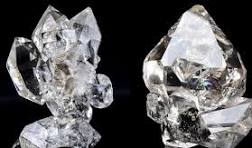
A good one almost seems too perfect to have come out of the ground. It is clear enough to disappear against the palm of your hand, then suddenly catches the light from one of its sharply developed natural faces. Turn it over and there is another point on the opposite end. Nothing has been cut. Nothing has been polished. The crystal came from the rock looking remarkably close to the way it appears in the display case.
That alone would have made Herkimer quartz collectible. But clarity is only the beginning of the story.
Some crystals carry tiny black inclusions that look like fragments of smoke frozen inside glass. Others contain miniature crystals, internal cavities, fluids or bubbles. Occasionally, old specimens reveal unexpected fluorescence under ultraviolet light. Those included crystals can be considerably more interesting to a collector than a flawless clear one because they preserve evidence of what was happening inside the rock while the quartz was growing.
Several Herkimer Diamonds in the Donald Wininger Collection date to the 1950s, long before the modern flood of similarly shaped quartz entered the mineral market from other countries. Some of those old New York specimens fluoresce. That makes them particularly intriguing, because fluorescence in genuine Herkimer material appears to be much less common than the spectacular petroleum fluorescence now associated with some doubly terminated quartz from Pakistan and Afghanistan.
To understand what is trapped inside these crystals, though, it helps to understand where they came from.
The classic Herkimer Diamond district lies in east-central New York, particularly around Herkimer County and neighboring parts of the Mohawk Valley. Little Falls and Middleville are among the names most closely associated with the crystals, although the geology does not stop at a county boundary.
The host rock is the Little Falls Dolostone, a Late Cambrian formation exposed through this portion of New York.
At Little Falls, the formation is roughly 400 feet thick. Dolostone dominates, but sandstone and mixed sandstone-dolostone beds also occur. Some beds contain abundant cavities, while other portions preserve stromatolites—the layered structures created by ancient microbial communities.
This rock began forming roughly 495 million years ago, when the geography of North America would have been almost unrecognizable to us. There was no New York. There were no Adirondacks as we know them, no farms across the Mohawk Valley and certainly no crystal mines.
Much of the region lay beneath a warm shallow sea. Carbonate sediment accumulated on the seafloor along with sand, organic material and other debris. Over immense stretches of time, burial changed those deposits into rock.
The important point for collectors is that the rock and the crystals are not necessarily the same age.
That distinction is often lost in popular descriptions of Herkimer Diamonds. They are frequently advertised as “500-million-year-old crystals.” The Little Falls Dolostone is indeed Late Cambrian, but USGS summaries cite a much younger, Carboniferous age interpretation for the quartz itself. In other words, nature built the house first. The crystals moved in much later.
Quartz is one of the most common minerals in Earth’s crust. Chemically it is simply silicon dioxide, SiO₂. So the question is not why quartz occurs in New York. The interesting question is why quartz in this particular part of New York grew into crystals so different from ordinary vein quartz. The answer begins with space.
The Little Falls Dolostone contains vugs and irregular cavities. Some developed during alteration of the carbonate rock; fracturing and dissolution also helped create openings through which fluids could move. Once there was an open pocket, quartz no longer had to grow tightly against surrounding stone. That freedom is enormously important.
Picture a typical quartz crystal growing upward from a vein wall. Its lower end is attached to the matrix. Silica continues to accumulate on the exposed surfaces until the upper end develops its familiar termination. The base never has the opportunity to form a point because rock is in the way. A Herkimer Diamond can be different.
When a crystal grows with little contact with its host, both ends can develop naturally. The result is the compact, doubly terminated form collectors associate with Herkimer. A classic crystal may show 18 natural faces—six prism faces and the termination faces at both ends. The brightness comes entirely from those natural surfaces. No faceting machine is required. GIA describes this exceptionally clear, doubly terminated habit as the characteristic form that made the locality famous.
That does not mean every Herkimer is a flawless 18-faced floater. Far from it. There are attached crystals, skeletal crystals, clusters, scepters, intergrowths, odd contacts and specimens distorted by neighboring crystals. Those variations are part of the attraction for serious collectors.
Once you move beyond souvenir-grade Herkimers, the district becomes a study in crystal growth.
For a crystal to grow, silica had to reach those cavities in solution. This is one of the more interesting parts of Herkimer geology because the pockets contain far more than quartz.
Calcite and dolomite occur there. So do iron sulfides such as pyrite and marcasite, along with sphalerite and other minerals. Carbon-rich material is especially important. The USGS lists anthraxolite among the minerals and materials associated with the Little Falls Dolostone.
One proposed model, summarized in GIA’s review of Michael Walter’s Collector’s Guide to Herkimer Diamonds, connects crystal growth with the burial and heating of the sedimentary sequence. Organic-rich material and quartz-bearing sediments were buried; increasing temperature changed the chemistry of the system and silica was eventually precipitated slowly enough to produce unusually clear quartz.
The exact details of Herkimer formation remain more complicated than the simple versions repeated in tourist literature, but one fact becomes obvious when examining enough specimens: hydrocarbons were part of the system. And that brings us to some of the most sought-after Herkimers.
Open enough Herkimer pockets and eventually you meet the black material. It can coat rock. It can appear along fractures. It may occur around the quartz and sometimes it ends up inside the crystal itself.
Collectors have traditionally called much of this black carbonaceous material anthraxolite. Modern discussions often use broader terms such as hydrocarbon because the material is not necessarily chemically identical in every pocket. Regardless of terminology, its association with Herkimer quartz is well established.
Geology.com notes that solid hydrocarbons are among the most common inclusions in Herkimer Diamonds. They can occur as visible particles or as much finer material; when abundant, these tiny inclusions may even darken the appearance of the quartz.
A specialized Herkimer research and collector archive describes hydrocarbon as probably the most abundant inclusion after fractures and documents everything from isolated flakes to crystals heavily filled with black material.
A novice might see those black inclusions and decide the crystal is dirty. A collector may have exactly the opposite reaction. The inclusion is part of the story.
In an especially clear crystal, a sharply isolated black inclusion can create spectacular contrast. More importantly, it establishes a direct physical connection between the quartz and the carbon-rich fluids and materials circulating through the deposit.
This is where Herkimer collecting stops being about perfect transparency and starts becoming much more interesting.
Some inclusions are solid and others are fluid. Quartz can trap tiny portions of the fluid surrounding it while it grows. Once the crystal closes around that space, the fluid can remain sealed inside.
These fluid inclusions may be extremely small, visible only with magnification, or large enough to see without equipment. Some contain more than one phase—perhaps liquid with a gas bubble. Occasionally that bubble can move when the crystal is turned. Collectors commonly refer to fluid-filled Herkimers as enhydros, although geologically the more precise term is fluid inclusion.
Herkimer specimens are known to contain salt water, petroleum-related liquids and gases; carbon dioxide is among the gaseous components reported in the literature. Two- and three-phase inclusions and negative crystals are also known. There are even documented New York specimens containing golden-orange fluid interpreted as possibly oil-related material, together with black hydrocarbon in the same crystal.
For an inclusion collector, that can be much more desirable than a plain clear crystal. Think about what is being preserved. A microscopic pocket opens inside growing quartz. Fluid is trapped. The quartz seals it.
That tiny environment survives through geological time until someone opens the surrounding dolostone and brings the crystal to the surface. The material inside has effectively been placed in a natural quartz container.
That is why oil-bearing or unusual fluid inclusions command such attention. They are not decorative additives. They are remnants of the environment in which the crystal grew.
This is where today’s collector market can create confusion. There is a great deal of petroleum-included, doubly terminated quartz coming from Pakistan and Afghanistan. Some of it is outstanding. Under normal light, small petroleum inclusions may appear yellow, amber or brown. Put them beneath ultraviolet light and they can explode into vivid blue or blue-white fluorescence.
The Fluorescent Mineral Society documents Balochistan, Pakistan quartz in which petroleum inclusions fluoresce blue under both longwave 365 nm and shortwave 254 nm ultraviolet light.
Because these crystals are also doubly terminated, they are sometimes casually marketed as Herkimer Diamonds or “Herkimer-style” quartz. The second description is reasonable. The first is not.
A true Herkimer Diamond is a locality specimen from the New York district. This led to another oversimplification, however: the idea that genuine New York Herkimers do not have fluorescent inclusions. The evidence is more nuanced.
A 2018 Japanese study analyzed New York Herkimer material alongside petroleum-bearing double-terminated quartz from Afghanistan and Pakistan. In the specimens studied, the Asian quartz contained fluorescent alkylbenzene-bearing oil inclusions, while the Herkimer samples contained solid graphitic material and did not show the same fluorescent inclusions. That study is useful.
It tells us the two deposits should not be assumed to contain identical hydrocarbons. What it does not establish is that no Herkimer Diamond from New York can ever contain a fluorescent inclusion. Later work by the same researcher specifically acknowledged fluorescent inclusions in genuine Herkimer material, describing them as occurring in small quantities.
That distinction matters for the Donald Wininger Collection. Some of the collection’s New York Herkimer specimens date to the 1950s and some fluoresce under ultraviolet light.
Their age and provenance make them especially interesting because they predate today’s widespread trade in petroleum-included quartz from Pakistan and Afghanistan. It would still be inappropriate to look at that fluorescence and simply declare, “That is petroleum.”
Fluorescence tells us that something within the specimen is responding to ultraviolet radiation. Determining exactly what that material is may require microscopy, spectroscopy or other analytical methods. But it would be equally inappropriate to dismiss the response because modern petroleum quartz from Pakistan is better known for strong UV fluorescence.
Historic Herkimer specimens remind us why collections with old provenance matter. They preserve material that can challenge overly broad statements made from small analytical sample sets.
For collectors with fluorescent Herkimers, documentation is important. Record the locality if known. Preserve old labels. Note whether the response occurs under longwave UV, shortwave UV or both. Photograph the specimen in normal light and under ultraviolet illumination.
Hydrocarbons are only one reason to look closely. Herkimers are remarkably good inclusion specimens. A clear crystal may contain a tiny dolomite rhomb apparently floating inside it. Another can engulf fragments of earlier quartz. Sulfide minerals may become trapped during growth. Some contain tiny secondary crystals.
Then there are negative crystals. These are internal cavities bounded by crystallographic faces. Instead of looking like an irregular bubble, the empty space can mimic the geometry of a crystal. It is a wonderful contradiction: a crystal shape defined by what is missing. Growth interruptions can produce still stranger forms.
Some Herkimers show skeletal or hopper development, where the edges advance more rapidly than portions of the faces. Others become scepters, with a later crystal generation growing over an earlier stem. Crystals may intersect, grow together or produce complicated contact marks that tell us neighboring quartz occupied the same pocket.
For a serious collector, these are not imperfections, they are records that can be read!
There is a natural tendency to rank quartz the way we rank gemstones. Clearer must be better. Bigger must be better. Fewer inclusions must be better. That works poorly with mineral specimens.
A water-clear, perfectly terminated Herkimer is undeniably beautiful and can be an exceptional specimen. But an included crystal may be scientifically and historically more interesting. A well-positioned anthraxolite inclusion can create better contrast.
A movable bubble can transform a small specimen into something collectors will spend minutes turning beneath a loupe. An unusual fluorescent inclusion can make an old locality specimen remarkable. A tiny crystal completely enclosed inside a larger crystal provides evidence of multiple stages of growth. Provenance can outweigh all of them.
A Herkimer accompanied by an original 1950s collection label tells us considerably more than a flawless loose crystal in a dealer tray with no locality history beyond “New York.”
The Donald Wininger Collection is particularly important in that regard because it comes from an era when collecting was often much closer to the source. Old collections sometimes preserve pockets, habits and material that are rarely represented on today’s market.
“Herkimer Diamonds are diamonds.” — Myth.
They are quartz, SiO₂. Their exceptional clarity, natural brilliance and sharply developed crystal faces inspired the diamond nickname.
“The crystals are 500 million years old.” — Not quite.
The Little Falls Dolostone is Late Cambrian and approximately that old. Geological interpretations summarized by the USGS place formation of the quartz substantially later, possibly during the Carboniferous.
“Every Herkimer has 18 perfect faces.” — Myth.
Eighteen natural faces describe the classic fully developed doubly terminated habit. Real specimens may be distorted, contacted, intergrown, skeletal, damaged or partially attached.
“Black material inside a Herkimer means it is poor quality.” — Myth.
Carbon-rich hydrocarbon inclusions are characteristic of the deposit and can make specimens considerably more interesting to inclusion and locality collectors.
“Some Herkimers contain petroleum or other fluids.” — Fact.
Fluid, petroleum-related, gas and multiphase inclusions have all been documented in New York Herkimer quartz.
“Only Pakistan petroleum quartz fluoresces.” — Myth.
Pakistan and Afghanistan are particularly famous for strongly fluorescent petroleum inclusions, but fluorescent inclusions have also been recognized in genuine New York Herkimer material, apparently in much smaller quantities.
“If a New York Herkimer fluoresces, the glowing material must be oil.” — Myth.
Fluorescence by itself does not identify the inclusion. Its chemistry would need to be established analytically.
“Every doubly terminated quartz crystal is a Herkimer Diamond.” — Myth.
Herkimer is a locality designation. Similar quartz from Pakistan, Afghanistan, China and other countries should be identified by its actual locality.
“The crystals are naturally faceted.” — Fact.
Their brilliant faces developed naturally during crystal growth. No cutting or polishing is necessary.
After decades of mineral collecting, the question becomes less about whether something is rare and more about whether the specimen has something to say. Herkimer Diamonds have a lot to say. The clear ones demonstrate how beautifully quartz can grow when given open space.
The included ones preserve carbon, fluids and minerals from the environment surrounding the crystal. The odd habits record changes in growth. Fluorescent specimens introduce another layer of chemistry that is still more complicated than popular mineral descriptions suggest. And old specimens preserve the history of collecting itself.
That is what makes the Herkimer Diamonds of the Donald Wininger Collection particularly fitting for this archive.
Donald was collecting during a period when American minerals were circulating through clubs, local dealers, field trips, estate collections and direct exchanges between collectors. A Herkimer acquired in the 1950s carries that history along with its geology.
Staurolite is just one chapter in the remarkable story of Earth’s mineral treasures. We invite you to continue exploring the Mine to Mind series, where each article follows a specimen from its geological origins to its place in a collector’s cabinet. Enjoy more from the Donald Wininger Collection: North Vernon Calcite, Realgar, dolomite, fluoro-richterite, zircon crystal, hexagonite, sand calcite, uranophane, Native Silver from Cobalt, Blue and Orange Celestite, Apatite, Calcite Pugh Quarry and more. Along the way you’ll discover the science, history and human stories that make every mineral unique.
If you’re attending one of the upcoming gem and mineral shows, stop by the Grounded Lifestyles booth to see selections from the Donald Wininger Collection in person.
The Donald Wininger Collection spans decades of careful collecting and includes minerals from many of North America’s most celebrated localities.
Future installments of Mine to Mind will continue to explore these remarkable specimens, uncovering the geology, mining history and collector appeal behind each one. Every label tells a story. Every specimen preserves a moment in Earth’s history. And every collection helps ensure those stories continue to inspire future generations of collectors.
At Grounded Lifestyles, our love for crystals began in the peaceful flow of Reiki and energy healing sessions — where we saw how natural stones could amplify intentions, restore balance, and bring comfort. But the more time we spent with these treasures, the more curious we became about their origins. That curiosity led us into the fascinating world of geology and mineral specimen collecting. We fell in love not just with the energy of crystals, but with the science and artistry of their creation — the intricate crystal structures, the vibrant mineral hues, and the wonder of holding a piece of Earth’s history in our hands.