
Every crystal, mineral, fossil, meteorite, and handcrafted piece is selected with purpose. Whether you’re building a museum-worthy mineral collection, searching for a meaningful gift, decorating your home with natural beauty, or beginning your journey into the world of geology, you’ll discover authentic specimens with stories worth sharing.
Over 15 shows a year throughout the Southwest. Check to see if we are coming to a show near you!
Home > Blog > Minerals Blog | Crystal Guides, Geology & Metaphysical Meaning > Orange Celestite from Forks of the Credit, Caledon Township, Ontario, Canada
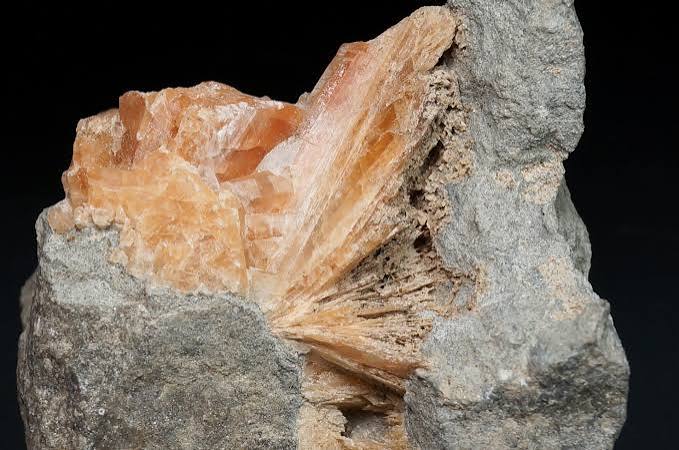
Donald Wininger Collection
Some minerals are collected because they are large and others because they are exceptionally rare. Orange celestite from Forks of the Credit is collected because it is unexpected. Even experienced collectors often pause when they first see one.
The warm honey-orange crystals seem out of place. Most people associate celestite with delicate shades of sky blue, yet this Ontario locality produced crystals with rich amber to orange coloration that immediately stand apart from the better-known material from Ohio, Madagascar and other classic localities. That surprise is exactly what makes this specimen memorable. It challenges expectations while reminding us that geology rarely follows our assumptions.
When Donald Wininger added this specimen to his collection, he wasn’t simply acquiring another example of celestite. He was preserving an unusual chapter of Canadian mineral collecting.
Mineral: Celestite (Celestine)
Chemical Formula: SrSO₄
Mineral Class: Sulfates
Crystal System: Orthorhombic
Color: Orange, honey-orange to amber (this locality)
Luster: Vitreous
Transparency: Transparent to translucent
Mohs Hardness: 3–3.5
Cleavage: Perfect in one direction
Primary Locality Featured: Forks of the Credit, Caledon Township, Ontario, Canada
Associated Minerals:
One of the most enjoyable aspects of exploring the Donald Wininger Collection is discovering specimens that make even experienced collectors take a second look. This orange celestite is one of those pieces.
At first glance, many assume they are looking at calcite or perhaps a honey-colored fluorite. Only after closer examination do the crystal form and luster reveal its true identity. Specimens from Forks of the Credit have long been appreciated by Canadian collectors because they represent a locality that produced something distinctly different from the celestite found elsewhere. They were never abundant, and many entered private collections decades ago when access to the locality was easier.
Today, specimens with reliable locality information have become increasingly desirable, especially those that can be traced to older collections. This example represents more than an attractive mineral. It represents a locality that helped shape Ontario mineral collecting.
Celestite is a strontium sulfate mineral best known for its beautifully formed crystals and its association with sedimentary environments. Its name comes from the Latin word caelestis, meaning “heavenly,” a reference to the pale blue color commonly seen in many famous deposits. That association is so strong that many collectors assume all celestite is blue.
Nature, however, occasionally has other plans. At Forks of the Credit, geological conditions produced celestite with warm orange hues that immediately distinguish it from more familiar material. While chemically identical to blue celestite, its appearance tells a very different story.
If you asked a room full of mineral collectors to imagine a celestite specimen, nearly everyone would describe blue crystals. Blue has become part of celestite’s identity. That is why the specimens from Forks of the Credit are so fascinating. They quietly ignore that expectation.
Instead of soft blues, collectors find crystals ranging from pale honey to rich orange, creating one of Canada’s most distinctive celestite occurrences. The color has been attributed to trace amounts of copper and the unique geochemical conditions under which the crystals formed, although the exact cause continues to interest collectors and mineralogists alike. Regardless of the precise mechanism, the result is unmistakable—a color variety that has become closely associated with this Ontario locality.
It is easy to understand why Donald chose to preserve this specimen. Not because it is the largest celestite. Not because it is the bluest. But because it tells a story that very few celestite specimens can.
The Forks of the Credit lies within the rolling landscape of Caledon Township, northwest of Toronto. Long before hikers discovered its scenic trails and waterfalls, the area attracted geologists and mineral collectors searching the exposures along the Niagara Escarpment. Unlike the large commercial quarries that produced thousands of specimens elsewhere, collecting here was always more personal.
Many discoveries came from small quarry operations, natural exposures and temporary excavations. Finding an exceptional specimen often depended on being in exactly the right place at exactly the right time. That sense of discovery has become part of the locality’s enduring appeal.
Ontario has produced many important mineral localities. Only a handful become legendary among collectors. Forks of the Credit earned that reputation because it produced a mineral that looked unlike the celestite found almost anywhere else. Collectors quickly recognized that these specimens were something special.
They were not simply acquiring celestite. They were acquiring Orange Celestite from Forks of the Credit—a locality that became synonymous with one of Canada’s most unusual color varieties. As older collections changed hands through the years, specimens carrying original locality labels became increasingly valued.
For many collectors, the label is almost as important as the specimen itself. It preserves the connection between the crystal and the place that made it possible.
Unlike mineral deposits formed by volcanic activity or mountain building, the Forks of the Credit occurrence developed quietly. Groundwater rich in dissolved minerals circulated through small openings in the carbonate rocks. As conditions changed, strontium and sulfate combined to crystallize celestite within these cavities.
The crystals had room to grow slowly, producing the sharp, well-formed shapes collectors admire today. The process was patient and there were no violent eruptions. No molten rock and no dramatic geological catastrophe. Instead, nature worked slowly, depositing one crystal face after another until the cavities were filled with sparkling celestite. That slow growth helped produce the clarity and crystal form that make specimens from this locality so appealing.
This is the question nearly every collector asks. Celestite is famous for its soft blue color, so why did Forks of the Credit produce orange crystals? The answer lies in the unique chemistry of the locality.
While celestite itself is always composed of strontium sulfate, tiny amounts of other elements and natural geological conditions can influence how light interacts with the crystals. Mineral dealers and researchers have long attributed the warm orange coloration of Forks of the Credit specimens to trace amounts of copper associated with the mineralizing environment, although subtle differences in crystal growth and other trace impurities may also contribute. Whatever the exact combination of factors, the result is unmistakable.
Collectors can often recognize a Forks of the Credit specimen from its color alone. Rather than trying to imitate the famous blue celestites of other localities, these crystals developed their own identity. That identity is what made the locality famous.
One reason collectors enjoyed searching this locality was its unpredictability. One cavity might contain pale honey-colored crystals. Another could produce deeper orange specimens. Some pockets yielded only a few attractive crystals, while others produced clusters worthy of display. No one could predict exactly what would appear beneath the next layer of rock.
That uncertainty is part of what makes historic locality collecting so rewarding. Every successful discovery felt personal. Every specimen carried the excitement of uncovering something few people had ever seen.
Unlike many famous mineral districts dominated by large commercial mines, the orange celestite locality was associated with relatively small quarry operations, road cuts and natural rock exposures around the Forks of the Credit area. Many of these collecting opportunities were temporary.
Construction projects ended resulting in the quarries to close. Exposure to weather and access changes over time. As a result, opportunities to collect fresh material gradually became more limited.
For today’s collectors, that history adds another layer of significance. Many specimens now circulating in collections were recovered decades ago when these exposures were still accessible.
One of the strengths of the Donald Wininger Collection is that it preserves specimens from localities that helped define mineral collecting in their regions.
This orange celestite is a perfect example.
It represents a locality that never produced minerals on the scale of large commercial operations. Instead, it produced specimens that became memorable because they were different. Collectors recognized that difference early. Many pieces entered private collections where they remained for decades, carefully labeled and preserved.
As older collections are dispersed, specimens like this become increasingly important because they carry both the mineral and its history. Donald understood that. He wasn’t simply collecting crystals. He was preserving classic localities.
Collectors often value specimens for one—or more—of four reasons:
Orange celestite from Forks of the Credit brings all four together. Its crystals are attractive. Its color is uncommon. Its locality is a recognized Canadian classic. And many surviving specimens trace back to collecting during the middle decades of the twentieth century.
That combination has kept demand strong even though relatively few specimens reach the market.
Unlike minerals that continue to be mined in large quantities, the supply of well-documented Forks of the Credit specimens is essentially fixed. Each time one enters a museum or long-term private collection, another piece of the locality’s history becomes a little harder to acquire.
Collectors often reach a point where they stop looking for the biggest specimen. Instead, they begin looking for the specimen with the best story. Orange celestite from Forks of the Credit fits that description perfectly.
It isn’t famous because thousands of specimens entered the market. It isn’t known for producing giant crystal groups. Instead, its appeal comes from rarity, locality and the unexpected beauty of its color.
When placed beside a traditional blue celestite, the difference is immediately obvious. The two specimens share the same chemistry, yet each tells the story of a completely different geological environment.
For many collectors, owning both completes the story of the mineral.
Experienced collectors evaluate orange celestite much differently than someone simply shopping for a decorative crystal. Several characteristics contribute to a specimen’s desirability.
Color is usually the first thing collectors notice.
The most desirable specimens display rich honey-orange to amber tones distributed evenly across the crystal group.
Some specimens show subtle color zoning, while others range from pale golden hues to deeper orange.
Whatever the shade, the unusual coloration is what immediately separates Forks of the Credit material from nearly every other celestite locality.
Well-formed crystals with sharp edges and bright vitreous luster are especially prized.
Because celestite has perfect cleavage and a relatively low hardness, crystals with minimal damage are becoming increasingly difficult to find.
Collectors appreciate specimens that retain their natural crystal faces without broken terminations or excessive wear.
Many of the finest specimens retain portions of their original limestone or dolostone matrix.
The matrix provides context.
It reminds the viewer that these crystals formed within cavities inside ancient marine sediments rather than appearing as isolated crystal clusters.
For locality collectors, the matrix is part of the specimen’s identity.
Perhaps the most valuable feature is documentation.
Original handwritten labels, old collection tags or records tracing a specimen to Forks of the Credit greatly increase its historical significance.
The Donald Wininger Collection has always emphasized preserving that connection between specimen and locality.
Without the locality, the specimen loses part of its story.
Unlike minerals that continue to be recovered through active mining, orange celestite from Forks of the Credit represents a finite chapter in Ontario collecting.
Many of the productive exposures that yielded these crystals decades ago are no longer accessible. Natural weathering has altered others. Land ownership has changed. Environmental protection has also helped preserve portions of the Niagara Escarpment, limiting opportunities for casual collecting.
As a result, most specimens entering today’s market come from older collections rather than newly discovered material. Each generation sees a little less available than the one before it. That limited supply has quietly increased the locality’s importance among collectors of classic Canadian minerals.
Celestite is a beautiful but relatively delicate mineral.
Its perfect cleavage means a sharp impact can split crystals even when they appear solid.
To help preserve specimens:
Because the natural color contributes significantly to the specimen’s appeal, harsh cleaning methods should be avoided.
Fact: While blue is the best-known color, celestite also occurs in white, colorless, pale gray and the distinctive orange variety found at Forks of the Credit.
Fact: It is still celestite (SrSO₄). The unusual color results from the unique geological conditions under which it formed.
Fact: Color, crystal quality, locality and provenance often outweigh size.
Fact: Several Ontario occurrences are known, but Forks of the Credit remains the classic locality for orange celestite.
Fact: Most collectors prefer specimens that retain their natural surfaces and original character.
Traditionally, celestite has been associated with peace, clear communication and emotional balance.
Many practitioners believe it encourages thoughtful reflection and creates a calming atmosphere.
Orange celestite is sometimes viewed as combining those traditional qualities with themes of creativity, optimism and personal growth because of its warm coloration.
Yes.
Compared to the abundant blue celestite from well-known commercial localities, orange celestite from Forks of the Credit is uncommon and highly sought after by Canadian locality collectors.
The color is generally attributed to trace amounts of copper and the unique geochemical conditions present during crystal growth, although the exact mechanism continues to be discussed.
Under normal display conditions, the color is generally stable. Protecting specimens from unnecessary heat, moisture and physical damage helps preserve their appearance.
Most classic collecting areas are no longer readily accessible, making older specimens increasingly desirable.
They preserve the specimen’s connection to one of Canada’s classic mineral localities and document its history within earlier collections.
Orange celestite from Forks of the Credit reminds us that remarkable mineral discoveries are not always measured by production or size.
Sometimes a locality becomes famous because it produced something that challenged expectations. Collectors who first encountered these warm orange crystals quickly realized they were seeing a different side of a familiar mineral. That realization transformed a small Ontario occurrence into one of Canada’s classic collector localities.
The specimen preserved in the Donald Wininger Collection carries that history forward. It represents careful collecting, thoughtful preservation and an appreciation for the unusual. More than anything, it reminds us that every classic locality has a story—and sometimes the most memorable stories come from the places few people expected.
This orange celestite is part of the Donald Wininger Collection, a three-generation mineral collection spanning specimens acquired from the 1940s through the 2000s. The collection includes minerals from historic localities across the United States, Canada, Mexico and beyond, with many specimens dating from the height of American mineral collecting in the 1950s and 1960s.
Explore available specimens from the Donald Wininger Collection and discover historic minerals, classic localities and pieces that preserve decades of collecting history.

At Grounded Lifestyles, our love for crystals began in the peaceful flow of Reiki and energy healing sessions — where we saw how natural stones could amplify intentions, restore balance, and bring comfort. But the more time we spent with these treasures, the more curious we became about their origins. That curiosity led us into the fascinating world of geology and mineral specimen collecting. We fell in love not just with the energy of crystals, but with the science and artistry of their creation — the intricate crystal structures, the vibrant mineral hues, and the wonder of holding a piece of Earth’s history in our hands.