
Every crystal, mineral, fossil, meteorite, and handcrafted piece is selected with purpose. Whether you’re building a museum-worthy mineral collection, searching for a meaningful gift, decorating your home with natural beauty, or beginning your journey into the world of geology, you’ll discover authentic specimens with stories worth sharing.
Over 15 shows a year throughout the Southwest. Check to see if we are coming to a show near you!
Home > Blog > Minerals Blog | Crystal Guides, Geology & Metaphysical Meaning > Blue Celestite from Pugh Quarry, Ohio
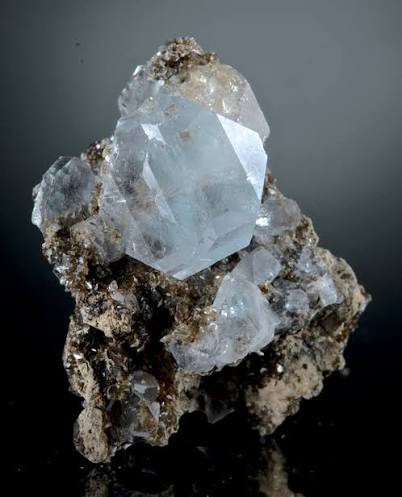
Donald Wininger Collection
Some minerals catch your eye. Others stop you in your tracks. Blue celestite from Pugh Quarry belongs firmly in the second category.
Few minerals possess such an unmistakable color. The delicate sky-blue crystals seem almost too perfect to have formed naturally, their glassy faces reflecting light with a brilliance that contrasts beautifully against the pale gray dolomite from which they emerged.
Collectors have admired these specimens for more than a century. Museum displays, mineral exhibitions, and private collections around the world often feature Pugh Quarry celestite as one of the finest examples of the mineral ever found.
The specimen featured in this article comes from the Donald Wininger Collection, a remarkable three-generation family collection assembled by Donald Wininger, his father, and his grandfather. Preserved with its history and provenance, it represents more than a beautiful crystal—it represents a chapter in the golden age of American mineral collecting.
Like every specimen in this series, it reminds us that minerals are more than objects. They are pieces of Earth’s history preserved by generations of curious people who recognized their significance long before many localities became inaccessible.
Mineral: Celestine (commonly called Celestite)
Mineral Group: Sulfates
Chemical Formula: SrSO₄
Crystal System: Orthorhombic
Classic Locality: Pugh Quarry, Custar, Wood County, Ohio
Geologic Formation: Silurian Lockport Dolomite
Age of Host Rock: Approximately 425–430 million years
Hardness: 3–3.5
Collector Appeal: ★★★★★
Historic Significance: Exceptional
Difficulty to Replace: High
Every specimen within the Donald Wininger Collection carries two histories. The first was written by nature over hundreds of millions—or sometimes billions—of years. The second was written by collectors who recognized something extraordinary and chose to preserve it.
The blue celestite featured here is an excellent example of that partnership between geology and stewardship.
Collected during an era when classic American localities were still actively producing outstanding material, this specimen reflects a time when mineral dealers, quarry workers, museums, and private collectors worked together to rescue exceptional crystals before they disappeared into crushers or industrial processing.
Many of the specimens preserved in the Donald Wininger Collection still retain their original handwritten labels and dealer information, providing an invaluable connection to the history of mineral collecting itself.
Today these remarkable pieces continue that journey, allowing a new generation to appreciate not only their beauty but also the stories behind them.
One of the first questions many collectors ask is whether celestite and celestine are different minerals. They are not. Both names refer to the same mineral species: strontium sulfate (SrSO₄).
The official name recognized by modern mineralogical organizations is celestine, derived from the Latin word caelestis, meaning “heavenly” or “sky blue.”
However, for well over a century, collectors, dealers, museums, and scientific publications have commonly used the name celestite, particularly in North America.
Today both names remain widely accepted in the collecting community. Because “celestite” is the name most familiar to collectors, it continues to appear on dealer labels, museum displays, and educational materials.
Whether labeled celestine or celestite, the remarkable blue crystals from Pugh Quarry remain among the world’s finest examples of this beautiful mineral.
Long before Ohio became farmland and forests, it lay beneath a warm, shallow tropical sea near the equator.
Around 425 million years ago, during the Silurian Period, this sea teemed with life. Coral reefs flourished alongside crinoids, brachiopods, trilobites, bryozoans, and countless other marine organisms. As generations of these creatures lived and died, their skeletal remains accumulated on the seafloor, eventually forming thick deposits of lime-rich sediment.
Over millions of years those sediments hardened into what geologists now know as the Lockport Dolomite, the rock formation that hosts the famous Pugh Quarry crystals.
But the dolomite itself was only the beginning of the story. Long after the rock had formed, mineral-rich groundwater slowly moved through fractures and cavities within the formation. These fluids carried dissolved strontium and sulfate ions. Under the right chemical conditions, the solution became saturated, and crystals of celestite began to grow.
Unlike minerals that crystallize directly from molten magma, celestite formed quietly within open cavities deep underground. Crystal by crystal, molecule by molecule, transparent blue prisms slowly developed over thousands—perhaps even millions—of years.
The spacious cavities allowed the crystals to grow freely without interference from surrounding rock. This unrestricted growth is one of the reasons Pugh Quarry produced such spectacular, well-formed specimens with sharp faces and exceptional clarity.
The first thing almost everyone notices about celestite is its color. The finest Pugh Quarry specimens display shades ranging from pale ice blue to rich sky blue, often appearing almost luminous when viewed in natural light.
Interestingly, pure celestine is actually colorless. Its beautiful blue coloration is believed to result from trace impurities and subtle defects within the crystal structure that affect how light passes through the mineral. Minute amounts of certain elements, combined with natural radiation and the conditions under which the crystals formed, likely contribute to the delicate hues seen in Ohio specimens.
The exact cause remains an active subject of mineralogical study, but whatever the mechanism, the result is unmistakable. Few minerals evoke the color of a clear summer sky as convincingly as blue celestite from Pugh Quarry.
Although collectors prize celestite for its beauty, it also has considerable industrial importance.
As the primary ore of strontium, celestine has long been mined for use in pyrotechnics, specialty glass, ceramics, ferrite magnets, medical imaging, and other industrial applications. Strontium compounds are responsible for the brilliant red color in many fireworks, making celestine an important mineral well beyond the collecting world.
Fortunately for collectors, Pugh Quarry produced crystals that were appreciated not only for their industrial value but also for their exceptional aesthetic quality. Workers and collectors recognized that some crystal pockets were simply too beautiful to destroy, and many of the finest specimens were carefully preserved.
That foresight has allowed today’s collectors to enjoy some of the world’s most iconic blue celestite specimens—each one a reminder that nature’s finest creations are often found in the most unexpected places.
Few mineral localities in the United States have achieved the legendary status of Pugh Quarry. Located near the small village of Custar in Wood County, northwestern Ohio, the quarry has produced some of the finest celestite crystals ever discovered. For more than a century, specimens from this locality have appeared in museum collections, university displays, and the finest private collections around the world.
Yet Pugh Quarry was never opened with mineral collectors in mind. Like many classic mineral localities, its fame began with an entirely different purpose.
It is difficult to imagine today, but approximately 425 million years ago, Ohio was located much closer to the equator and covered by a warm, shallow tropical sea.
Instead of forests and farmland, this region was home to extensive coral reefs, lime-producing algae, crinoid meadows, brachiopods, trilobites, gastropods, and countless other marine organisms. Over millions of years, their skeletal remains accumulated layer upon layer across the sea floor.
Pressure gradually transformed these calcium-rich sediments into thick deposits of limestone and dolostone, collectively known as the Lockport Dolomite, one of the principal rock units exposed at Pugh Quarry.
Today, quarry walls reveal this ancient seafloor in remarkable detail, preserving not only beautiful mineral specimens but also abundant fossils that tell the story of a thriving Silurian marine ecosystem.
For geologists, the quarry is an exceptional window into Earth’s distant past. For collectors, it became one of America’s greatest mineral treasures.
Unlike many minerals that occur as veins or solid masses, celestite at Pugh Quarry formed inside vugs—natural cavities left within the dolomite.
These openings provided ideal conditions for crystal growth. As mineral-rich groundwater circulated through fractures in the rock over millions of years, dissolved strontium and sulfate combined to form celestine. Because the cavities were open, the crystals had room to develop freely, producing the sharp, transparent prisms that collectors admire today.
Some cavities were only a few inches across. Others measured several feet in diameter. When quarry operations intersected one of these pockets, workers were sometimes greeted by spectacular clusters of shimmering blue crystals lining every surface. The sight was unforgettable.
Many longtime quarry employees later recalled that discovering a fresh celestite pocket was among the highlights of their careers.
Pugh Quarry was operated primarily for crushed stone used in construction, road building, and other industrial applications. Every blast exposed new sections of the Silurian dolomite. Most rock was destined for the crusher.
Occasionally, however, blasting revealed crystal-lined cavities that immediately caught the attention of workers. Fortunately, many quarry employees recognized that these beautiful blue crystals had value beyond the aggregate industry. Rather than destroying them, they carefully removed exceptional specimens whenever possible. Local mineral dealers soon developed relationships with quarry personnel. Collectors visited regularly.
Museums acquired important finds. As word spread throughout the mineral community, Pugh Quarry earned an international reputation. By the middle of the twentieth century, it had become one of the premier American sources for collector-quality celestite.
For many collectors, the decades between the 1940s and the 1970s represented the golden age of American mineral collecting. This was a period when many industrial quarries still permitted limited collecting under controlled conditions. Rock clubs organized field trips. University geology departments visited active quarries.
Collectors eagerly exchanged locality information through newsletters, mineral magazines, and local gem and mineral societies. Pugh Quarry quickly became one of the destinations every serious Midwestern collector hoped to visit. The possibility of discovering a fresh celestite pocket kept enthusiasm high.
Even those who never found their own crystals often purchased specimens directly from local dealers or quarry workers. Many of these pieces eventually found their way into family collections such as the Donald Wininger Collection, preserving a remarkable chapter in American collecting history.
Although celestite is undoubtedly Pugh Quarry’s best-known mineral, it is far from the quarry’s only claim to fame. The locality is equally celebrated among fossil collectors.
Silurian-age rocks preserve a diverse marine fauna that includes:
These fossils provide a vivid picture of reef communities that flourished hundreds of millions of years before the first dinosaurs appeared. The combination of outstanding fossils and world-class mineral specimens makes Pugh Quarry unique among North American collecting localities.
Few sites offer such exceptional opportunities to study both ancient life and mineral formation within the same rock sequence.
While blue celestite is the undisputed star of Pugh Quarry, many associated minerals contribute to the beauty and scientific importance of specimens from the locality.
Most celestite crystals formed within cavities lined by buff to gray dolomite. The sparkling dolomite crystals create an attractive contrast with the translucent blue celestite and provide a natural matrix that enhances display specimens.
Calcite occurs throughout the quarry as crystals, vein fillings, and cavity linings. Clear, white, and honey-colored calcite is common and occasionally forms striking combinations with celestite.
Although less abundant than at some famous fluorite localities, fluorite is occasionally encountered and adds another dimension to the quarry’s mineral diversity.
Iron sulfides are found in portions of the quarry and reflect the sulfur-rich chemical environment that existed during mineral formation.
Secondary gypsum occasionally develops in fractures and weathered portions of the quarry, illustrating the continuing chemical changes occurring long after the primary minerals formed.
Together, these minerals reveal that Pugh Quarry was not simply a source of blue crystals but a complex geochemical environment where multiple mineral-forming processes occurred over immense spans of time.
Because many of the finest crystal pockets were discovered decades ago, provenance has become increasingly important.
Original labels identifying “Pugh Quarry, Custar, Ohio” are more than simple location tags. They document the history of the specimen. A handwritten dealer label. A mineral society show tag. A note identifying the collector. Each adds another chapter to the specimen’s story.
For historic collections like the Donald Wininger Collection, provenance transforms an already beautiful mineral into an artifact of the collecting community itself.
These records help preserve not only where a specimen came from but also how it passed through generations of collectors who appreciated its significance.
More than a century after the first remarkable crystal pockets were discovered, Pugh Quarry remains one of the defining localities in American mineral collecting.
Its reputation rests not only on the beauty of its celestite but also on the remarkable intersection of geology, paleontology, mining, and human curiosity. Every specimen recovered from its ancient Silurian rocks carries two stories. One began beneath a tropical sea over 425 million years ago. The other began when a collector recognized that a sky-blue crystal hidden inside ordinary gray dolomite was something worth preserving.
The specimen featured in the Donald Wininger Collection is part of that continuing story—a reminder that the finest mineral collections are built not merely from beautiful objects but from places that have shaped the history of the hobby itself.
There are certain mineral localities that every collector recognizes immediately.
Bisbee for azurite. Sweet Home Mine for rhodochrosite. Franklin for fluorescent minerals.
And for celestite, few names carry the same prestige as Pugh Quarry.
A fine blue celestite specimen from this classic Ohio locality represents far more than a beautiful crystal. It is a specimen from one of North America’s most celebrated mineral-producing regions, a locality that has supplied museums, universities, and private collections for generations.
Collectors often speak about “classic localities.” The term isn’t reserved simply for places that produced beautiful minerals. A classic locality is one that fundamentally shaped mineral collecting, became widely recognized within the hobby, and produced specimens that remain benchmarks decades after they were discovered.
Pugh Quarry unquestionably belongs in that category. The specimen featured here, preserved within the Donald Wininger Collection, represents another layer of significance. It is not merely a crystal from a famous quarry—it is part of a documented three-generation collection assembled during the golden age of American mineral collecting. Its value lies not only in its striking appearance but also in the story that accompanies it.
In many ways, that story is irreplaceable.
Blue celestite is one of those minerals that seems easy to recognize until several specimens are placed side by side. Experienced collectors quickly begin noticing subtle differences that dramatically influence desirability.
Color is the defining characteristic of Pugh Quarry celestite.
The most sought-after specimens display a rich, even sky-blue color with excellent saturation. Pale blue crystals are attractive, while deeper blue examples with good transparency are especially prized.
Because natural lighting affects perception, collectors often examine specimens under daylight rather than artificial lighting.
Well-developed orthorhombic crystals with sharp edges and crisp terminations are highly desirable.
Large blocky crystals are impressive, but elegant groups of smaller, undamaged crystals often create more aesthetically balanced display pieces.
Transparency varies considerably.
Some crystals are nearly transparent, allowing light to penetrate deep into the specimen.
Others are translucent because of microscopic inclusions or internal fractures.
High transparency combined with strong blue coloration creates exceptional visual appeal.
Many collectors prefer celestite left on its natural dolomite matrix.
Matrix tells part of the geological story while providing contrast that enhances the blue crystals.
Specimens showing sparkling dolomite crystals surrounding celestite often display particularly well.
Celestite has a Mohs hardness of only 3 to 3½, making it susceptible to scratches and broken crystal tips.
Because quarry blasting frequently damaged exposed crystal pockets, completely intact specimens have become increasingly difficult to obtain.
Even small chips may influence collector value.
Historic labels remain one of the most valuable aspects of classic specimens.
Original dealer labels, handwritten collection notes, mineral society tags, or documentation connecting a specimen to a recognized collection provide confidence in its history and preserve information that cannot be recreated once lost.
For specimens from the Donald Wininger Collection, that documented provenance forms an important part of the specimen’s legacy.
Fact: They are exactly the same mineral. “Celestine” is the official mineral name, while “celestite” remains the traditional name commonly used by collectors, museums, and dealers.
Fact: Unlike minerals such as azurite or turquoise, celestite contains no significant copper. Its delicate blue coloration is believed to result from trace impurities and structural defects within the crystal lattice rather than a single coloring element.
Fact: Celestine occurs worldwide, with important localities in Madagascar, Sicily, England, Germany, Mexico, Poland, and elsewhere. However, Pugh Quarry remains one of the world’s classic sources for blue collector-quality crystals.
Fact: Size is only one factor. Color, transparency, crystal sharpness, condition, aesthetics, matrix, and provenance often influence desirability more than dimensions alone.
Fact: With a hardness of only 3–3½ and perfect cleavage in one direction, celestite is relatively fragile. Most fine crystals are preserved as display specimens rather than worn in jewelry.
For centuries, celestite has attracted attention not only for its remarkable beauty but also for the symbolism many people associate with its serene blue color. While these traditions are not supported by scientific evidence, they remain a meaningful part of how some individuals appreciate the mineral.
Traditionally, celestite has been associated with:
Its gentle blue color naturally evokes images of open skies and calm waters, qualities that have contributed to these longstanding symbolic associations across many cultures.
Whether admired for its geological history or its traditional meanings, celestite continues to inspire collectors around the world.
Celestine itself is not especially rare, but fine blue crystals from Pugh Quarry have become increasingly scarce. Since many of the famous crystal pockets were discovered decades ago, most collector-quality specimens now come from older collections rather than newly recovered material.
Pugh Quarry produced some of the finest blue celestite crystals ever discovered. The combination of exceptional color, crystal quality, and historical importance established it as one of North America’s classic mineral localities.
Yes. Both names refer to the mineral strontium sulfate (SrSO₄). “Celestine” is the official mineralogical name, while “celestite” remains the traditional name widely used by collectors.
Generally, yes. Warm water, a mild detergent, and a soft brush are appropriate for routine cleaning. Harsh chemicals, abrasive tools, and ultrasonic cleaners should be avoided because they may damage delicate crystal surfaces or exploit cleavage planes.
Celestite is typically weak or non-fluorescent. However, associated minerals such as calcite may display strong fluorescence under ultraviolet light, depending on the specimen.
Original labels preserve the specimen’s provenance by documenting where it was collected, purchased, or previously owned. This historical information adds scientific value and often enhances collector interest.
Celestine is the principal ore of strontium, which is used in fireworks, specialty glass, ceramics, electronics, ferrite magnets, and other industrial applications. The brilliant red color in many fireworks comes from strontium compounds derived from minerals like celestine.
Exceptional specimens from classic localities such as Pugh Quarry have remained consistently desirable among collectors. As with all minerals, value depends on quality, rarity, condition, aesthetics, and documented provenance rather than on size alone.
Blue celestite from Pugh Quarry reminds us that some of Earth’s most extraordinary creations develop in complete silence.
Deep beneath an ancient tropical sea, mineral-rich waters slowly filled open cavities within the Lockport Dolomite. Over immense spans of time, molecule by molecule, transparent crystals grew undisturbed until quarry operations finally revealed them hundreds of millions of years later.
Those crystals might easily have been destroyed in the process of mining limestone.
Instead, many were recognized for what they were—natural works of art worthy of preservation.
The specimen featured in the Donald Wininger Collection carries that legacy forward. It connects the ancient Silurian seas to the quarry workers who uncovered it, the collectors who carefully preserved it, and the generations of enthusiasts who continue to appreciate its beauty today.
Mineral collecting is often described as the study of Earth’s history.
In truth, it is also the study of human history.
Every classic specimen represents a chain of discovery, stewardship, and appreciation stretching across generations. The blue celestite from Pugh Quarry is a perfect example of that enduring connection, reminding us that we are not simply owners of these remarkable minerals—we are their caretakers until it is time to pass them on.
If you enjoyed exploring the remarkable blue celestite from Pugh Quarry, continue your journey, explore Serpentine, Herkimer Diamonds, Fluor-Richterite, Hexagonite, and more here on the Mine to Mind blog. Browse our collection of historic mineral specimens, explore our educational eBooks, and visit us at upcoming gem and mineral shows, where you’ll have the opportunity to see many specimens from the Donald Wininger Collection in person and learn the stories behind these extraordinary pieces of Earth’s history.
This Pugh Quarry blue celestite is part of the Donald Wininger Collection, a three-generation mineral collection spanning specimens acquired from the 1940s through the 2000s. The collection includes minerals from historic localities across the United States, Canada, Mexico and beyond, with many specimens dating from the height of American mineral collecting in the 1950s and 1960s.
Explore available specimens from the Donald Wininger Collection and discover historic minerals, classic localities and pieces that preserve decades of collecting history.

At Grounded Lifestyles, our love for crystals began in the peaceful flow of Reiki and energy healing sessions — where we saw how natural stones could amplify intentions, restore balance, and bring comfort. But the more time we spent with these treasures, the more curious we became about their origins. That curiosity led us into the fascinating world of geology and mineral specimen collecting. We fell in love not just with the energy of crystals, but with the science and artistry of their creation — the intricate crystal structures, the vibrant mineral hues, and the wonder of holding a piece of Earth’s history in our hands.