
Every crystal, mineral, fossil, meteorite, and handcrafted piece is selected with purpose. Whether you’re building a museum-worthy mineral collection, searching for a meaningful gift, decorating your home with natural beauty, or beginning your journey into the world of geology, you’ll discover authentic specimens with stories worth sharing.
Over 15 shows a year throughout the Southwest. Check to see if we are coming to a show near you!
Home > Blog > Minerals Blog | Crystal Guides, Geology & Metaphysical Meaning > Fluoro-Richterite Bancroft, Ontario: A Rare Amphibole from Canada’s Mineral Capital
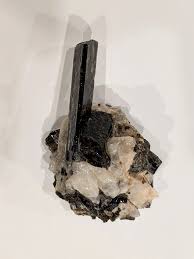
The Donald Wininger Collection
Some minerals immediately capture attention with dazzling color or dramatic crystal forms. Others quietly earn admiration through rarity, fascinating geology, and the remarkable stories they tell about Earth’s ancient past. Fluoro-richterite belongs firmly in the latter category. While relatively unknown outside serious mineral collecting circles, this uncommon amphibole represents one of the finest examples of the unique mineralogy found in Ontario’s famous Bancroft region.
For collectors, specimens from Bancroft are far more than attractive cabinet pieces. They represent one of North America’s most significant mineral localities—a region where billion-year-old metamorphic rocks, alkaline intrusions, and carbonate-rich veins combined to create an extraordinary diversity of mineral species. Fluoro-richterite is among the minerals that make Bancroft so special, occurring as striking black to dark green crystals often embedded within massive calcite alongside other classic Canadian minerals.
Today, many of the classic collecting localities that once produced exceptional specimens are no longer accessible. Road construction, private ownership, environmental protection, and decades of collecting have transformed many famous sites. As a result, vintage specimens acquired during the 1950s and 1960s have become increasingly desirable, preserving a chapter of mineral collecting history that can never be recreated.
The specimen featured in this article is part of the Donald Wininger Collection, an extraordinary three-generation family collection built by Donald Wininger, his father, and his grandfather.
Spanning much of the twentieth century, the collection reflects decades of careful collecting, trading, and appreciation for minerals from many of North America’s classic localities. Numerous specimens were acquired during the 1950s and 1960s, when collecting opportunities at legendary sites such as Bancroft differed dramatically from those available today.
Many pieces retain the character of an earlier era of mineral collecting, representing localities that have since changed significantly or disappeared altogether. Grounded Lifestyles is honored to preserve this remarkable collection and share both its specimens and the stories behind them with a new generation of collectors.
Every mineral in this series represents more than a beautiful crystal—it is part of a family legacy spanning three generations and decades of exploration, curiosity, and appreciation for the natural world.
Fluoro-richterite is a relatively uncommon member of the amphibole supergroup, a complex family of double-chain silicate minerals that includes more familiar species such as hornblende, tremolite, actinolite, and riebeckite.
Its ideal chemical formula is:
Na(NaCa)Mg₅Si₈O₂₂F₂
The defining characteristic of fluoro-richterite is the dominance of fluorine within its crystal structure. This distinguishes it from the closely related mineral richterite, in which hydroxyl groups occupy the same structural position. Although the chemical difference appears minor, it reflects very different geological conditions during mineral formation and influences the stability of the mineral in fluorine-rich environments.
Fluoro-richterite commonly forms elongated prismatic crystals with excellent crystal faces and strong longitudinal striations. Most Bancroft specimens display lustrous black crystals, although dark green, brownish-green, and nearly opaque varieties also occur.
Unlike colorful collector favorites such as fluorite or tourmaline, fluoro-richterite attracts collectors because of its rarity, association with classic Canadian localities, and impressive crystal habit.
| Property | Description |
|---|---|
| Mineral Group | Amphibole |
| Chemical Formula | Na(NaCa)Mg₅Si₈O₂₂F₂ |
| Crystal System | Monoclinic |
| Crystal Habit | Long prismatic, columnar, fibrous |
| Color | Black, dark green, brownish green |
| Streak | White to grayish white |
| Luster | Vitreous |
| Transparency | Transparent to opaque |
| Hardness | 5–6 on Mohs scale |
| Cleavage | Two perfect amphibole cleavages at approximately 56° and 124° |
| Specific Gravity | Approximately 3.1 |
| Fracture | Uneven to splintery |
These physical characteristics immediately place fluoro-richterite within the amphibole family. Experienced collectors often recognize amphiboles by their characteristic cleavage angles, which differ distinctly from those of pyroxenes.
Amphiboles are among the most structurally complex minerals in nature. Rather than forming isolated silicate tetrahedra or simple chains, amphiboles develop double chains of silica tetrahedra that extend throughout the crystal.
This structure creates elongated crystals that commonly develop as needles, blades, or long prisms. It also explains why amphiboles exhibit two excellent cleavage directions intersecting at approximately 56° and 124°, one of the quickest ways mineralogists distinguish them from pyroxenes, whose cleavages intersect at nearly 90 degrees.
The amphibole group contains dozens of recognized mineral species, each differing slightly in chemical composition depending upon the availability of sodium, calcium, magnesium, iron, aluminum, fluorine, and hydroxyl during crystallization.
Fluoro-richterite occupies a relatively specialized position within this family because it requires an unusual combination of magnesium-rich chemistry together with abundant fluorine—conditions that are uncommon in most geological environments.
Located approximately three hours northeast of Toronto, Bancroft sits within one of Canada’s richest mineral collecting districts.
For decades the town has proudly carried the nickname:
“The Mineral Capital of Canada.”
Few regions in North America have produced such an extraordinary diversity of collectible minerals. More than 300 mineral species have been identified from the Bancroft district, including spectacular crystals of:
The district became internationally known not only because of its abundance of minerals but because many could be collected directly from roadcuts, abandoned quarries, open pits, and active mines during the middle decades of the twentieth century.
Collectors from across Canada and the United States made annual pilgrimages to Bancroft, returning home with exceptional specimens that now occupy museum collections around the world.
The story of fluoro-richterite starts long before the first crystal formed.
It begins more than one billion years ago during the formation of what geologists call the Grenville Province, one of Earth’s oldest and most complex geological regions.
The Grenville Province stretches across eastern Ontario, western Quebec, parts of New York State, and beyond. These rocks record a series of massive continental collisions that ultimately helped assemble an ancient supercontinent long before the Atlantic Ocean existed.
Immense pressures and temperatures transformed existing sedimentary, igneous, and volcanic rocks into high-grade metamorphic rocks including:
These metamorphic events reached temperatures exceeding several hundred degrees Celsius and pressures equivalent to burial tens of kilometers beneath Earth’s surface.
Instead of melting completely, many rocks underwent profound mineralogical changes as new minerals grew in response to changing temperature, pressure, and chemical composition.
The result is one of the most mineralogically diverse geological provinces on the planet.
The Grenville Province alone would have produced an impressive suite of metamorphic minerals, but Bancroft experienced an additional geological event that made it truly exceptional.
Deep beneath the surface, unusual alkaline magmas and carbonate-rich fluids migrated upward through fractures in the ancient rocks. These chemically enriched fluids introduced elements such as:
When these hot fluids encountered favorable host rocks, they crystallized an extraordinary variety of uncommon minerals rarely found together elsewhere.
Among those minerals was fluoro-richterite.
Rather than forming through ordinary cooling of magma, fluoro-richterite developed within these chemically unusual environments where fluorine-rich hydrothermal fluids reacted with magnesium-rich carbonate rocks and calc-silicate assemblages. The availability of fluorine—an element that is relatively scarce in most geological settings—allowed fluoro-richterite to form instead of its hydroxyl-bearing relative, richterite.
This unique combination of ancient metamorphism followed by alkaline metasomatism explains why Bancroft continues to fascinate geologists and collectors alike.
While fluoro-richterite has been identified from several locations around the world, few have achieved the reputation of the Bancroft district in Ontario. Within this famous collecting region, two occurrences stand above all others for producing the large, well-formed crystals that have become icons among amphibole collectors.
Perhaps the best-known locality for collector-quality fluoro-richterite is the Essonville Roadcut, located near the village of Wilberforce in Haliburton County, just northeast of Bancroft.
Unlike a traditional underground mine, this occurrence was exposed during road construction, revealing a coarse crystalline limestone lens enclosed within ancient Grenville gneiss. These roadcuts unexpectedly opened a window into one of the district’s most unusual mineral assemblages.
The locality became famous for producing:
Collectors quickly realized they had discovered one of North America’s finest amphibole localities. The striking contrast between glossy black crystals and brilliant white calcite created cabinet specimens unlike anything else from the region.
Many of the finest examples entered private collections during the 1960s and 1970s, when collecting at the roadcut was still relatively unrestricted.
Less than a kilometer from the Essonville Roadcut lies another legendary occurrence known simply as Earle’s Farm.
Although physically close to the roadcut, the geological setting differs enough to produce its own distinctive style of specimen.
Here, a carbonatite vein-dike cuts through Grenville gneiss, creating ideal chemical conditions for fluoro-richterite crystallization. Instead of white calcite, many specimens occur within beautiful coarse salmon-pink calcite, creating an even more dramatic contrast with the dark amphibole crystals.
The Geological Survey of Canada described specimens containing:
Under ultraviolet light the calcite itself fluoresces a vivid pink, making specimens from this occurrence especially desirable among collectors interested in fluorescent minerals.
One reason collectors prize vintage specimens from Earle’s Farm is that the original exposure has disappeared.
Prior to 1986, road improvements removed the carbonatite exposure entirely, ending any opportunity to collect additional material directly from the original occurrence. Today, nearly every specimen bearing an original Earle’s Farm label originates from material recovered before the locality vanished beneath modern road construction.
This is one of the reasons provenance matters so much.
When collectors purchase an older specimen from a documented collection, they are preserving a tangible piece of geological history that cannot simply be replaced with newly collected material.
Collectors often ask why older specimens command greater respect than newly collected material.
The answer lies in three factors.
Many famous collecting sites throughout the Bancroft district have been:
Consequently, many minerals that were once considered relatively obtainable are now encountered primarily through older collections.
During the 1950s and 1960s, enthusiastic collectors often visited local roadcuts, quarries, feldspar mines, mica mines, and abandoned workings with relatively few restrictions.
Many of the finest cabinet specimens entered collections during this period because fresh exposures were continually being created by active mining and highway construction.
Today’s collectors often search through weathered dumps or small remaining exposures, making comparable finds considerably less common.
Mineral collecting increasingly values provenance.
Knowing that a specimen originated from a respected historic collection adds another dimension beyond aesthetics.
In the same way art collectors value an object’s ownership history, mineral collectors appreciate documented provenance because it helps preserve the history of both the specimen and the people who collected it.
That is precisely what makes the Donald Wininger Collection so meaningful.
The fluoro-richterite featured by Grounded Lifestyles is part of the Donald Wininger Collection, a remarkable three-generation family collection assembled by Donald Wininger, his father, and his grandfather.
Rather than representing a single purchase or brief collecting period, the collection reflects decades of curiosity, travel, trading, and appreciation for Earth’s natural treasures.
Many specimens were acquired during the golden age of North American mineral collecting throughout the 1950s and 1960s—years when localities such as Bancroft offered collecting opportunities that no longer exist.
For today’s collectors, specimens from the Donald Wininger Collection are more than beautiful minerals. They are historical artifacts connecting three generations of collectors with the classic localities that shaped modern mineral collecting.
One of the pleasures of collecting Bancroft minerals is that no specimen exists in isolation.
Fluoro-richterite commonly formed alongside several equally interesting minerals.
Perhaps the most recognizable companion mineral.
Large masses of coarse white or salmon-pink calcite often serve as the matrix supporting the black amphibole crystals.
Some calcite from the district fluoresces brilliant pink under ultraviolet light, creating spectacular display specimens.
The golden to bronze mica known as phlogopite frequently accompanies fluoro-richterite.
Its shimmering platy crystals provide beautiful contrast against the darker amphibole.
Phlogopite itself was once mined commercially throughout Ontario as an important source of sheet mica.
Magnesium-rich pyroxenes occur in several Bancroft carbonatite and calc-silicate assemblages.
Their presence reflects the high-temperature metamorphic environment that produced these unusual rocks.
Some crystals display attractive reddish-brown coatings produced by goethite.
These coatings formed long after the amphibole crystallized as groundwater slowly oxidized iron-bearing minerals near the Earth’s surface.
Rather than detracting from the specimen, these natural coatings often document the specimen’s geological journey through time.
Unlike minerals that crystallize directly from cooling magma, Bancroft fluoro-richterite formed through a complex interaction between hot fluids and existing metamorphic rocks.
Geologists believe the process involved several stages.
First, the Grenville rocks underwent intense regional metamorphism during ancient mountain-building events.
Later, fluorine-rich alkaline fluids migrated upward through fractures.
These fluids reacted chemically with magnesium-rich carbonate rocks, introducing sodium and fluorine while reorganizing existing minerals into new crystal assemblages.
Because crystal growth occurred slowly over extended periods under relatively stable conditions, some fluoro-richterite crystals reached impressive sizes.
In geology, time is often the most important ingredient.
Given enough time—and the right chemistry—Earth can produce crystals measured not merely in millimeters but in inches.
Beginning collectors occasionally mistake fluoro-richterite for several other dark minerals.
Fortunately, careful observation usually separates them.
Fluoro-richterite typically displays:
Unlike black tourmaline, amphiboles possess characteristic cleavage planes.
Unlike hornblende, Bancroft fluoro-richterite often develops remarkably clean, sharply terminated crystals.
Unlike pyroxenes, amphibole cleavage angles intersect at approximately 56° and 124°, producing a distinctly different crystal geometry.
Fluoro-richterite occupies a unique niche within mineral collecting.
It appeals to collectors who appreciate:
Although it may never become as widely recognized as fluorite or amethyst, experienced collectors understand that rarity often outweighs popularity.
For many mineral enthusiasts, owning a fine Bancroft fluoro-richterite specimen represents acquiring an important piece of Canadian mineralogical history.
Every mineral collector eventually reaches a point where the appeal of a specimen extends beyond its appearance. Color and crystal size remain important, but history, rarity, locality, and provenance begin to carry equal weight. Fluoro-richterite from Bancroft, Ontario, is one of those minerals that embodies all of these qualities.
Unlike minerals that are widely available through commercial mining operations, fine fluoro-richterite specimens have always been relatively uncommon. Even during the height of collecting activity in the Bancroft district, exceptional specimens required patience, persistence, and a bit of luck. Today, decades after many of the classic localities have closed or disappeared, they have become even more desirable.
For many collectors, Bancroft represents a golden era of North American mineral collecting. The district produced some of the finest apatite, titanite, zircon, fluorapatite, and amphibole specimens ever discovered in Canada. A well-documented fluoro-richterite specimen from this region is more than a beautiful crystal—it’s a tangible connection to one of the continent’s most celebrated collecting districts.
Experienced collectors typically evaluate fluoro-richterite using a combination of geological significance and aesthetics.
Well-developed crystals should display sharp faces, distinct longitudinal striations, and, when fortunate, complete terminations. Although crystal size attracts attention, symmetry and condition often matter even more.
One of the defining characteristics of classic Bancroft material is its dramatic contrast between glossy black fluoro-richterite crystals and coarse white or salmon-pink calcite. Collectors generally prefer specimens that remain attached to their natural matrix because they preserve the geological story of the locality.
Because amphiboles possess perfect cleavage, damaged crystals are common. Chips along prism faces or broken terminations can reduce collector value. Specimens with minimal damage are increasingly difficult to find.
Perhaps no factor has become more important in recent years than provenance.
A specimen accompanied by an original handwritten label, an old dealer card, or documentation from an established collection often carries greater historical significance than an otherwise similar specimen with no collecting history.
The fluoro-richterite featured in this article comes from the Donald Wininger Collection, a remarkable three-generation family collection assembled by Donald Wininger, his father, and his grandfather.
This collection was not created in a single decade or through a single purchase. Instead, it represents a lifetime of curiosity, travel, trading, and careful collecting spanning much of the twentieth century. Many specimens were acquired during the 1940s through 1980s, when classic localities throughout North America were far more accessible than they are today.
As each specimen is cataloged and shared, Grounded Lifestyles is committed to preserving not only the mineral itself but also its story. In many cases, these specimens have remained together for decades. Now they begin a new chapter, carrying their geological and collecting history into the hands of a new generation.
For collectors, that history is part of the specimen’s value.
While the scientific significance of fluoro-richterite lies in its unique chemistry and geological origin, many people also appreciate minerals through the lens of spiritual and metaphysical traditions.
The following associations are traditional beliefs and personal practices. They are not supported by scientific evidence.
Within crystal healing communities, fluoro-richterite is often associated with:
Grounding – Because it formed deep within ancient metamorphic rocks, practitioners believe it encourages stability and a stronger connection to the Earth.
Mental Focus – Its orderly crystal structure has led some to associate it with clarity, concentration, and thoughtful decision-making.
Personal Growth – Some believe it supports steady progress through periods of change while encouraging patience and resilience.
Whether viewed through science or personal belief, many collectors simply appreciate the quiet reminder that these crystals formed more than one billion years ago, surviving mountain building, erosion, and countless geological changes before reaching our hands.
No. They are closely related members of the amphibole group, but they differ in their chemistry. Fluoro-richterite contains fluorine as the dominant anion, while richterite contains hydroxyl (OH). Although this difference is subtle, it reflects different chemical conditions during mineral formation.
The Bancroft district is internationally recognized for producing exceptionally large, well-formed fluoro-richterite crystals in attractive calcite matrix. Many classic collecting localities have since closed, making older specimens increasingly difficult to obtain.
Yes. The mineral itself is uncommon, and well-crystallized collector specimens are considerably rarer. Fine examples from Bancroft are especially sought after because of their crystal quality and historic locality.
While the Bancroft district still offers collecting opportunities, many of the famous localities that produced museum-quality fluoro-richterite specimens are no longer accessible. Road construction, private ownership, and decades of collecting have limited access to many classic sites.
Depending on the locality, associated minerals may include:
These mineral associations provide important clues about the chemical environment in which the crystals formed.
Authentic specimens typically display long prismatic crystals with characteristic amphibole cleavage and longitudinal striations. Provenance, original labels, and purchasing from reputable dealers also provide confidence in authenticity.
Look for:
For many collectors, documented history is just as valuable as crystal size.
Provenance records where a specimen originated and who previously owned it. Historic collections often preserve original locality information that may otherwise be lost. As classic localities disappear, well-documented specimens become increasingly important to collectors and museums.
Generally no. Although it has moderate hardness, its cleavage makes it vulnerable to damage. Most collector-quality material is preserved as natural mineral specimens rather than cut into gemstones.
Minerals should first be collected because they inspire curiosity and appreciation for the natural world. That said, documented specimens from classic localities and historic collections have generally remained desirable because they cannot be replaced once the original localities are exhausted or inaccessible.
If you enjoyed learning about fluoro-richterite, you may also enjoy these articles already available on Grounded Lifestyles:
As the Treasures from the Donald Wininger Collection series grows, you’ll also be able to explore additional articles featuring minerals from this extraordinary three-generation collection.
This Bancroft fluoro-richterite is part of the Donald Wininger Collection, a three-generation mineral collection spanning specimens acquired from the 1940s through the 2000s. The collection includes minerals from historic localities across the United States, Canada, Mexico and beyond, with many specimens dating from the height of American mineral collecting in the 1950s and 1960s.
Explore available specimens from the Donald Wininger Collection and discover historic minerals, classic localities and pieces that preserve decades of collecting history.
At Grounded Lifestyles, our love for crystals began in the peaceful flow of Reiki and energy healing sessions — where we saw how natural stones could amplify intentions, restore balance, and bring comfort. But the more time we spent with these treasures, the more curious we became about their origins. That curiosity led us into the fascinating world of geology and mineral specimen collecting. We fell in love not just with the energy of crystals, but with the science and artistry of their creation — the intricate crystal structures, the vibrant mineral hues, and the wonder of holding a piece of Earth’s history in our hands.