
Every crystal, mineral, fossil, meteorite, and handcrafted piece is selected with purpose. Whether you’re building a museum-worthy mineral collection, searching for a meaningful gift, decorating your home with natural beauty, or beginning your journey into the world of geology, you’ll discover authentic specimens with stories worth sharing.
Over 15 shows a year throughout the Southwest. Check to see if we are coming to a show near you!
Home > Blog > Minerals Blog | Crystal Guides, Geology & Metaphysical Meaning > Donald Wininger Collection > Native Copper from Michigan: The Metal That Built the Keweenaw
The Donald Wininger Collection
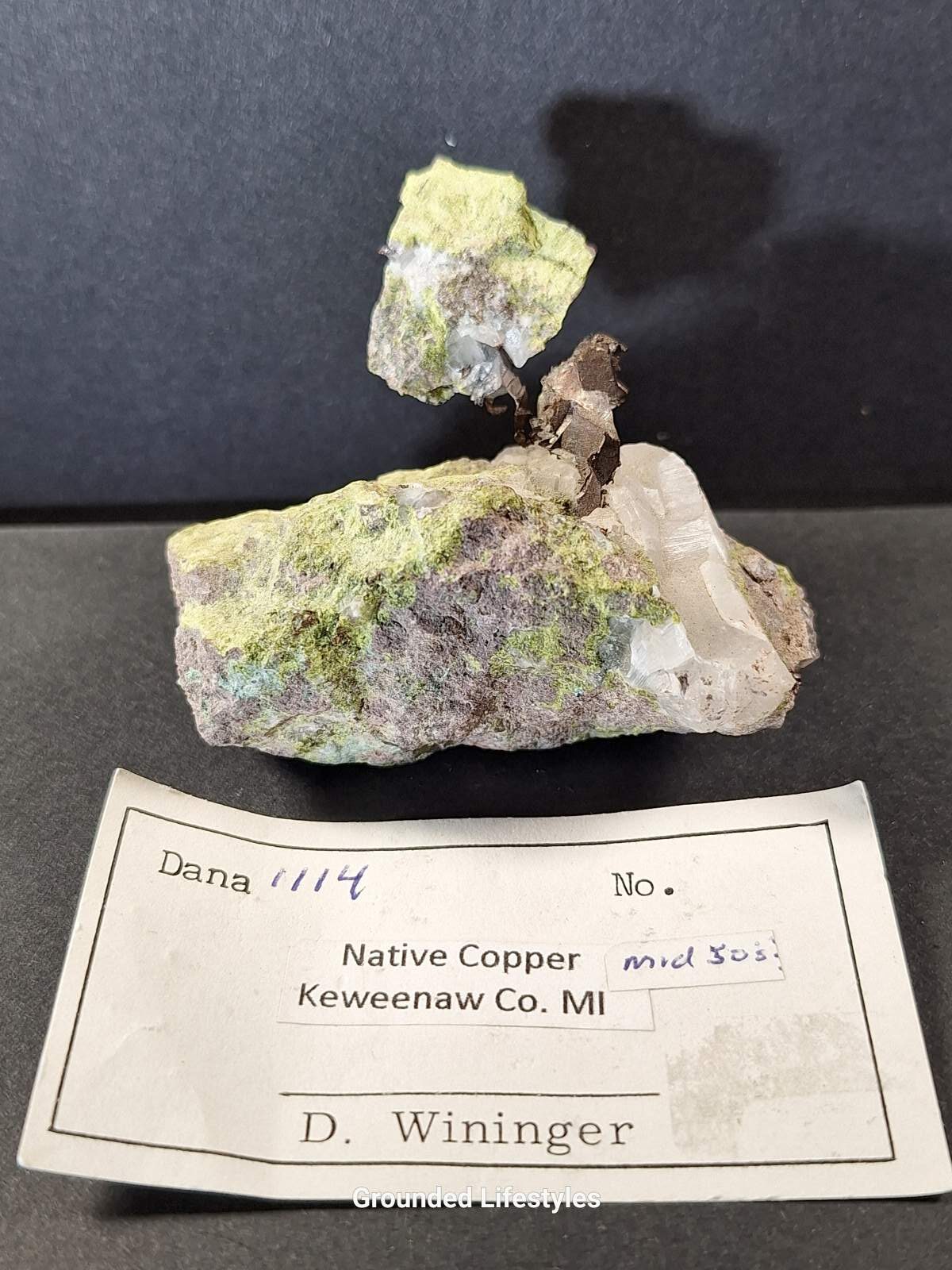
There are mineral specimens that need an explanation before you appreciate them, and then there is Michigan native copper. Pick up a good piece and much of the appeal is immediate. It is surprisingly heavy, unmistakably metallic and often shaped in ways that hardly look geological. Copper can twist into branches, spread through rock in thin sheets, form wires and jagged masses, or develop actual crystals. On an older specimen, the familiar copper-red metal may be partly hidden beneath decades of brown, black or green patina.
The Michigan native copper specimens in the Donald Wininger Collection are especially appropriate for a collection assembled over generations. Much of the collection dates from a period when specimens from the great American mining districts still circulated regularly among mineral clubs, dealers and collectors. Some Michigan pieces were acquired while the Copper Country mines were still operating or within living memory of their production. A specimen from that era carries something newer material cannot recreate: a connection to the period when Michigan copper was still part of an active mining culture rather than simply a chapter in mineral history.
Michigan copper deserves that historical perspective because its story is extraordinary. The metal formed more than a billion years ago during an event that nearly split North America apart. It was discovered and worked by Indigenous peoples thousands of years before industrial mining. In the nineteenth century it triggered a mining rush that began before the California Gold Rush, built communities across the Keweenaw Peninsula and briefly made Michigan the dominant copper producer in the United States.
Most remarkable of all is the copper itself. In many of the world’s great copper districts, miners extract minerals containing copper and then separate the metal through processing. In Michigan’s Keweenaw Peninsula, enormous quantities occurred naturally as metallic copper. This is native copper, elemental Cu, and the scale on which it developed around Lake Superior made the district one of the great geological exceptions of the mineral world.
To understand why all of this copper is in Michigan, we have to go back about 1.1 billion years, to a time when there was no Lake Superior and North America looked nothing like the continent we know today.
The crust began pulling apart through the center of the continent. Magma rose through fractures and tremendous amounts of basaltic lava reached the surface. Geologists now call this event the Midcontinent Rift. The rift extends in a great arc through the Lake Superior region and continues beneath younger rocks farther south.
Had the process continued, North America might have separated and a new ocean could eventually have formed between the two pieces. Instead, the rifting stopped. The continent remained intact, but the volcanic rocks created during the event remained behind.
Around what is now the Keweenaw Peninsula, lava erupted again and again. One flow cooled and another covered it. The volcanic sequence eventually became several miles thick. Much of the classic Michigan copper mineralization occurs within these ancient basaltic rocks of the Portage Lake Volcanics.
The lava itself did not simply contain giant blobs of molten copper. That popular explanation misses the more interesting part of the story. The major copper mineralization occurred later, after the volcanic rocks were already in place.
Water heated deep underground began circulating through the enormous volcanic sequence. As these hydrothermal fluids interacted with the rocks, they picked up dissolved elements and transported them through fractures, porous zones and cavities. When temperature, pressure and chemistry changed, copper came out of solution.
Under the unusual chemical conditions present in the Keweenaw, much of that copper was deposited as metal rather than becoming locked inside sulfur-rich minerals such as chalcopyrite.
USGS-supported dating places this major native-copper mineralizing event at roughly 1.06 to 1.047 billion years ago. That makes the copper itself astonishingly old, but it also gives us a more accurate story than simply saying it formed when the lava erupted. The basalt created the landscape and the spaces. Hydrothermal fluids later brought much of the copper.
One of the most interesting things about Michigan copper is the variety of forms it can take. That variety makes much more sense once you understand the rock in which it grew.
As basaltic lava cools, gas bubbles can become trapped inside it. When the gas escapes or disappears, small cavities remain. Later, mineral-bearing fluids enter those openings and begin depositing minerals. Once filled, these former gas cavities are called amygdules, and volcanic rock containing many of them is described as amygdaloidal.
Copper entered these openings along with minerals such as calcite, prehnite, epidote and quartz. In some cavities it occupied only a small portion of the available space. In others it filled much of the opening. Copper also followed fractures through the surrounding rock, sometimes producing thin sheets or irregular branching structures.
This is why a good Michigan copper specimen can look more like a small metallic sculpture than a conventional crystal.
Copper belongs to the isometric crystal system and can produce recognizable cubes, octahedra and more complicated crystal combinations. Sharp individual crystals are highly desirable, but much of the Keweenaw material had enough room and enough copper available that crystals grew together into larger aggregates. The original crystal shapes may still be visible in places, while other portions become twisted, branching or massive.
Collectors use words such as arborescent and dendritic to describe some of these growths because they resemble trees and branches. Other specimens develop thin wires. Some spread as plates or sheets. Still others retain pieces of the original basalt between masses of copper.
There is no single shape that defines Michigan native copper, and that is part of its appeal. Two specimens from the same district can look as though they contain completely different minerals.
Some of the richest Keweenaw deposits did not occur inside lava cavities at all.
Between periods of volcanic activity, erosion wore down older volcanic rocks and deposited layers of rounded rock fragments. These eventually became conglomerates, sedimentary rocks made of pebbles and fragments cemented together.
The open spaces between those fragments provided excellent pathways for hydrothermal fluids. Copper-bearing solutions moved through the porous beds and deposited native copper between and around the pieces of rock.
These conglomerate lodes became enormously important during Michigan’s mining era. The most famous was the Calumet Conglomerate, which helped turn Calumet & Hecla into one of the most successful copper-mining operations in American history.
For collectors, the distinction between amygdaloidal copper and conglomerate copper is more than geological trivia. It explains why specimens from different mines and lodes can have such different appearances. A piece of copper filling a volcanic cavity developed in a different physical environment from copper occupying the spaces between fragments in a conglomerate bed.
This is also why an old mine label is so valuable. “Michigan native copper” tells us what the specimen is and gives us a broad locality. A label identifying a particular Keweenaw mine can tell us much more about the geological environment from which that specimen came.
Michigan native copper did not always occur as delicate crystals and attractive cabinet specimens. Sometimes miners encountered pieces so large that they became engineering problems.
Masses of native copper weighing many tons were discovered underground. They could not simply be blasted into convenient fragments like brittle rock because copper is tough and malleable. It bends and deforms rather than breaking easily.
Miners sometimes had to expose these enormous masses and physically cut them into sections before they could be hauled to the surface.
Stories of giant copper masses helped make the Keweenaw famous, but they also illustrate just how unusual this deposit was. We are not talking about a few microscopic grains of native copper scattered through rock. The geological system concentrated elemental metal on a scale large enough to support generations of industrial mining.
The smaller specimens preserved in collections are the attractive survivors of that same system.
Most copper removed from the Keweenaw was never destined for a mineral cabinet. It was ore. It was crushed, separated, smelted and sold as metal. Pieces showing unusual crystals, branching forms or attractive associations had to be recognized and saved before they disappeared into the industrial process.
That makes an old specimen particularly interesting. Someone looked at it and decided that its natural form was worth preserving.
One of the classic prizes of Lake Superior mineral collecting is native copper associated with native silver.
Silver occurs in the Keweenaw copper deposits and can appear intimately associated with the copper while remaining a separate native metal. On a good specimen, the contrast can be striking: warm reddish copper beside bright silver-white metal.
These specimens became classics of American mineralogy and remain desirable today, particularly when the silver is obvious and the locality is well documented.
Their geological relationship is interesting as well. Copper and silver can occur so closely together that a casual glance might suggest they blended into one metal, yet they can remain visibly distinct. Specimens showing that relationship provide a small demonstration of the changing chemical conditions within the hydrothermal system.
As with all valuable native-metal specimens, old provenance becomes especially important. Copper-silver material has been sold from several world localities, and a historic label connecting a specimen specifically to the Keweenaw gives it far more collector significance.
The human relationship with Lake Superior copper did not begin with nineteenth-century miners.
It began thousands of years earlier.
Indigenous peoples discovered that the Lake Superior region contained something extraordinary: naturally occurring metal that could be collected and worked without first developing the complex smelting technology required for many copper ores.
Native copper is malleable. It can be hammered, shaped and worked while retaining the useful properties of the metal. Archaeological evidence shows that people were mining and working copper in the Lake Superior region at least 8,000 years ago.
Ancient miners worked surface deposits and shallow pits, using stone tools to separate copper from the surrounding rock. The metal became tools, projectile points, fishhooks, beads, bracelets and other useful or decorative objects.
Lake Superior copper did not remain in Michigan. Copper artifacts associated with the region have been discovered far from the source, evidence that the material moved through extensive exchange networks.
This history is important because the phrase “Michigan copper mining began in the 1840s” tells only the industrial part of the story. People had already understood the value of Keweenaw copper for thousands of years.
The nineteenth-century mining companies did not discover copper in a place where nobody knew it existed. They entered a landscape where Indigenous knowledge of copper was ancient.
By the early nineteenth century, reports of enormous quantities of copper around Lake Superior were attracting increasing attention.
Michigan’s first state geologist, Douglass Houghton, documented the region’s copper deposits in an 1840 report. Houghton actually cautioned against reckless speculation, but caution had little chance against stories of native copper masses waiting in the wilderness.
The federal government opened the region to mineral leasing, and prospectors, investors and mining companies moved into the Keweenaw during the 1840s.
Many early ventures failed.
The country was remote, transportation was difficult and winter was severe. Finding copper did not automatically mean a mine could produce it profitably.
Then the Cliff Mine changed expectations.
Located near Eagle River, the Cliff became the first major profitable copper mine in the district. Its success demonstrated that Keweenaw copper could support serious commercial mining.
This happened before California became synonymous with mineral rushes.
By the time gold was discovered at Sutter’s Mill in 1848, Michigan’s copper rush was already underway.
Once profitable lodes were identified, the scale of mining changed quickly.
Companies including Quincy Mining Company and Calumet & Hecla became major industrial operations. Shafts went deeper. Hoisting equipment became larger. Stamp mills processed immense quantities of rock. Rail lines moved ore and supplies. Smelters converted concentrates into marketable copper.
Communities grew around the mines.
Workers arrived from Cornwall, Finland, Ireland, Italy, Slovenia, Croatia and many other parts of the world. The Keweenaw became a place where geology shaped almost every part of daily life. The location of a copper lode could determine where a town grew, where a railroad was built and where generations of families would live and work.
For a period, Michigan dominated American copper production. In 1849, the Keweenaw region supplied approximately 96 percent of the copper produced in the United States. From 1845 until 1887, it remained the country’s leading copper-producing region.
That history gives Michigan native copper a cultural weight that most mineral specimens do not carry.
A piece from Quincy is not simply native copper from Michigan. It connects to one of the most famous mining companies in the district.
A Calumet specimen connects to another history.
A specimen from an old mine dump may have been broken from rock hauled out of a shaft generations ago.
Locality changes the story.
Michigan had extraordinary copper, but extraordinary geology does not guarantee that mining remains profitable forever.
As the mines followed the lodes underground, shafts became deeper and operations more expensive. Water had to be pumped. Rock had to be raised increasingly long distances. Labor, transportation and processing costs continued.
Meanwhile, huge copper deposits were being developed elsewhere in the United States. Montana and Arizona became major competitors, and large-scale mining methods increasingly favored enormous lower-grade deposits that could be processed efficiently.
The Keweenaw gradually lost its position as the center of American copper production.
Some mines closed early. Others continued for generations.
Quincy ended its regular mining operations in the twentieth century, while Calumet & Hecla survived until 1968. By the time the great native-copper mining era ended, the Keweenaw had produced billions of pounds of copper.
The mines became quiet.
For collectors, that changed everything.
This is where specimens from collections such as the Donald Wininger Collection become particularly interesting.
Donald and the generations represented in the collection acquired minerals during a period when material from historic American mines was much closer to its original source. Copper from Michigan was circulating through mineral clubs, dealers, field collectors and exchanges while some mining operations were still active and old mine dumps were much more accessible.
A Michigan copper collected in the 1950s is not automatically rare simply because it is old. There are plenty of ordinary old specimens.
But a good specimen with old provenance belongs to a different collecting era.
That is why the original label should always stay with it.
Old labels are sometimes unimpressive. They may be typed on yellowing paper, handwritten on an index card or contain an outdated mine name. Resist the urge to replace them and throw the originals away.
The label may preserve the only remaining connection between the specimen and the place it came from.
Once that information is lost, no amount of testing can necessarily bring it back.
New collectors often assume that the brightest copper specimen must be the best one.
Experienced collectors usually look at form first.
A sharp copper crystal can be exceptional because good crystal development is far less common than irregular native copper. Branching specimens are desirable when the copper forms an attractive, balanced structure rather than an indistinct mass. Wires and sheets have their own following.
Matrix can make a specimen better.
Copper emerging naturally from basalt immediately provides context. Copper associated with calcite or other contrasting minerals can become much more visually interesting than a completely isolated piece.
Then there is patina.
Fresh native copper has the familiar bright copper-red metallic appearance, but copper changes at the surface as it ages. Old specimens can become brown, dark brown or nearly black. Green alteration may appear in protected areas.
That does not mean the specimen needs cleaning.
In fact, cleaning can be one of the fastest ways to diminish a good old copper.
Polishing removes the natural surface. Aggressive chemical cleaning can attack associated minerals, alter patina and soften the visual detail of fine crystal forms. A specimen that has survived in a collection for seventy years does not need to look like a new penny.
Sometimes the old surface is part of what makes it beautiful.
A dark patina can emphasize the edges of crystals and branching structures. Small areas of exposed copper-red metal provide contrast. More importantly, the surface is part of the specimen’s history.
With older collection pieces, doing less is usually safer than doing too much.
Michigan native copper presents an interesting collector contradiction.
The Keweenaw produced enormous quantities of copper. Native copper specimens are still available, and owning a genuine example does not require finding one of the rarest minerals on Earth.
Yet exceptional specimens can be genuinely scarce.
There is a tremendous difference between a chunk of copper-bearing rock and a beautifully crystallized native copper specimen.
Sharp crystals are harder to find.
Aesthetic branching forms are harder to find.
Fine wires are specialized.
Copper with visible native silver adds another level of interest.
An attractive specimen from a documented historic mine is more desirable than one labeled only Michigan.
Add an old collection label and reliable mid-century provenance and the specimen becomes both mineralogical and historical.
This is why prices for Michigan copper vary so dramatically. Weight alone tells you very little.
A small, elegant crystallized specimen from a classic mine may be considerably more collectible than a heavy irregular mass.
Buy the specimen, not the pounds.
One of the most persistent misconceptions is that Michigan’s native copper was simply molten metal trapped inside volcanic lava. The volcanic rocks are absolutely central to the story, but the major native-copper mineralization occurred later. Hydrothermal fluids moved through the ancient volcanic sequence and deposited copper in fractures, cavities, porous flow tops and conglomerates.
It is true, however, that the native copper itself is more than a billion years old. Modern dating places the major mineralizing event roughly between 1.06 and 1.047 billion years ago.
It is also true that native copper is a mineral. Because it occurs naturally as the element copper, its chemical formula is simply Cu.
Another myth is that Michigan copper occurs mainly as large solid masses. Those spectacular masses certainly existed, but collector specimens can take the form of crystals, wires, sheets, branching aggregates, cavity fillings and copper naturally associated with other minerals.
The idea that industrial miners were the first people to discover Michigan copper is also false. Indigenous mining and metalworking in the Lake Superior region extends back thousands of years and represents one of the oldest chapters in North American metal use.
Finally, bright does not mean better. An old copper specimen does not become more authentic or valuable because someone polishes it until it shines. Natural crystal form, aesthetics, locality, associated minerals and provenance are generally far more important to a mineral collector than whether the surface resembles a new penny.
Native copper from Michigan is only one part of the much larger story preserved in the Donald Wininger Collection. Built across three generations of collecting, the collection includes minerals from classic American and Canadian localities, many dating to the mid-twentieth century and earlier. Each specimen adds another piece to the history of the mines, collecting regions and mineral discoveries that shaped generations of collectors.
Continue through the Donald Wininger Collection Articles to explore more of the localities, geology and collector stories represented in the archive. You can also browse the Donald Wininger Collection to see specimens currently available from the estate.
For collectors drawn specifically to Michigan material and metallic minerals, visit our Copper Specimens Collection to explore available native copper and related pieces from classic collecting localities.

At Grounded Lifestyles, our love for crystals began in the peaceful flow of Reiki and energy healing sessions — where we saw how natural stones could amplify intentions, restore balance, and bring comfort. But the more time we spent with these treasures, the more curious we became about their origins. That curiosity led us into the fascinating world of geology and mineral specimen collecting. We fell in love not just with the energy of crystals, but with the science and artistry of their creation — the intricate crystal structures, the vibrant mineral hues, and the wonder of holding a piece of Earth’s history in our hands.