
Every crystal, mineral, fossil, meteorite, and handcrafted piece is selected with purpose. Whether you’re building a museum-worthy mineral collection, searching for a meaningful gift, decorating your home with natural beauty, or beginning your journey into the world of geology, you’ll discover authentic specimens with stories worth sharing.
Over 15 shows a year throughout the Southwest. Check to see if we are coming to a show near you!
There is something different about buying an agate compared with buying most mineral specimens. With a quartz crystal, fluorite cube or tourmaline, much of what you are buying is already visible. Agate keeps its best feature hidden. A rough Moroccan agate nodule can be surprisingly plain on the outside, giving only a few clues about what developed within it. It may have a weathered brown or gray surface, perhaps with a small patch of exposed chalcedony, but the real specimen remains concealed until the stone is cut.
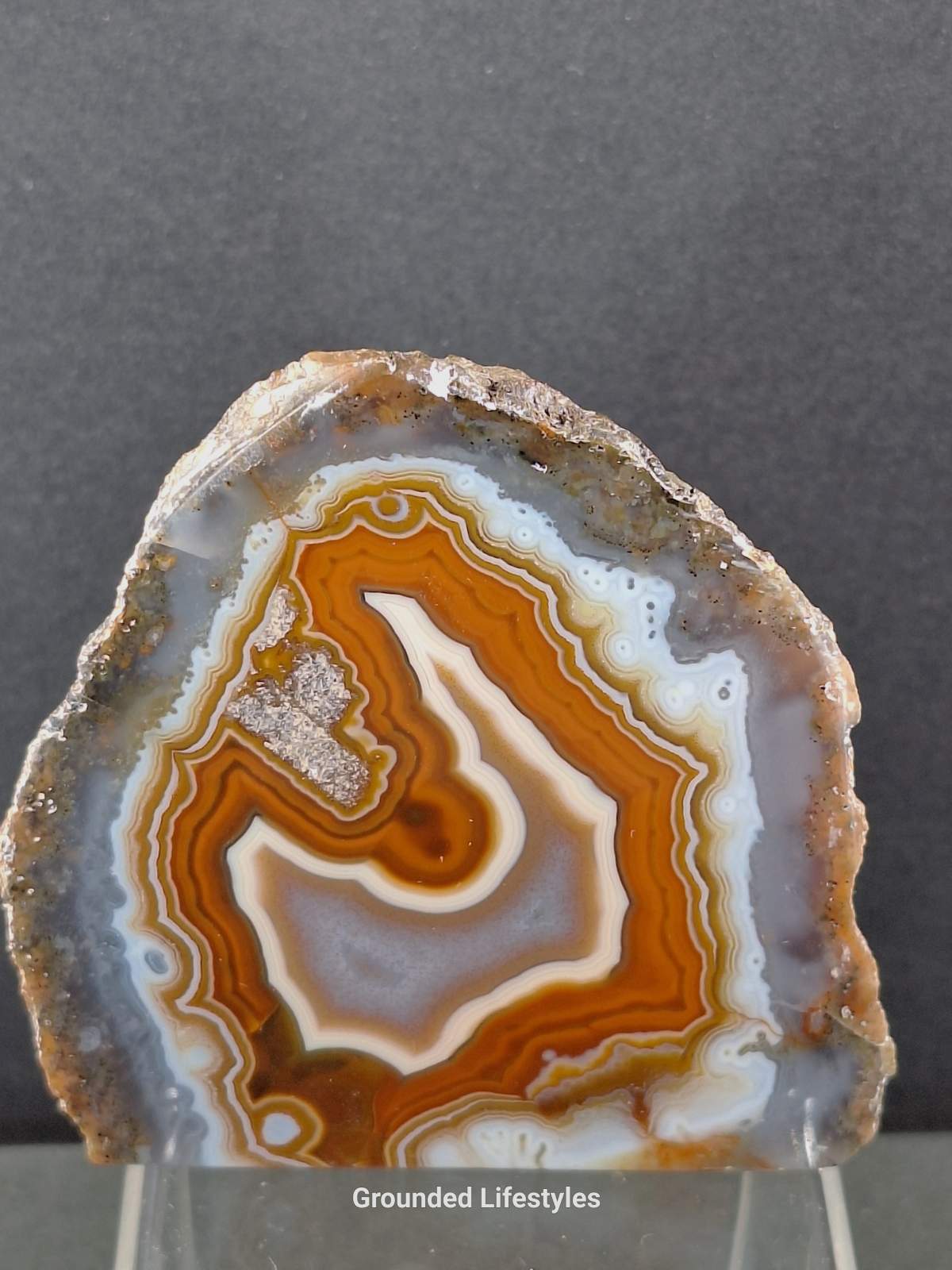
That first cut is one of the reasons people become serious agate collectors. The saw passes through a nodule that may have remained closed for millions of years, the halves separate, and an interior no human being has ever seen is suddenly exposed. Sometimes the result is modest. Other times there are tightly packed bands of red, orange, cream and gray, strange tubes running through the center, plume-like structures, crystalline pockets or patterns that seem far too organized to have developed naturally. No two are exactly alike, and there is no way to order another copy once an exceptional specimen is gone.
Moroccan agate has become particularly desirable because the country produces an extraordinary variety of these internal patterns. Among the best-known sources is the Kerrouchen area of Khénifra Province in central Morocco, although Moroccan agate also occurs around Sidi Rahal, Asni, Agouim, Tizi-n-Tichka and other localities. These are not simply different names for the same material. Individual districts can produce their own combinations of colors, structures and mineral inclusions, which is why a precise locality adds considerably more meaning to a collector specimen than a label that says only “Morocco.”
Kerrouchen deserves particular attention because it has produced some of the Moroccan material most recognizable to modern agate collectors. It is sometimes referred to commercially as the “Kerrouchen Mine,” but that description can be misleading. Kerrouchen is better understood as an agate-producing district or group of occurrences associated with extensive basaltic volcanic rocks. Agates have been recovered from weathered volcanic exposures, mountain slopes, agricultural fields, roadsides and areas where erosion has released nodules from their original host rock. The basaltic rocks extend across a substantial area rather than representing one small underground agate mine.
That volcanic rock is the beginning of the story. Long before the Atlas Mountains looked anything like they do today, volcanic activity spread basaltic lava through parts of the region. As lava cools, gases trapped inside it can leave bubbles and irregular openings. Once the basalt becomes solid, those empty spaces remain. At that point there is still no agate, only a cavity inside volcanic rock. Yet that empty space provides exactly what is needed for the mineral story that follows.
Water moving through the surrounding rocks gradually picks up dissolved silica and other elements. When silica-rich fluids enter one of those cavities, silica begins to accumulate along the walls. It does not necessarily fill the opening during one continuous event. Conditions change, fluid chemistry changes and mineral deposition may stop and begin again. One layer develops, followed later by another. Over time, these repeated episodes create chalcedony and fine crystalline quartz arranged in the bands that define agate.
This is why the bands in a Moroccan agate are more interesting than simple decoration. They are a physical record of changing conditions inside the cavity. A narrow gray band and the orange band immediately beside it did not necessarily form under identical circumstances. Something changed between them. The chemistry of the fluid may have shifted, different trace elements may have become available, or the way silica crystallized may have changed. A polished agate face therefore becomes a cross section through a sequence of geological events.
Scientific examination of Kerrouchen material has shown that the silica is primarily low quartz with smaller quantities of moganite, another silica mineral commonly associated with chalcedony. Even the moganite is not distributed uniformly throughout every specimen. It can be concentrated within particular zones, reinforcing what collectors already see visually: the interior of an agate is not one homogeneous mass.
The wonderful reds, oranges, yellows and browns found in many Moroccan agates are also part of this changing chemistry. Pure quartz does not naturally possess those colors. Extremely fine mineral inclusions help create them. Hematite, an iron oxide familiar to mineral collectors, is an important contributor to red coloration. Goethite contributes yellow and brown tones. The particles can be so small that you do not see individual hematite or goethite crystals. Instead, they become dispersed through the chalcedony and color an entire band.
This is worth understanding because brightly colored Moroccan agate is sometimes assumed to have been dyed simply because inexpensive commercial agate is frequently treated. Moroccan material can naturally produce remarkably rich colors. Treatment is always possible in the broader agate market and should be disclosed when known, but red, orange and yellow coloration alone is not evidence that a Moroccan specimen has been altered. The volcanic environment and iron-rich chemistry are fully capable of creating those colors naturally.
Color, however, is only half of what makes the best Moroccan material so interesting. The structures inside the nodules can become wonderfully complicated. Some agates develop familiar concentric or fortification bands that follow the outline of the original cavity. Others have several centers of growth competing within the same nodule. Still others contain tubes, eyes, plumes and structures mineralogists describe as pseudostalactitic.
The word “pseudostalactitic” sounds more intimidating than the feature itself. Imagine elongated structures developing inside the original open cavity and later becoming surrounded by successive layers of chalcedony. When a cutter passes through those structures, their cross sections can appear as circles, tubes, flowers or plume-like forms. A cut made lengthwise can reveal something completely different. This is one reason high-quality agate cutting involves much more judgment than simply placing a rock on a saw and cutting it in half.
A skilled cutter studies the shape and exterior of the nodule before deciding where the blade should enter. There may be subtle clues suggesting the direction of internal growth. Even then, there is an element of chance. A cut made an inch away from the ideal location can completely change the appearance of a specimen. When the orientation is right, however, a complicated internal structure can open across the entire polished surface.
That uncertainty plays an important role in the price of exceptional Moroccan agate. People sometimes compare a costly collector specimen with inexpensive agate rough and wonder why there is such a large difference. The finished specimen does not show all the material that had to be found, transported and cut before the exceptional piece appeared. A promising nodule may turn out to contain ordinary gray chalcedony. Another may be heavily fractured. One may have beautiful color but very little pattern, while another contains spectacular structure positioned in a way that cannot be displayed effectively. Only a fraction of the material becomes exceptional collector grade.
Once the right piece is found, considerable work can also go into presenting it properly. Agate is hard, generally around 6.5 to 7 on the Mohs scale, and producing a flat, high-quality polished surface requires several stages of grinding and polishing. Large specimens take additional time and equipment. A poor polish can hide fine banding beneath scratches and uneven surfaces, while a good polish allows the internal structure to become visible without making the finishing work itself the focus.
Even so, labor alone does not explain why certain Moroccan agates command premium prices. Collectors are paying for the specimen itself. Strong natural color, sharp contrast, unusual growth structures, fine banding, good condition and an attractive overall composition all matter. Locality matters as well. A documented Kerrouchen specimen carries more collector significance than an attractive stone labeled only “African Agate.” When several of these characteristics come together in one piece, replacing that specimen becomes extremely difficult.
Size is important, but it is not the deciding factor. A large agate with weak color and an ordinary interior can be less desirable than a much smaller specimen containing extraordinary fortification bands or a perfectly positioned plume. Experienced collectors learn quickly that the question is not simply, “How big is it?” The better question is, “What happened inside it?”
That individuality is one of agate’s greatest advantages as a collectible. Another quartz crystal of approximately the same size and clarity can often be found. Another Moroccan agate with exactly the same arrangement of red bands, gray chalcedony, tubes and crystalline pockets cannot. The geological process created that pattern once. When the specimen leaves a collection, there is no ordering another identical example.
Some Moroccan agates have another characteristic that is completely hidden under ordinary lighting. Place the right specimen beneath ultraviolet light and certain bands or areas can begin to fluoresce. Green and yellow-green responses are particularly interesting because the fluorescent pattern may be completely different from the colors visible in daylight.
Not every Moroccan agate fluoresces, and even within a fluorescent specimen the entire stone may not respond. One band may glow strongly while the band immediately beside it remains dark. That uneven response makes sense when we remember how an agate formed. Each layer can represent slightly different chemical conditions, so trace elements incorporated into one generation of chalcedony may be absent or present at different concentrations in another.
One scientifically documented cause of green fluorescence in agate and chalcedony is uranium present in the oxidized form known as the uranyl ion. Research on agates from different localities has shown that uranium can become concentrated unevenly during silica deposition and that its distribution may correspond to individual agate bands. Under ultraviolet excitation, uranyl ions can produce a distinctive green luminescence.
The word uranium naturally attracts attention, but the amount required to produce visible fluorescence can be surprisingly small. Laboratory studies have detected uranyl-related luminescence in agate containing uranium at concentrations around one part per million. Fluorescence is therefore not evidence that an agate contains a large quantity of uranium, nor should a glowing specimen automatically be treated as though it were a highly radioactive uranium mineral. A UV lamp reveals luminescence; it does not measure radioactivity.
The type of ultraviolet light used also matters. Many inexpensive household blacklights operate in the longwave range, commonly around 365 nanometers. Uranyl-related fluorescence in agate can respond much better to ultraviolet wavelengths below approximately 300 nanometers, making a 254 nm shortwave mineral lamp considerably more revealing in some specimens. An agate that appears inactive beneath an ordinary longwave blacklight may show a much stronger response under shortwave UV.
At the same time, it is important not to identify every fluorescent Moroccan agate as “uranium agate” simply because it glows green. Trace elements other than uranium and defects within the silica structure can also contribute to luminescence. Without analytical testing, fluorescence tells us that something within the specimen is responding to ultraviolet energy; it does not automatically tell us the exact chemistry responsible.
For collectors, that uncertainty actually makes the phenomenon more interesting. A polished Moroccan agate may show one pattern in normal light and another beneath UV. Bands that appear nearly identical in daylight suddenly behave differently. The fluorescence reveals chemical variations that were present all along but invisible to the human eye. In a particularly good specimen, it can feel as though you own two different agates depending on how you illuminate it.
Fluorescence can also add collector appeal when it complements an already strong specimen. A mediocre agate does not automatically become exceptional simply because one band fluoresces, but an agate with excellent natural color, unusual structure and an attractive UV response offers another feature to study and display. For collectors who specialize in fluorescent minerals, the combination can be especially desirable.
There is sometimes debate about whether cutting an agate diminishes its value as a natural mineral specimen. With Moroccan agate, the answer depends heavily on how it is done. Leaving a nodule completely natural preserves its original exterior, but it also leaves nearly everything that makes the agate interesting hidden inside. Completely shaping and polishing the stone can reveal its color beautifully while removing much of its geological context.
For collector material, a particularly effective compromise is often a specimen that retains much of its natural exterior while one face is cut and polished. The back and sides show the original nodule and weathered rind. Turn the specimen around and the polished face becomes a window into the interior. You can understand both what was found and what was hidden inside it.
Slices have their own appeal because they can show banding across the entire width of a nodule, particularly when the material contains repeating structures. Matching pairs made from consecutive cuts can be especially attractive because they show nearly mirrored views of the same geological formation. Rough nodules appeal to collectors who enjoy the anticipation of what might be inside, although cutting a documented or unusual old specimen should always be considered carefully before destroying its original form.
Another important part of collecting Moroccan agate is learning not to treat the entire country as one locality. Kerrouchen may be the name most collectors recognize, but it is not Morocco’s only agate-producing area. Sidi Rahal and other Atlas Mountain localities have their own geological characteristics and appearances.
This is why labels should be preserved. If a specimen comes with a more precise locality, keep that information with it. An old handwritten label may look insignificant beside a beautifully polished stone, but provenance tends to become more valuable as collecting areas change, access disappears and older material becomes separated from its history.
For the same reason, sellers should avoid improving a locality beyond what is actually known. If the information says Morocco, label it Morocco. If it says Kerrouchen and the provenance is reliable, preserve Kerrouchen. Inventing a mine name makes the label sound more impressive but ultimately reduces the scientific integrity of the specimen.
One of the most common myths is that Moroccan agate comes from a single famous mine. It does not. Morocco contains several important agate occurrences, and Kerrouchen itself is better described as a district or group of occurrences associated with extensive volcanic rocks rather than one conventional underground mine.
Another misconception is that vivid Moroccan agate must be dyed. Natural treatment questions should always be taken seriously when purchasing commercial agate, but scientific studies of Moroccan material document naturally occurring hematite, goethite and other mineral components capable of producing the reds, yellows and browns collectors prize. Bright color by itself is not evidence of dye.
It is also a myth that all Moroccan agate fluoresces. Some does, some does not, and some specimens show fluorescence only in particular bands. The response may also change depending on whether longwave or shortwave ultraviolet light is used.
The idea that green fluorescence automatically means an agate is dangerously radioactive is another misconception. Uranyl ions can produce visible luminescence at extremely low concentrations. Fluorescence and radioactivity are related to different physical processes and should not be treated as interchangeable measurements.
Finally, bigger does not automatically mean better. This may be the most important collector lesson of all. A large nodule can be impressive, but pattern, color, contrast, condition, locality and composition determine whether it is an exceptional specimen. A small agate that captures everything desirable about a famous locality can be far more important than a large but ordinary piece.
The best Moroccan agates succeed on several levels at once. Someone with no geological knowledge can appreciate the color and pattern immediately. A lapidary artist can study how the cut intersects the internal structures. An experienced agate collector can compare banding, tubes, plumes and growth centers with material from other famous world localities. A mineral collector can examine the iron minerals, quartz, chalcedony and associated features. Put a fluorescent specimen under ultraviolet light and there is another layer to investigate.
You do not have to understand every part of the geology before enjoying the stone. That may be one of Moroccan agate’s greatest strengths. The specimen catches your attention first and gives you reasons to learn afterward.
The story itself is surprisingly simple at its core. Volcanic activity created basalt. Gas left cavities inside the cooling rock. Silica-bearing fluids later entered those openings, depositing layer after layer of chalcedony and quartz. Changing chemistry introduced iron and other trace components, creating colors and patterns. Some trace chemistry remained invisible until ultraviolet light revealed it. Eventually weathering exposed the nodules and collectors recovered them.
Then came the final moment.
Someone put the nodule on a saw.
Until that cut was made, all of those bands, colors and structures remained concealed inside what might have looked like an ordinary rock. The blade opened a geological record that had never before been visible.
Most nodules will never become exceptional collector specimens. That is precisely why the great ones matter.
When a Moroccan agate combines beautiful natural color, unusual internal growth, strong contrast, good provenance and perhaps an unexpected fluorescent response, it becomes much more than polished chalcedony. It becomes a one-of-a-kind record of the changing conditions inside an ancient volcanic cavity—and a reminder of why agate collectors are always tempted to cut just one more rock.
Moroccan agate is only one chapter in a much larger story. From the distinctive patterns of individual collecting localities to the different ways color, minerals and crystal growth develop inside each stone, agate offers an almost endless variety to explore. If this article has sparked your curiosity, continue through our Agate Articles to discover other localities, formation stories, collecting tips and varieties from around the world.
If you are looking for a specimen of your own, visit our Agate Collection to explore available natural specimens, polished pieces, slices and other hand-selected agates. Because every agate forms differently, each piece offers its own combination of color, pattern and geological history—and once a one-of-a-kind specimen finds a new collection, there is never another exactly like it.

At Grounded Lifestyles, our love for crystals began in the peaceful flow of Reiki and energy healing sessions — where we saw how natural stones could amplify intentions, restore balance, and bring comfort. But the more time we spent with these treasures, the more curious we became about their origins. That curiosity led us into the fascinating world of geology and mineral specimen collecting. We fell in love not just with the energy of crystals, but with the science and artistry of their creation — the intricate crystal structures, the vibrant mineral hues, and the wonder of holding a piece of Earth’s history in our hands.