

Every crystal, mineral, fossil, meteorite, and handcrafted piece is selected with purpose. Whether you’re building a museum-worthy mineral collection, searching for a meaningful gift, decorating your home with natural beauty, or beginning your journey into the world of geology, you’ll discover authentic specimens with stories worth sharing.
Over 15 shows a year throughout the Southwest. Check to see if we are coming to a show near you!
Home > Blog > Meteorites Blog | Space Rocks, Collecting & Meaning > Meteorites Ancient Space Rocks
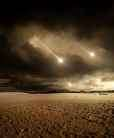
Meteorites are among the oldest physical objects most people will ever have the opportunity to see or hold, and their stories reach far beyond the few seconds we may glimpse a meteor crossing the night sky. Some meteorites contain material that formed before the planets existed, while others are pieces of once-molten asteroids, fragments of the Moon, rocks blasted from Mars, or metallic remnants of differentiated planetary bodies that were broken apart billions of years ago. By the time one of these objects reaches Earth, it may already have passed through several stages of planetary formation, collision, heating, cooling, fragmentation, interplanetary travel, atmospheric entry, and terrestrial weathering.
That long history is what makes meteorites so valuable to both science and collecting. A plain gray chondrite may contain components dating to the earliest stages of the Solar System, while a small iron slice can preserve a crystal structure formed through cooling so slow that it took place over millions of years. A tiny classified fragment of Martian rock may not look visually spectacular, yet it represents genuine geology from another planet. Meteorites allow us to examine events and environments that are otherwise inaccessible, which is why they occupy such an important place in planetary science, mineral collecting, natural history, and even modern metaphysical traditions.
Understanding meteorites begins with a few simple definitions, but the subject quickly expands into a much larger story involving asteroids, planetary differentiation, impact craters, organic chemistry, lunar geology, Martian volcanism, meteorite hunting, provenance, conservation, and the scientific effort to reconstruct worlds that may no longer exist in their original form.
The words meteoroid, meteor, and meteorite describe different stages of the same general journey. A meteoroid is a natural rocky or metallic object traveling through space, usually much smaller than what we would call an asteroid. When that object enters Earth’s atmosphere at high velocity, collisions with atmospheric molecules create intense heating and compression around it, producing the bright phenomenon we see from the ground. That visible streak of light is the meteor, often called a shooting star even though it has nothing to do with an actual star.
If part of the incoming object survives atmospheric passage and reaches Earth’s surface, the material that remains is called a meteorite. This distinction becomes especially useful when discussing meteor showers, because most meteor showers are produced by tiny particles left behind by comets, and those grains usually burn or disintegrate high in the atmosphere rather than reaching the ground as collectible meteorites. A spectacular meteor in the sky therefore does not automatically mean a meteorite has landed nearby.
Earth encounters extraterrestrial material continuously. NASA estimates that roughly 44,000 kilograms, or about 48.5 tons, of meteoritic material reaches Earth’s surface each day, although most of it arrives as dust and micrometeorites rather than large specimens. Recognizable meteorites are much less common, particularly because incoming objects can lose substantial mass during atmospheric entry and fragmentation.
Most meteorites come from asteroids, which are remnants of early Solar System history. Collisions between asteroids break pieces free, and some of those fragments eventually enter orbits that cross Earth’s path. A much smaller number of meteorites come from the Moon or Mars, where sufficiently powerful impacts can launch rock beyond the gravity of those worlds and send it into independent orbit around the Sun.
Other meteorites come from differentiated asteroids such as Vesta, a body large enough to have melted internally, separated into different geological layers, and produced volcanic and plutonic rocks. This diversity is one reason the term meteorite should never be treated as though it describes one kind of space rock. A primitive chondrite, a Martian basalt, a pallasite, and an iron meteorite may all have reached Earth through similar final stages, yet their origins and geological histories are completely different.
Meteorites matter scientifically because they can be studied with laboratory instruments far more powerful than anything we can currently send aboard a spacecraft. Researchers can measure isotopes, trace elements, crystal structures, mineral chemistry, organic compounds, shock features, exposure ages, magnetic properties, and microscopic textures, allowing them to investigate how planets formed, how asteroids differentiated, how water moved through early Solar System bodies, and how often those bodies were later destroyed by collision.
Meteorites are traditionally introduced through three broad categories: stony meteorites, iron meteorites, and stony-iron meteorites. This is a useful starting point for collectors, but modern meteorite classification goes much deeper because those three groups contain many chemically and genetically distinct families.
Stony meteorites are dominated by silicate minerals and include both chondrites, which preserve relatively primitive material, and achondrites, which represent rocks that experienced melting, differentiation, or igneous processing. Iron meteorites consist mainly of iron-nickel metal and are divided into chemical and structural groups that reflect very different parent-body histories. Stony-iron meteorites contain significant amounts of both metal and silicate, with pallasites and mesosiderites being the best-known examples.
Our Meteorite Classification guide explores these groups in much greater detail, including the meaning of classifications such as H5, CM2, IVA, IAB-MG, diogenite, and pallasite.
Chondrites are among the most important meteorites for understanding the birth of the Solar System because their parent bodies never underwent complete global melting and differentiation. Many contain small rounded objects called chondrules, which formed during brief high-temperature events before being incorporated into larger asteroid parent bodies. They may also contain refractory inclusions, fine-grained matrix, metal, sulfides, presolar grains, water-altered minerals, and organic compounds.
Some of those components formed approximately 4.56 billion years ago, placing them among the oldest known solids in the Solar System. That means a seemingly ordinary gray or brown meteorite can preserve material that existed before Earth had fully formed.
Ordinary chondrites are commonly divided into H, L, and LL groups, based largely on their iron and metallic-iron content. H chondrites contain relatively high total iron, L chondrites contain less, and LL chondrites contain both low total iron and low metallic iron. These chemical groups are then combined with petrologic types that describe how much heating or alteration occurred inside the parent asteroid.
Carbonaceous chondrites preserve another side of early Solar System history. Some contain hydrated minerals, primitive matrix, amino acids, and a wide range of carbon-bearing compounds. These meteorites are often described as containing the “building blocks of life,” but that phrase needs context because the presence of organic molecules does not mean the meteorite contains life or proof of extraterrestrial organisms. What it demonstrates is that complex organic chemistry and water-bearing minerals existed on primitive asteroid parent bodies and may have contributed material to the early Earth.
The Winchcombe Meteorite is an especially useful modern example. Recovered rapidly after its 2021 fall in Britain, Winchcombe is a CM2 carbonaceous chondrite whose relatively pristine condition allowed scientists to examine water-altered material with far less terrestrial contamination than is common in older finds.
Achondrites tell a very different story because their parent bodies experienced enough melting, differentiation, or igneous processing to erase ordinary chondritic textures. Many look surprisingly similar to terrestrial igneous rocks because the same broad geological processes apply: molten material cools, crystals grow, magma differentiates, and bodies develop chemically distinct regions.
The HED meteorites—howardites, eucrites, and diogenites—provide one of the best examples. These meteorites are strongly connected with asteroid Vesta through chemistry, mineralogy, spectroscopy, and observations made by NASA’s Dawn spacecraft. Eucrites broadly represent basaltic crustal material, diogenites are dominated by orthopyroxene and are associated with deeper plutonic environments, while howardites are impact breccias that contain mixtures of both.
The Tatahouine Meteorite is a classic diogenite and offers collectors a direct example of differentiated asteroid geology. Its importance comes not simply from being a meteorite, but from representing rock that crystallized within a body that had already developed a complex internal structure.
Some achondrites come from worlds whose parent bodies are not inferred but directly identified. Lunar Meteorites were launched from the Moon by impacts powerful enough to accelerate lunar rock beyond escape velocity. Their origin can be established by comparing mineralogy, chemistry, oxygen isotopes, and trace-element patterns with samples returned by the Apollo and Luna missions.
Lunar meteorites are especially valuable because they may come from parts of the Moon never sampled by those missions. Apollo material has precise geological context, while meteorites broaden the geographic range of available lunar samples, including highland breccias, basaltic material, regolith breccias, and impact-melt rocks.
Mars Meteorites provide another remarkable case of natural interplanetary transport. Large impacts on Mars can launch material beyond the planet’s gravity, after which fragments may spend millions of years in Solar orbit before reaching Earth. Their Martian origin is supported by mineral chemistry, isotopes, crystallization histories, shock features, and, in some meteorites, gases trapped within the rock that match spacecraft measurements of the Martian atmosphere.
Traditional Martian groups include shergottites, nakhlites, and chassignites, while unusual specimens such as ALH 84001 and the NWA 7034 “Black Beauty” breccia have expanded our understanding of Martian geology. These rocks preserve evidence of volcanism, ancient crust, water-rock interaction, impact shock, and atmospheric history, giving scientists actual samples of another planet long before sample-return missions from Mars become routine.
Iron meteorites are dominated by iron-nickel metal and often provide some of the most recognizable specimens in meteorite collections. Their density, sculpted surfaces, metallic interiors, and etched structures make them visually dramatic, but the simple statement that iron meteorites are “pieces of asteroid cores” is no longer sufficient.
Some iron groups are consistent with metallic material that crystallized inside differentiated cores, while others preserve far more complicated histories involving partial differentiation, metal-silicate mixing, impact disruption, and reassembly. Chemical groups such as IAB, IIAB, IIIAB, IVA, and IVB are defined through relationships involving nickel and trace elements, allowing scientists to connect meteorites that probably share common parent-body histories.
One of the most famous features of many iron meteorites is the Widmanstätten structure, which becomes visible when an appropriate surface is cut, polished, and etched. The intersecting kamacite and taenite bands formed through extraordinarily slow cooling inside an extraterrestrial body, and the acid used during preparation merely reveals a structure that already existed. Different meteorites produce different patterns depending on composition and cooling history, which is why etched Gibeon and Muonionalusta look different from coarser iron meteorites such as Sikhote-Alin.
Gibeon and Muonionalusta are both IVA irons, making them especially useful for comparison. Gibeon is known for a fine Widmanstätten pattern and a long history of collecting in Namibia, while Muonionalusta endured an extremely long terrestrial history in northern Scandinavia. Their chemistry connects them to the same broad parent-body system, yet their weathering histories and collector appearance are very different.
Sikhote-Alin belongs to a different iron group and fell over eastern Russia in 1947 during one of the most spectacular witnessed meteorite events of the twentieth century. Its shrapnel fragments and sculpted individuals preserve atmospheric fragmentation, regmaglypts, and orientation features that are especially easy to understand because the fall is so recent by geological standards.
Campo del Cielo and Canyon Diablo belong to the broader IAB complex and preserve more complicated parent-body histories. Campo del Cielo produced a multi-crater field in Argentina several thousand years ago, while Canyon Diablo struck northern Arizona roughly 50,000 years ago and created Meteor Crater. Both show why iron meteorites should not be reduced to simple “core fragments”; their chemistry, inclusions, impact histories, and terrestrial settings reveal far more complex stories.
The Hoba meteorite in Namibia is one of the great landmarks of meteorite science. The Meteoritical Bulletin lists Hoba as an Iron, IVB meteorite with a recorded mass of approximately 60 tonnes, making it the largest known individual meteorite mass remaining substantially intact at its discovery site.
Its size is extraordinary, yet Hoba did not produce a dramatic preserved crater. Its broad, relatively flat shape and atmospheric deceleration may have contributed to a much lower impact velocity than would normally be expected from such a large object. Seeing Hoba in place provides a sense of scale that is almost impossible to appreciate from small museum slices or fragments.
Stony-iron meteorites contain substantial amounts of both silicate minerals and metallic iron-nickel, but the two principal groups—pallasites and mesosiderites—should not be treated as though they formed through the same process.
Pallasites are famous for their olivine crystals suspended within metallic material. Thin slices can transmit light through the olivine and produce a stained-glass appearance that has made specimens such as Esquel, Imilac, Fukang, Brenham, and Seymchan highly prized by collectors.
Older descriptions often presented pallasites as literal samples from the core-mantle boundary of an asteroid, but modern research suggests that the formation of Main Group pallasites involved more complicated interactions and impact-driven mixing between metallic and olivine-rich materials. Their beauty is therefore tied to a violent planetary history rather than one simple internal boundary.
Mesosiderites present a completely different texture. They are breccias composed of metal mixed with silicate fragments and are generally interpreted as products of enormous collisions involving differentiated bodies. Their appearance may be less gem-like than pallasites, but their geology records one of the most dramatic ways planetary materials can be broken apart and recombined.
Meteorites are also described as either falls or finds. A fall is associated with an observed meteor event and subsequent recovery, while a find is discovered later without a recorded observation of its arrival. Winchcombe, Sikhote-Alin, and Tatahouine are documented falls, whereas Gibeon, Muonionalusta, Canyon Diablo, and many desert meteorites were discovered long after reaching Earth.
Falls can be scientifically valuable because their arrival date is known and recently recovered specimens may have experienced very little terrestrial weathering or contamination. That does not mean a fall is automatically more valuable than a find. An unusual classification, exceptional natural form, historic provenance, rare locality, or striking specimen can easily outweigh witnessed-fall status in the collector market.
Once a meteorite reaches Earth, terrestrial weathering becomes part of its story. Iron corrodes, metal grains oxidize, salts move through fractures, and surfaces can be altered until original atmospheric features are difficult to distinguish from later weathering. This is why a fresh Sikhote-Alin individual and an ancient Canyon Diablo fragment can look so different even though both are iron meteorites.
Fresh stony meteorites commonly develop a thin dark layer called fusion crust during atmospheric entry. The outermost surface heats and melts briefly while material is being removed through ablation, and that thin layer solidifies once intense heating stops. Fresh crust can appear black, matte, glossy, or slightly textured, while older crust may weather to brown or disappear almost entirely.
Fusion crust is useful evidence but not proof of meteorite identity because terrestrial rocks can develop dark weathering rinds, burned surfaces, or desert varnish that resemble it.
Iron meteorites and some other meteorites may also develop rounded depressions known as regmaglypts. These features are sculpted during ablation and are especially striking on fresh iron meteorites such as Sikhote-Alin. On very old specimens, however, terrestrial corrosion can modify or enlarge depressions, so not every cavity should be treated as a perfectly preserved atmospheric feature.
Our Meteorites 101: Identifying, Collecting and Preserving Space Rocks guide covers these identification clues and the many terrestrial “meteorwrongs” that can imitate them.
Meteorites often preserve evidence of collisions that took place long before their final journey to Earth. Shock can fracture minerals, create melt veins, form breccias, transform crystal structures, and generate high-pressure minerals. Some meteorites record multiple generations of collision, burial, reheating, fragmentation, and reassembly.
Once a fragment is exposed in space as a relatively small object, cosmic rays begin interacting with its minerals and producing measurable isotopes. Scientists use those products to calculate cosmic-ray exposure ages, which can help estimate how long the object traveled through space after leaving its parent body.
This means one meteorite can contain several different ages: the time when its minerals originally crystallized, the age of parent-body metamorphism, the time of major impact events, the length of its journey through space, and the amount of time it has spent weathering on Earth. Understanding which age is being discussed is critical because those values represent completely different stages of the meteorite’s history.
Some meteorites reached Earth hundreds of millions of years ago and later became incorporated into sedimentary rocks. These fossil meteorites provide an unusual way to study changes in the extraterrestrial material reaching Earth through deep time.
One of the best-known examples comes from Ordovician limestone quarries in Sweden, where fossil meteorites and extraterrestrial chromite grains preserve evidence related to a major asteroid disruption event around 470 million years ago. Many original meteorite minerals have been replaced during burial and alteration, yet resistant components still preserve chemical evidence of extraterrestrial origin.
These specimens remind us that meteorite falls are not simply modern events. Earth has been receiving extraterrestrial material throughout its geological history, and the composition of that incoming material has changed as the asteroid belt itself evolved.
Large meteorites and asteroids can produce impact structures when they strike Earth at hypervelocity. At several kilometers per second, the collision behaves very differently from an ordinary object hitting the ground because shock waves transfer energy almost instantaneously into both impactor and target. Rock is fractured, compressed, heated, melted, and sometimes vaporized, which is why large impact craters may contain surprisingly little recognizable meteorite material compared with the original incoming body.
Famous impact structures include Meteor Crater in Arizona, Chicxulub in Mexico, Vredefort in South Africa, Sudbury in Canada, Ries in Germany, Bosumtwi in Ghana, and Chesapeake Bay in the United States. Each preserves a different chapter of Earth’s collision history.
Chicxulub is the most famous example because the approximately 66-million-year-old impact is strongly connected with the end-Cretaceous mass extinction that eliminated non-avian dinosaurs and many other groups. The event demonstrates how extraterrestrial collisions range from small meteorite falls that leave hand-sized specimens to planet-altering impacts with global environmental consequences.
Meteorites are frequently confused with tektites, but the distinction is fundamental. A meteorite originated outside Earth, while a tektite consists primarily of terrestrial material melted and transported during a major impact.
Moldavite is therefore not a meteorite. It is a tektite formed during the Ries impact approximately 14.8 million years ago. Australites, indochinites, bediasites, Georgiaites, and Ivory Coast tektites likewise represent terrestrial impact material rather than pieces of the objects that struck Earth.
Our Tektites vs. Meteorites guide explores this distinction in depth and also examines Libyan Desert Glass, Saffordite, Colombianite, Agni Manitite, Tibetan natural glass, and the reason not every unusual natural glass should automatically be classified as a tektite.
Experienced collectors can often recognize a likely meteorite quickly, but no single field characteristic proves extraterrestrial origin. Fusion crust, appropriate density, magnetism, chondrules, metallic grains, regmaglypts, and characteristic interior textures can all contribute useful evidence, yet terrestrial materials can imitate nearly every one of those features.
Industrial slag may be magnetic, magnetite can be unusually dense, basalt can be dark and fine grained, desert weathering can imitate crust, and manufactured metal can be etched. Formal classification may therefore require petrography, mineral chemistry, electron microscopy, trace-element analysis, isotopic measurements, or other laboratory techniques.
This is especially important for rare claims. A rock cannot responsibly be identified as Lunar, Martian, carbonaceous, or another valuable type simply because it resembles one in a photograph. Extraordinary classifications require scientific evidence and reliable provenance.
Provenance is the documented history connecting a physical specimen with a recognized meteorite. Once a meteorite has been cut into small fragments, that documentation can become nearly as important as the specimen itself.
A tiny piece of Lunar meteorite may resemble an ordinary terrestrial breccia, while a small Martian fragment may look like an unremarkable igneous rock. Several iron meteorites can display similar etched patterns, making it impossible to assign a named locality based on appearance alone.
Old collection labels, dealer invoices, finder information, museum records, specimen numbers, and scientific classification documentation should therefore remain with the meteorite. Collectors sometimes replace old labels with cleaner modern cards and inadvertently discard valuable historical information, even though an original handwritten label may prove far more useful than a new certificate.
Official meteorite names generally refer to geographic locations associated with the find or fall and are maintained through the scientific meteorite nomenclature system. Gibeon, Sikhote-Alin, Tatahouine, Winchcombe, Canyon Diablo, and Campo del Cielo are names of recognized meteorites rather than broad meteorite types.
Classification describes something different. Gibeon is the meteorite name, while IVA iron is its chemical group. Winchcombe is the meteorite name, while CM2 describes its classification.
Collectors also frequently encounter the abbreviation TKW, meaning Total Known Weight. This refers to the total recorded amount of material associated with a named meteorite and can provide useful context for availability, but it is not a simple price or rarity scale. Some material resides permanently in museums or research institutions, while other portions may have been consumed during analysis, divided into collections, or lost from the commercial market.
Meteorite value cannot be reduced to one price-per-gram chart. Classification matters, but so do provenance, total known mass, witnessed-fall status, morphology, fusion crust, weathering, preparation, scientific importance, specimen size, historical significance, stability, and current availability.
A sculptural Sikhote-Alin individual with strong atmospheric features can occupy a very different market from an ordinary fragment of the same meteorite. A pallasite slice may be judged partly by olivine transparency and preparation quality, while a tiny Lunar or Martian specimen derives much of its significance from planetary origin and documentation.
Historic labels can also increase collector interest because they connect an object with a previous collection, institution, expedition, or early period of meteorite study. The best approach is therefore to understand why a particular specimen is important rather than assuming that one classification automatically determines its value.
Meteorites can fall anywhere, but certain environments make them easier to preserve and recognize. Deserts are particularly productive because vegetation is sparse, weathering can be slower, and dark meteorites often contrast strongly with pale ground. Antarctica is scientifically important because glacial movement can concentrate meteorites within blue-ice areas, allowing organized research teams to recover large numbers systematically.
Recent strewn fields can also be productive when fireball camera networks reconstruct an incoming trajectory and estimate where surviving fragments may have landed. These searches can begin within hours or days of a fall, which makes it possible to recover unusually fresh material before extensive terrestrial contamination occurs.
Regardless of the environment, land ownership and collecting law matter. A promising area does not become legal to collect simply because meteorites are present.
Meteorite laws vary by country, land ownership, and managing agency. On some eligible Bureau of Land Management lands in the United States, limited casual meteorite collecting is allowed for personal use under specific rules. Private land requires landowner permission, while National Parks and many other protected areas prohibit removal of natural objects.
State lands, tribal lands, research areas, and other jurisdictions have their own requirements. Outside the United States, some countries treat meteorites as protected national heritage or regulate recovery and export.
Namibia’s protection of meteorites such as Gibeon and Argentina’s regulation of meteorite material demonstrate why collectors should not assume that something found outdoors is automatically available for private removal or commercial sale.
Meteorites may have survived billions of years in space, atmospheric entry, and impact, but they are not indestructible once they enter a collection. Iron meteorites can rust, ordinary chondrites can contain metal grains and sulfides that deteriorate in humid conditions, carbonaceous material can be physically and chemically delicate, and pallasites combine corrosion-prone metal with brittle olivine crystals.
Planetary meteorites and historically important specimens may also contain scientific information that can be permanently destroyed through unnecessary polishing, washing, coating, or cutting.
Dry, stable storage and conservative treatment are generally safer than aggressive restoration. Prepared irons should be monitored for fresh corrosion, fragile stones should be protected from unnecessary handling, and labels should remain physically associated with specimens.
Our Meteorites 101 guide covers identification, buying, legal collecting, storage, and preservation in greater detail.
People encountered meteorites long before modern astronomy explained where they came from. Meteoritic iron was sometimes used for tools, ornaments, ceremonial objects, and weapons before smelted iron became widely available, while unusual stones falling from the sky naturally accumulated cultural and spiritual meanings.
Modern science transformed our interpretation of those objects by connecting meteorites with asteroids, planetary differentiation, impact processes, and Solar System formation, but their human history remains worth preserving alongside their geology.
A meteorite can therefore be both a scientific specimen and a cultural object whose meaning has changed repeatedly as people learned more about the universe.
Meteorites also occupy a distinctive place within modern metaphysical traditions because their extraterrestrial origin is scientifically established rather than symbolic. Practitioners commonly associate them with grounding, resilience, transformation, perspective, courage, cosmic connection, and major periods of personal change.
Iron meteorites are often associated with grounding and stability because of their weight and metallic character, while their origin beyond Earth leads others to use them symbolically with Third Eye or Crown Chakra practices involving perspective and expanded awareness. Pallasites may represent integration because they combine metallic and silicate material, while Lunar meteorites naturally attract associations with cycles, reflection, intuition, and receptivity. Martian material is often connected with courage, action, motivation, and exploration.
Within Reiki, meditation, or intention-setting practices, meteorites can serve as physical focal objects representing deep time, transformation, and the immense scale of the Solar System. These interpretations belong to modern spiritual traditions rather than scientifically demonstrated medical effects, and keeping that distinction clear allows metaphysical meaning and geological accuracy to coexist.
Certain meteorites have become especially useful because they illustrate very different aspects of meteorite science. Hoba demonstrates the enormous size iron meteorites can reach, while Sikhote-Alin preserves the morphology of a dramatic witnessed atmospheric fragmentation event. Campo del Cielo combines large recovered masses, a prehistoric crater field, cultural history, and complex IAB chemistry, whereas Canyon Diablo is inseparable from the scientific history of Meteor Crater.
Gibeon and Muonionalusta provide beautiful examples of IVA iron crystallization and allow collectors to compare meteorites related chemically but altered under very different terrestrial conditions. Winchcombe represents unusually fresh carbonaceous material recovered rapidly after a modern fall, while Tatahouine provides a direct connection with differentiated asteroid Vesta.
Lunar and Martian meteorites extend the story beyond asteroids altogether, demonstrating that natural impacts can move rocks from one planetary body to another.
Together, these specimens show why “meteorite” describes an enormous geological category rather than one style of space rock.
A meteorite is natural extraterrestrial material that survives atmospheric entry and reaches the surface of Earth or another planetary body.
A meteoroid is the object while it is traveling through space, the visible atmospheric phenomenon is a meteor, and any surviving material recovered from the ground is a meteorite.
Most come from asteroids, while smaller numbers originate from the Moon and Mars. Some asteroid meteorite groups can also be tied strongly to specific differentiated bodies such as Vesta.
Some meteorite components formed approximately 4.56 billion years ago during the earliest stages of Solar System history, making them comparable in age to or slightly older than Earth as a fully formed planet.
The traditional broad categories are stony, iron, and stony-iron meteorites, although modern classification divides them into many additional chemical and mineralogical groups.
A chondrite is a relatively primitive meteorite whose parent body did not undergo complete global melting and differentiation. Many contain chondrules and other components dating to the early Solar System.
An achondrite is a meteorite lacking ordinary chondritic texture and generally representing material that experienced melting, differentiation, igneous activity, or substantial recrystallization.
No. Some iron groups represent crystallized metallic material from differentiated interiors, while others preserve more complicated histories involving partial differentiation, mixing, impact disruption, and reassembly.
Hoba in Namibia is the largest known intact individual meteorite mass remaining substantially at its discovery site, with an official recorded mass of approximately 60 tonnes.
It is a crystallographic intergrowth of iron-nickel phases produced through extremely slow cooling inside metallic extraterrestrial bodies and revealed when an appropriate surface is polished and etched.
Yes. Lunar meteorites were launched from the Moon by impacts and later fell naturally to Earth.
Yes. Their Martian origin is supported by mineralogy, chemistry, isotopes, crystallization histories, shock features, and atmospheric gases trapped in some specimens that match spacecraft measurements of Mars.
No. Moldavite is a tektite made primarily from terrestrial material melted during the Ries impact approximately 14.8 million years ago.
Many are, particularly iron meteorites and ordinary chondrites, but magnetism alone cannot establish meteorite identity.
Yes. Iron meteorites and metal-bearing stony meteorites can oxidize under humid or salty conditions.
Ordinary meteorite specimens are not hazardous radioactive objects simply because they came from space. They contain naturally occurring and cosmogenic isotopes, but normal collector specimens do not require special radiation precautions solely because they are meteorites.
Modern metaphysical traditions commonly associate meteorites with grounding, resilience, transformation, cosmic connection, and perspective. These are symbolic spiritual interpretations rather than scientifically demonstrated effects.
Meteorites are far more than unusual rocks that happened to fall from the sky. They are physical records of processes that shaped the Solar System from its earliest stages, and the differences among them reveal how dramatically planetary materials evolved after the Sun and planets began to form.
A chondrite may preserve dust, chondrules, refractory inclusions, water-altered minerals, and organic compounds dating almost to the beginning of planetary formation, while an achondrite can record volcanism and differentiation inside an asteroid. An iron meteorite can preserve metallic crystallization from a parent body that was later disrupted by collision, and a pallasite can preserve interactions between olivine-rich silicate material and extraterrestrial metal during violent planetary evolution.
The story becomes even broader when meteorites from known planetary bodies are added. Lunar Meteorites give scientists naturally delivered samples from regions of the Moon beyond the Apollo landing sites, while Mars Meteorites preserve volcanic rocks, ancient crustal material, evidence of water-rock interaction, and in some cases trapped Martian atmospheric gases.
Named meteorites make those larger processes personal and tangible. Winchcombe preserves unusually fresh carbonaceous material, Tatahouine connects us with differentiated asteroid Vesta, Gibeon and Muonionalusta reveal different aspects of IVA iron history, Sikhote-Alin preserves the aftermath of a dramatic witnessed fall, while Campo del Cielo and Canyon Diablo connect iron meteorites with major terrestrial impact events.
Collectors who understand these relationships are no longer simply acquiring “space rocks.” They are building a physical record of planetary formation, collision, volcanism, differentiation, atmospheric entry, impact, terrestrial weathering, scientific discovery, and human interpretation.
Continue with Meteorite Classification for the scientific framework behind the major meteorite families, or read Meteorites 101: Identifying, Collecting and Preserving Space Rocks for practical guidance on identification, provenance, legal collecting, buying, storage, and care.
For the impact-glass side of the story, explore Tektites vs. Meteorites, which explains Moldavite, Australasian tektites, Libyan Desert Glass, Saffordite, Colombianite, Agni Manitite, Tibetan natural glass, and the important reason not every unusual natural glass should be classified as a tektite.
Browse the complete Grounded Lifestyles Meteorite Articles for additional guides covering planetary geology, famous falls, iron meteorites, tektites, impact science, collecting, identification, and preservation. To connect that education with specimens available through Grounded Lifestyles, explore our Meteorites & Tektites Collection, or continue learning through our Free E-Book Library.

At Grounded Lifestyles, our love for crystals began in the peaceful flow of Reiki and energy healing sessions — where we saw how natural stones could amplify intentions, restore balance, and bring comfort. But the more time we spent with these treasures, the more curious we became about their origins. That curiosity led us into the fascinating world of geology and mineral specimen collecting. We fell in love not just with the energy of crystals, but with the science and artistry of their creation — the intricate crystal structures, the vibrant mineral hues, and the wonder of holding a piece of Earth’s history in our hands.

