

Every crystal, mineral, fossil, meteorite, and handcrafted piece is selected with purpose. Whether you’re building a museum-worthy mineral collection, searching for a meaningful gift, decorating your home with natural beauty, or beginning your journey into the world of geology, you’ll discover authentic specimens with stories worth sharing.
Over 15 shows a year throughout the Southwest. Check to see if we are coming to a show near you!
Home > Blog > Meteorites Blog | Space Rocks, Collecting & Meaning > Muonionalusta Meteorite: Sweden Ancient Widmanstätten Iron
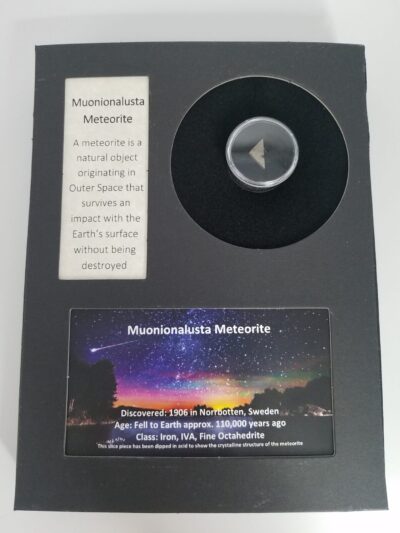
Far above the Arctic Circle in northern Sweden, fragments of an ancient iron meteorite have been recovered from glacial deposits near the Muonio River for more than a century. Known as Muonionalusta, this meteorite is famous among collectors for the extraordinarily fine geometric pattern revealed when its iron-nickel metal is cut, polished, and etched. Those intersecting metallic bands, commonly called a Widmanstätten pattern, are not decoration applied by a lapidary or jeweler. They formed naturally as extraterrestrial metal cooled at an extraordinarily slow rate inside an early planetary body, preserving a crystallization history that reaches almost to the beginning of the Solar System.
Muonionalusta belongs to the IVA group of iron meteorites and is structurally classified as a fine octahedrite. Its scientific importance goes well beyond its appearance. High-precision dating of troilite inclusions produced an age of approximately 4.5653 billion years, placing crystallization and cooling of the IVA parent material extremely early in Solar System history. The meteorite also preserves strong evidence of later impact shock, including the high-pressure silica mineral stishovite, and its long residence on Earth has produced an additional mineralogical story through corrosion products such as muonionalustaite.
Its terrestrial history is nearly as interesting as its cosmic one. Muonionalusta fragments are thought to have arrived in northern Scandinavia hundreds of thousands of years ago, with an age around one million years commonly cited, after which repeated glacial cycles moved, buried, abraded, and weathered the material. By the time the first recognized specimen was discovered in 1906, the meteorite had already passed through a remarkable sequence of planetary formation, asteroid disruption, interplanetary travel, atmospheric entry, glacial transport, and terrestrial corrosion.
For collectors, this combination makes Muonionalusta much more than attractive patterned metal. A polished slice exposes one of the best-known examples of fine iron-meteorite crystallization, while the weathered exterior of a natural fragment tells an entirely different story about survival in Arctic soils and glacial deposits. Its widespread use in jewelry, watchmaking, inlays, and decorative objects has made the pattern familiar far beyond meteorite collecting, but understanding how that pattern formed gives the material a depth that appearance alone cannot provide.
Muonionalusta is an iron meteorite of chemical group IVA, one of several iron-meteorite groups distinguished by their elemental and isotopic characteristics. Like other irons, it consists primarily of iron and nickel, but trace elements and inclusions provide the chemical fingerprint that connects it with other IVA meteorites and helps researchers reconstruct the history of their common parent material.
Structurally, Muonionalusta is a fine octahedrite, meaning that its iron-nickel phases developed relatively narrow kamacite lamellae during extremely slow cooling. Kamacite is a lower-nickel iron alloy, while taenite contains more nickel, and the intergrowth between them becomes visible after a cut surface is carefully polished and chemically etched. The etchant attacks the metallic phases at different rates, exposing a pattern that existed inside the meteorite long before it reached Earth.
This is important because Widmanstätten patterns are sometimes described casually as though etching creates them. Etching only reveals the structure. The actual arrangement of kamacite and taenite developed during cooling over geological timescales and could not have formed during atmospheric entry or after the meteorite landed.
The IVA designation is equally important because it connects Muonionalusta with a broader parent-body history. Modern research indicates that the IVA irons formed from fractionally crystallized metallic material associated with an early differentiated asteroid or planetesimal that experienced major disruption extremely early in Solar System history. The cooling history appears to have been unusually rapid for core metal in some parts of the group, helping drive models in which the metallic body lost much of its insulating silicate mantle during a catastrophic collision.
For readers who want a broader explanation of how iron meteorites, chondrites, achondrites, pallasites, and planetary meteorites are classified, our Meteorite Classification guide provides the larger framework.
Muonionalusta became especially important to planetary scientists because of high-precision radiometric dating performed on troilite inclusions within the meteorite. A Pb-Pb age of approximately 4,565.3 million years was obtained from one of the most radiogenic troilite samples, placing the crystallization and isotopic closure of the material within only a few million years of the formation of the earliest known Solar System solids.
That number should be interpreted carefully. It does not mean someone measured the entire meteorite and found every part to be exactly 4.5653 billion years old. Rather, the date comes from a specific isotopic system preserved in troilite and provides a powerful constraint on when the IVA material differentiated, crystallized, and cooled enough for that isotopic system to close.
The significance is extraordinary. The results indicate that the parent body associated with the IVA irons accreted, differentiated, and began cooling extremely early, within roughly the first few million years of Solar System history. That places Muonionalusta among the best meteorite records for understanding how quickly small planetary bodies formed after the solar nebula began producing solid material.
This early formation also challenges the image of the young Solar System as a quiet disk where planetary bodies accumulated slowly and peacefully. Some asteroids became hot enough to separate metal from silicate almost immediately on astronomical timescales, only to be disrupted by collisions soon afterward. Muonionalusta preserves material from that violent formative era.
The traditional shorthand that iron meteorites are fragments of asteroid cores works reasonably well as an introduction, but Muonionalusta tells a more complicated story. Studies of IVA meteorites indicate that they came from fractionally crystallized metallic material associated with a differentiated parent body, yet their unusual cooling rates are difficult to explain if the metal remained sealed beneath a thick insulating mantle.
One influential model proposes that the IVA parent body’s metallic core became exposed or largely stripped of its rocky mantle during a major impact while still very hot. Once exposed, different portions of the metal could cool at different rates depending on their location and surrounding material. This helps explain why members of one chemical group can preserve a wide range of cooling histories.
The idea is important because it turns Muonionalusta from merely “a piece of an asteroid core” into evidence of an early planetary catastrophe. A small differentiated body formed very rapidly, separated metal from silicate, and then experienced a collision powerful enough to reorganize or strip away much of its structure. Later impacts further modified the material and eventually liberated fragments into independent Solar System orbits.
The extraterrestrial metal in a collector’s Muonionalusta slice therefore does not represent a perfectly preserved intact core. It represents material that survived planetary differentiation and subsequent disruption, preserving evidence of both processes in its chemistry and internal structure.
Muonionalusta’s visual appeal comes primarily from the network of intersecting metallic bands exposed on etched surfaces. These patterns developed as iron-nickel metal cooled through the temperature range in which taenite became unstable and kamacite began separating from it. Because diffusion in solid metal is slow, the scale of the final pattern depends partly on composition and cooling rate.
This process took place over enormously long periods inside a planetary body. Nickel atoms moved through the metal as temperatures fell, allowing kamacite plates to grow along crystallographically favorable directions within the original taenite. The resulting geometry follows the octahedral structure of the iron alloy, which is why polished sections display characteristic intersecting bands rather than random lines.
The width of those bands is one reason meteorite collectors distinguish structural classes such as fine, medium, and coarse octahedrites. Muonionalusta develops a comparatively fine pattern, whereas Sikhote-Alin is much coarser. Gibeon is another IVA iron famous for a beautifully developed etched pattern, making it an especially useful comparison.
No amount of ordinary modern cooling can reproduce this structure in manufactured metal under normal industrial conditions because the natural pattern reflects planetary-scale cooling over immense spans of time. That is one reason a genuine Widmanstätten structure remains one of the most recognizable features of etched iron meteorites.
Muonionalusta and Gibeon are frequently compared because both belong to the IVA group and both produce highly attractive etched patterns. Their relationship is scientifically meaningful, not merely visual. Studies of IVA meteorites use members such as Muonionalusta and Gibeon to investigate the crystallization, cooling, and disruption history of the same broader parent-body system.
Their individual histories, however, are very different once they reached Earth. Gibeon was recovered from the dry landscapes of Namibia and has a long history of Indigenous use and collecting in southern Africa, while Muonionalusta spent a very long period within a cold glacial environment in northern Scandinavia. Those terrestrial conditions influenced weathering, preservation, and the way specimens appear today.
The patterns also differ from specimen to specimen. Muonionalusta is particularly known for fine, delicate metallic geometry, while Gibeon can produce broad, highly regular patterns prized in both collections and jewelry. Neither should be treated as inherently superior; they preserve related but not identical portions of the IVA crystallization history.
For a collector, displaying etched examples of both makes an excellent comparison because the similarities demonstrate their shared iron-meteorite heritage while the differences reveal how composition, cooling, section orientation, shock, weathering, and preparation influence the final appearance.
Muonionalusta carries evidence that its history did not end after metallic crystallization. Researchers identified stishovite, a high-pressure form of silicon dioxide, in the meteorite, making Muonionalusta notable as the first iron meteorite in which this mineral was reported.
Stishovite has the same overall chemical formula, SiO₂, as quartz, but its atoms are arranged in a much denser crystal structure that forms only under very high pressure. On Earth it is commonly associated with meteorite-impact environments, where shock waves can transform silica-bearing material almost instantaneously.
Its presence in Muonionalusta therefore provides evidence that the meteorite or its parent material experienced intense shock before arriving on Earth. Researchers have connected this with major impact events affecting the IVA parent body, adding another layer to the meteorite’s history after its initial crystallization.
This is a particularly useful example of why iron meteorites should not be thought of as compositionally simple. Although metallic iron and nickel dominate the specimen, small inclusions can preserve minerals that record events invisible in the surrounding metal. A tiny high-pressure silica grain may contain evidence of an ancient asteroid collision that happened billions of years ago.
At some point long after the IVA material formed and was disrupted, a fragment entered an Earth-crossing orbit and eventually encountered our planet. Unlike Sikhote-Alin, whose fall was witnessed in 1947, Muonionalusta arrived long before written observations could record it.
A terrestrial age around one million years is commonly cited for the meteorite, although it should be understood as an estimate derived from geological and exposure evidence rather than an exact fall date. The meteorite is generally interpreted as having arrived during the Quaternary, when northern Scandinavia experienced repeated glaciation.
That environment profoundly affected what happened afterward. Advancing and retreating ice could move meteorite fragments, incorporate them into glacial sediments, abrade exterior surfaces, and redeposit pieces far from their original landing points. Meltwater, soil moisture, salts, and freeze-thaw processes then contributed additional weathering.
This means the modern distribution of Muonionalusta fragments does not necessarily represent a simple untouched strewn field comparable with a recent observed fall. The landscape itself has been repeatedly reorganized by glacial processes since the meteorite arrived.
For collectors, that glacial story is part of the appeal. A natural Muonionalusta fragment is not simply material that fell from space; it is extraterrestrial iron that subsequently survived one of Earth’s most dynamic cold-climate environments for an extraordinary length of time.
The first recognized Muonionalusta meteorite was discovered in 1906 near Kitkiöjärvi in northern Sweden. Additional finds followed during the twentieth century, but the number of known specimens increased significantly once modern metal detectors made systematic searches of the region more practical.
The finds are associated with the Pajala area of Norrbotten County near the Muonio River, north of the Arctic Circle. Specimens have been recovered from glacial deposits and soils rather than from one compact crater site. This broad distribution reflects both the original meteorite fall and the extensive modification of the landscape by ice.
Early specimens were comparatively large individual masses, while modern searching produced a much broader range of sizes. Some fragments retain weathered natural exteriors, while many commercial specimens are slices cut from larger masses so that their internal pattern can be displayed.
Exact figures for total recovered material and the dimensions of the find field can change as new pieces are discovered and mapped, which is why collector descriptions should avoid presenting one old number as permanent. The important point is that Muonionalusta represents a geographically dispersed meteorite occurrence heavily influenced by glacial transport and long-term terrestrial weathering.
A natural Muonionalusta fragment and a polished slice can appear so different that a beginning collector might not immediately realize they came from the same meteorite. Exterior surfaces may be heavily oxidized, irregular, dark brown, or deeply weathered after their long residence in glacial soils. The famous silver-gray pattern appears only after the meteorite is cut, polished, and etched.
The natural exterior tells the terrestrial part of the story. Corrosion layers, pits, fractures, and mineral alteration reflect the meteorite’s residence on Earth, while the interior preserves the ancient metallic structure that formed on the IVA parent body. Both surfaces are geologically meaningful, but they record completely different environments separated by billions of years.
An etched slice sacrifices part of the original form to expose the internal pattern, which is why cutting is most justified when the resulting section reveals something educational or aesthetically exceptional. Large complete individuals with good provenance may be more valuable intact, while heavily weathered masses can yield spectacular slices whose interior would otherwise remain invisible.
Collectors interested primarily in planetary metallurgy may prefer etched material, while someone building a locality or natural-history collection may appreciate an intact fragment preserving its weathered rind. Owning both provides the clearest comparison between extraterrestrial crystallization and terrestrial alteration.
One of the most unusual chapters in Muonionalusta’s story occurred not in space but after it landed. Long-term weathering of the iron meteorite produced a mineral eventually named muonionalustaite, with the formula Ni₃(OH)₄Cl₂·4H₂O.
Muonionalustaite is a hydrated nickel chloride and was approved as a valid mineral species after being identified in corrosion crust associated with Muonionalusta. It formed as nickel derived from the meteorite reacted with water- and chlorine-bearing terrestrial conditions, showing that meteorites continue undergoing mineralogical changes long after atmospheric entry. The mineral was named for the meteorite on which it was discovered and Muonionalusta remains its type locality.
This is scientifically fascinating because it creates a mineralogical bridge between extraterrestrial and terrestrial processes. The nickel originated in ancient planetary metal, but the new mineral formed through reactions taking place on Earth. A weathering crust that might appear to be nothing more than corrosion can therefore contain a formally recognized mineral species that did not exist until extraterrestrial metal encountered the terrestrial environment.
Collectors should not interpret this as a reason to encourage corrosion. Muonionalustaite is microscopic and scientifically interesting, while active rust can still destroy a specimen. The lesson is instead that even weathering products can carry useful information when studied rather than simply removed.
Muonionalusta has a reputation among collectors and jewelers for being more corrosion-prone than some other commonly used iron meteorites. That reputation makes sense when its history is considered. The metal spent an exceptionally long period in glacial and soil environments, where fractures, inclusions, chloride-bearing fluids, freeze-thaw processes, and corrosion could penetrate the material.
Once the meteorite is cut, additional vulnerabilities become exposed. An etched slice presents bare iron-nickel metal directly to humidity and skin salts, while microscopic cracks and inclusions can provide pathways for corrosion to develop below the visible surface. A slice that appears completely stable when first purchased can begin producing small rust spots if moved into a humid environment.
Prevention is much easier than restoration. Collectors should keep Muonionalusta dry, avoid unnecessary handling of prepared surfaces, and use a controlled display or storage environment when possible. Desiccant can help inside an enclosed specimen case if it is monitored and replaced appropriately.
Some prepared specimens are protected with microcrystalline wax or other conservation coatings. These can slow moisture contact but should not be viewed as permanent waterproofing. If corrosion begins beneath a coating, the underlying problem still has to be addressed.
The material’s tendency toward corrosion does not make it unsuitable for collecting. It simply means that the spectacular etched pattern comes with a maintenance responsibility that should be understood before purchase.
Few meteorites have crossed into contemporary design as successfully as Muonionalusta. Its fine geometric pattern works exceptionally well in rings, watch dials, pendants, knife handles, pens, instrument accessories, decorative inlays, spheres, and other objects because even a relatively small polished surface can reveal unmistakably extraterrestrial structure.
That visual appeal has advantages and disadvantages. On the positive side, design use introduces people to meteorites who might never visit a mineral show or planetary-science museum. A wedding band or watch dial can become an entry point into questions about asteroid differentiation, iron-nickel crystallization, and the age of the Solar System.
At the same time, Muonionalusta jewelry requires realistic expectations about care. Sweat contains water and salts, hand washing repeatedly wets rings, and daily wear exposes the metal to humidity, chemicals, and abrasion. Sealing and stabilization can help, but no iron meteorite should be treated as though it has the corrosion resistance of stainless steel.
Anyone purchasing wearable Muonionalusta should understand how the meteorite has been stabilized, whether the exposed surface is sealed, and what maintenance the maker recommends. Patina or occasional corrosion does not necessarily mean the material is fake or defective; it reflects the reality of wearing ancient iron-nickel metal in a modern terrestrial environment.
Muonionalusta does not have a universal grading system, and descriptions such as museum grade, premium, or AAA should not substitute for evaluating the specimen itself. For slices, the pattern is often the first consideration. A well-prepared surface should reveal the kamacite-taenite structure clearly without excessive etching, uneven polishing, obvious active rust, or a finish that obscures the natural metallic contrast.
Orientation matters because the appearance of the Widmanstätten pattern depends on how the metal is cut relative to its crystal structure. Two slices from the same mass can display noticeably different geometry simply because they intersect the internal lattice at different angles. The most attractive pattern is therefore partly a function of cutting rather than a fundamental measure of whether one piece of meteorite is “better” than another.
Inclusions can add substantial interest. Troilite, phosphides, and shock-related features interrupt the regular metallic pattern and can make a specimen more scientifically distinctive, although they may also complicate corrosion. A collector focused on perfect geometry might prefer a clean slice, while another may choose a heavily included piece because it tells a more complicated mineralogical story.
For natural individuals or end pieces, provenance, surface condition, shape, visible rind, and stability may matter more than the etched pattern. As with all meteorites, documentation becomes part of the specimen. Original labels, recovery information, collection history, and dealer records should be preserved rather than separated from the material.
Muonionalusta and Sikhote-Alin are both classic iron meteorites, but almost every part of their terrestrial stories differs. Sikhote-Alin fell in 1947 during a spectacular witnessed event and was recovered beginning shortly afterward, while Muonionalusta arrived long before human observation and spent hundreds of thousands of years or more interacting with glacial environments.
Their structures also provide a striking contrast. Muonionalusta is an IVA fine octahedrite known for a delicate Widmanstätten pattern, while Sikhote-Alin is a IIAB iron with a much coarser metallic structure. Sikhote-Alin’s natural individuals are particularly prized for fresh atmospheric sculpting and deep regmaglypts, whereas Muonionalusta is most widely recognized through cut and etched surfaces.
The comparison demonstrates why “iron meteorite” is much too broad a label for serious collecting. Chemistry, internal structure, terrestrial age, weathering, fall history, and preparation all influence what the specimen can teach us.
A collection containing examples of both creates an excellent educational contrast between a recent witnessed iron fall and an ancient Scandinavian find whose interior reveals one of the finest patterns in the meteorite world.
Campo del Cielo provides another revealing comparison because it too has spent a long period on Earth, although only thousands rather than perhaps hundreds of thousands of years. Campo belongs to the IAB complex and is often characterized by coarse metallic structures, abundant inclusions, heavy terrestrial patina, and a prehistoric multi-crater impact field.
Muonionalusta belongs to IVA and is valued especially for its fine internal geometry. The Swedish material’s extremely long glacial history contributes to its weathering and corrosion behavior, while Campo’s exterior reflects thousands of years in the Gran Chaco.
Both meteorites demonstrate why terrestrial age matters. The moment a meteorite reaches Earth, a second geological history begins. Soil chemistry, water, temperature, salts, ice, burial, erosion, and human recovery all alter what survives.
Displaying Campo and Muonionalusta alongside the much younger Sikhote-Alin creates an effective progression showing how iron meteorites change after decades, millennia, and far longer periods on Earth’s surface.
Muonionalusta’s popularity in jewelry and decorative products makes authenticity especially important because buyers frequently encounter the name outside traditional meteorite dealerships. A genuine etched specimen should display metallographic structure consistent with iron-meteorite metal, but visual appearance alone is not enough to establish that a particular patterned slice is specifically Muonionalusta.
Widmanstätten patterns occur in many iron meteorites, including Gibeon and other octahedrites. Therefore, the presence of a geometric etched pattern may help establish that a material is meteoritic but does not automatically establish locality.
Provenance is what connects the object to Muonionalusta. Reputable dealers and makers should be able to identify the meteorite by name and provide reasonable sourcing information. For collector specimens, older collection labels and documented find histories add significant value because they connect the fragment with the recognized Swedish locality rather than relying solely on appearance.
The same principle applies to heavily manufactured objects. Once meteorite material has been cut into a thin watch dial, ring inlay, guitar pick, or other design object, very little of the original morphology remains. Documentation therefore becomes even more important because the finished object cannot independently tell the buyer where its metal came from.
Within modern metaphysical traditions, Muonionalusta is often associated with ancient wisdom, resilience, transformation, structure, endurance, grounding, and cosmic perspective. Its actual geological history provides an unusually rich symbolic foundation because the material crystallized extremely early in Solar System history, survived catastrophic disruption of its parent body, traveled through space, reached Earth during the Quaternary, and then endured repeated glacial environments before eventual recovery.
The visible Widmanstätten structure can also carry symbolic meaning. The pattern looks ordered and deliberate even though it formed naturally through slow diffusion and crystallization, making it an appealing meditation object for people working with ideas of patience, structure, gradual change, and the emergence of order over time. Within Reiki or intention-setting practices, someone may use the specimen as a reminder that major transformations can develop through processes operating far beyond immediate human timescales.
Iron meteorites are frequently associated with the Root Chakra because of their density, metallic composition, and grounding symbolism, while their extraterrestrial origin leads some practitioners to use them in Third Eye or Crown Chakra work involving perspective, awareness, and contemplation of the cosmos. These are modern spiritual associations rather than scientifically demonstrated properties of the meteorite.
Muonionalusta does not need exaggerated claims about “star energy” to be meaningful. The verified history is already extraordinary. A person holding a small fragment is handling metal whose crystallization reaches back almost to the beginning of the Solar System and whose pattern developed long before Earth existed in its modern form.
Muonionalusta is an iron meteorite belonging to chemical group IVA and is structurally classified as a fine octahedrite.
High-precision Pb-Pb dating of troilite in Muonionalusta produced an age of approximately 4,565.3 million years, providing one of the earliest precise dates for differentiated planetary material in the Solar System.
An age around one million years is commonly cited for its arrival on Earth, but this is an estimated terrestrial age rather than a precisely observed fall date. The meteorite arrived during the Quaternary and was subsequently affected by glacial processes.
Fragments are recovered in northern Sweden, particularly in the Pajala area of Norrbotten County near the Muonio River and Kitkiöjärvi, north of the Arctic Circle.
The pattern developed when iron-nickel metal cooled extremely slowly and kamacite separated from taenite along crystallographically controlled directions. Cutting, polishing, and etching reveal the pre-existing structure.
It should not simply be called “the oldest meteorite.” Its troilite has yielded an exceptionally early high-precision age for differentiated planetary material, making it scientifically important for understanding the first few million years of Solar System history.
Stishovite is a high-pressure form of silicon dioxide. Its discovery in Muonionalusta provides evidence of intense shock associated with ancient impact events affecting the meteorite or its parent material.
Muonionalustaite is a hydrated nickel chloride mineral first identified in the terrestrial corrosion crust of the Muonionalusta meteorite. It formed after the meteorite reached Earth and became the mineral’s type locality.
It is iron-nickel metal that spent a very long period in glacial and soil environments. Moisture, salts, microfractures, and inclusions can promote corrosion, particularly on freshly cut and etched surfaces.
Yes, and it is widely used in rings, pendants, watch dials, and inlays, but it requires appropriate sealing and care because prolonged exposure to moisture, sweat, salts, and chemicals can encourage corrosion.
Both are IVA iron meteorites renowned for Widmanstätten structures. Muonionalusta is especially associated with a long glacial terrestrial history and very early radiometric age, while Gibeon has a different terrestrial history in Namibia. Individual pattern appearance and stability also vary.
Modern metaphysical traditions commonly associate it with ancient wisdom, grounding, resilience, transformation, structure, patience, and cosmic perspective. These meanings are symbolic spiritual interpretations rather than scientifically established effects.
Muonionalusta is one of the clearest examples of why an iron meteorite can be far more than an attractive piece of patterned metal. Its Widmanstätten structure records extraordinarily slow crystallization within an early planetary body, while high-precision dating of its troilite places part of that history within only a few million years of the beginning of the Solar System. Research on the IVA group then reveals an even more dramatic story in which a differentiated body was disrupted early enough for its metallic interior to cool under unusual conditions, leaving a record that scientists are still reconstructing from surviving meteorites.
The meteorite also preserves evidence of later violence. Stishovite records extreme shock, showing that Muonionalusta’s history involved powerful collisions after its metallic structure had formed. Eventually one fragment reached Earth during the Quaternary, where glacial ice, soils, water, and salts began changing it again. The later formation of muonionalustaite in its weathering crust provides an unusual final chapter in which extraterrestrial nickel became part of a new mineral created only after the meteorite entered Earth’s environment.
For collectors, the contrast between exterior and interior makes Muonionalusta especially compelling. A weathered natural fragment preserves its long Arctic terrestrial history, while an etched slice reveals crystallization that predates almost everything familiar on Earth. The famous pattern is beautiful, but its real value lies in what produced it: elemental diffusion and crystal growth operating over planetary timescales.
Its popularity in jewelry and design has made Muonionalusta one of the most recognizable meteorites outside traditional collecting, yet that familiarity should not reduce it to decorative metal. Proper provenance, careful preparation, corrosion control, and an understanding of its scientific history are essential if the material is to be appreciated and preserved responsibly.
Continue exploring classic iron meteorites with Gibeon, Sikhote-Alin, Campo del Cielo, and Canyon Diablo. For the larger scientific framework behind these materials, continue with Meteorite Classification and Meteorites: Ancient Space Rocks That Fall to Earth.
Explore the complete Grounded Lifestyles Meteorite Articles for additional guides covering iron meteorites, historic falls, planetary origins, impact science, collecting, identification, and care. To connect that educational material with documented specimens available to collectors, visit our Meteorites & Tektites Collection.

At Grounded Lifestyles, our love for crystals began in the peaceful flow of Reiki and energy healing sessions — where we saw how natural stones could amplify intentions, restore balance, and bring comfort. But the more time we spent with these treasures, the more curious we became about their origins. That curiosity led us into the fascinating world of geology and mineral specimen collecting. We fell in love not just with the energy of crystals, but with the science and artistry of their creation — the intricate crystal structures, the vibrant mineral hues, and the wonder of holding a piece of Earth’s history in our hands.

