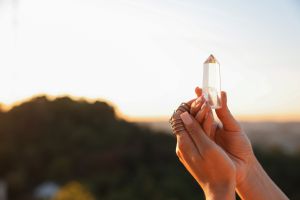

Every crystal, mineral, fossil, meteorite, and handcrafted piece is selected with purpose. Whether you’re building a museum-worthy mineral collection, searching for a meaningful gift, decorating your home with natural beauty, or beginning your journey into the world of geology, you’ll discover authentic specimens with stories worth sharing.
Over 15 shows a year throughout the Southwest. Check to see if we are coming to a show near you!
Home > Blog > Crystal Healing Blog | Benefits, Chakras & Reiki Stones > How to Set Intentions With Crystals: Charging, Programming & Personal Practice
Setting an intention with a crystal is one of the simplest practices in modern crystal work, but it is also one of the easiest to overcomplicate. You do not need an elaborate ceremony, a perfect moon phase, a collection of rare stones, or a memorized set of rules. At its heart, intention work is about choosing something meaningful, giving it your focused attention, and using a physical object as a continuing reminder of that purpose.
A person might choose Rose Quartz while working on self-compassion, Black Tourmaline while establishing stronger boundaries, Citrine while building a business, Clear Quartz while clarifying a goal, or Amethyst while developing a meditation practice. The crystal does not have to represent an enormous life change. An intention can be as practical as finishing a project, speaking more thoughtfully, maintaining a new routine, or making time each evening to become quiet.
Within metaphysical traditions, crystals are often described as being programmed, charged, or activated with intention. These words are sometimes used interchangeably, even though they can describe different parts of the practice. Understanding those differences makes crystal work more personal and considerably less confusing.
There is also another side to the subject that matters at Grounded Lifestyles. A crystal is simultaneously a metaphysical object, a personal symbol, and a real mineral formed through geological processes. Its chemical composition, crystal structure, color, hardness, inclusions, and formation history exist independently of whatever intention we associate with it.
That combination is part of what makes crystals interesting. A piece of Quartz may have formed millions of years before you held it, yet it can become connected with something happening in your life today.
If you are new to crystal practice, our Crystal Healing: History, Science, Metaphysical Beliefs & Modern Practice provides the broader foundation for understanding how geology, history, symbolism, energy traditions, Reiki, chakras, meditation, and modern crystal practices intersect.
An intention is a deliberately chosen direction for your attention or behavior.
That distinction matters because an intention is not exactly the same as a wish. A wish usually focuses on an outcome: I wish this would happen. An intention focuses more closely on how you want to participate in creating or responding to that outcome.
Instead of “I want my business to become successful,” an intention might be, “I will make consistent decisions that help my business grow.”
Instead of “I don’t want to feel overwhelmed,” it might become, “I will protect time for rest and focus on what I can control.”
Instead of “I want a better relationship,” the intention might be, “I will communicate clearly and listen before reacting.”
The crystal gives that intention a physical form.
Every time you see, touch, wear, or deliberately work with the stone, it can bring the original intention back into awareness. Within metaphysical traditions, practitioners may also view the stone as carrying, holding, amplifying, or interacting energetically with that intention.
These perspectives do not have to compete. A crystal can simultaneously hold spiritual meaning, participate in a metaphysical practice, and function as a tangible reminder of a conscious commitment.
These four terms are frequently mixed together, but separating them makes the process easier to understand.
Cleansing generally refers to clearing or resetting a crystal before or after use. Depending on the tradition, this may involve smoke, sound, Reiki, moonlight, another crystal, visualization, or other practices.
Charging refers to refreshing or intentionally energizing a crystal. Moonlight, sunlight when appropriate for the mineral, Reiki, Selenite, Clear Quartz, sound, and personal energy practices are commonly used.
Programming means giving the crystal a specific purpose or intention. This is the stage where you decide what the stone represents in your practice.
Using the crystal means bringing that intention into ordinary life. You might carry the stone, wear it, meditate with it, place it on a desk, include it in Reiki, build it into a crystal grid, or keep it somewhere you will regularly encounter it.
The terminology varies among practitioners, and there is no universal authority governing how every metaphysical tradition must use these words. What matters more is understanding what you are doing and why you are doing it.
Many crystal practitioners prefer to cleanse a stone before programming it, particularly when it is newly acquired, has been handled frequently, has been used for a previous intention, or simply feels ready for a reset.
It is not necessary to turn this into a complicated rule.
A new mineral specimen has already experienced an extraordinary physical journey. It formed within the Earth, was exposed or mined, collected, transported, perhaps cut or polished, handled, displayed, sold, packaged, and eventually arrived with you. In metaphysical practice, cleansing can symbolically mark the moment when that long journey ends and your relationship with the stone begins.
Smoke cleansing is one traditional approach used by many modern practitioners. Sound, Reiki, visualization, and other non-contact methods are also useful because they do not depend upon the mineral’s physical tolerance for water, salt, or sunlight.
Our guide to Burning Sage, Space Clearing, Energy Cleansing & Spiritual Renewal explores smoke-based clearing practices in greater depth.
Physical safety still matters. Some crystals should not be soaked in water, exposed to salt, or left for extended periods in strong sunlight. Metaphysical cleansing and physically cleaning a mineral are two different things, and a method that is symbolically meaningful should never require damaging the specimen.
For questions about stones and water, see The Crystal Water Debate: Which Stones Are Safe or Unsafe?.
There are several perfectly reasonable ways to choose a crystal.
Some people begin with traditional crystal meanings. Others choose according to color, chakra association, zodiac correspondence, mineral type, appearance, personal history, or simple attraction. Experienced collectors may feel drawn toward the geology or provenance of a specimen just as strongly as another person responds to its metaphysical meaning.
There is no requirement that every choice begin with a crystal meaning chart.
If you already have a stone that continually catches your attention, start there. Ask yourself what you associate with it and why you keep returning to it.
If you prefer traditional correspondences, choose a stone whose established metaphysical meaning fits your purpose.
Rose Quartz is commonly associated with love, compassion, and self-love. Black Tourmaline is associated with grounding, protection, and boundaries. Citrine is widely connected with prosperity, optimism, and confidence. Carnelian is associated with creativity, motivation, and action. Amethyst is traditionally used for intuition, reflection, and spiritual practice. Smoky Quartz is commonly chosen for grounding and release.
Clear Quartz occupies a particularly flexible place in modern crystal practice because it is commonly used with many different intentions.
The important part is not finding the one universally “correct” crystal. It is choosing a stone whose meaning makes sense to you and to the practice you are creating.
Clear Quartz appears repeatedly in intention work, crystal grids, Reiki, meditation, and other metaphysical practices.
Geologically, Quartz is crystalline silicon dioxide, SiO₂, and one of Earth’s most important mineral groups. It forms in an enormous range of geological environments and occurs in everything from small crystals to dramatic clusters and large points.
Quartz also has measurable physical properties, including piezoelectric behavior, that have made carefully engineered quartz components useful in watches, electronics, sensors, and other technologies.
Those technological applications should not be confused with metaphysical crystal programming. Setting an intention into a Quartz point is not the same process as engineering a quartz oscillator.
Within metaphysical traditions, however, Quartz’s clarity, crystalline structure, abundance, and long history of use have made it a natural symbol of amplification and focused intention.
That is why Clear Quartz can work well when your intention does not fit neatly into another crystal correspondence.
Learn more about the mineral itself in Why Quartz Is King, or explore currently available pieces in our Quartz collection.
There is no single required ceremony, but a simple process works extremely well.
Begin by choosing the crystal and deciding what you want it to represent. Sit somewhere relatively quiet and hold the stone in your hand or place it in front of you.
Spend a moment looking at the actual specimen. Notice its color, temperature, weight, texture, crystal faces, inclusions, polish, banding, or other characteristics. This small step is useful because it moves the practice away from abstraction and toward the physical object you are actually holding.
Then state the intention clearly.
You can speak it aloud, repeat it silently, write it in a journal, or place a written intention beneath the stone.
Keep the wording simple enough that you will remember it.
For example:
I choose to communicate clearly and listen carefully.
I am creating consistent habits that support my goals.
I protect my time and maintain healthy boundaries.
I make room for creativity in my daily life.
I release what I can no longer change.
I approach this new chapter with curiosity rather than fear.
Hold the crystal for another few moments while focusing on what that intention would actually look like in your life.
Then put the stone somewhere it can participate in the practice.
That last step is more important than making the ceremony elaborate.
The most useful intentions tend to be specific enough to guide behavior but broad enough to remain relevant.
“I want abundance” is understandable, but it leaves the word abundance undefined. Does it mean earning more money, finding new customers, spending less, feeling grateful for what you already have, building a savings account, or creating more professional opportunities?
A clearer intention gives the crystal a clearer role.
If you are using Citrine or Pyrite for business, your intention might be: I will consistently pursue opportunities that build a profitable and sustainable business.
If you are using Blue Lace Agate for communication: I will say what needs to be said calmly and listen before responding.
If you are using Black Tourmaline for boundaries: I can care about other people without taking responsibility for everything they feel.
If you are using Carnelian for creativity: I will make time to create instead of waiting until inspiration feels perfect.
The crystal then becomes connected with a recognizable choice rather than a vague desire.
You can, but more is not always better.
A single Clear Quartz point does not need to represent prosperity, protection, romance, confidence, sleep, creativity, spiritual awakening, communication, and a new career simultaneously.
A focused practice is usually easier to maintain.
If several goals are closely related, combining them can make sense. Confidence and communication, for example, may naturally belong together before a job interview. Grounding and boundaries can complement one another. Creativity and motivation often work well as a pair.
When the intentions are unrelated, using separate stones can make the practice more organized.
This is one reason Tumbled Stones are particularly practical for intention work. Their smaller size makes it easy to choose individual stones for different purposes, carry one during the day, or combine several intentionally without requiring a large collection.
Charging is usually understood as refreshing or adding energy to a crystal after cleansing or as part of an intention-setting practice.
Different traditions approach this in different ways.
Some practitioners place crystals in moonlight, particularly around the full moon. Others use brief sunlight exposure for minerals that tolerate it. Sound, Reiki, Selenite, Quartz clusters, visualization, prayer, breathwork, and meditation are also used.
Charging does not have to occur on a particular lunar date for the practice to be meaningful.
If moon phases are personally important, use them. A new moon can symbolize beginnings and intention-setting, while a full moon can represent culmination, illumination, gratitude, or release. Those associations can provide a useful rhythm for personal practice.
If lunar practice does not resonate with you, there is no reason to force it.
The most useful method is one that you can perform safely, intentionally, and consistently.
Reiki offers a particularly adaptable way to charge crystals because it does not require water, salt, or prolonged exposure to sunlight.
A practitioner may hold the crystal between the hands, enter their usual Reiki practice, focus on the chosen intention, and allow the session to unfold in the same manner as other Reiki work.
Those attuned to Reiki II or higher may incorporate symbols according to their lineage and training.
Some practitioners charge a single stone. Others work with an entire crystal grid or collection.
Our Role of Reiki in Crystal Energy Work explores Reiki-charged crystals, biofield research, Reiki practice, grids, chakra work, and the relationship between traditional energy concepts and current research in considerably greater depth.
This distinction is worth emphasizing because the terms are so frequently blended together.
Charging is about energy within the metaphysical framework.
Programming is about purpose.
You can charge a crystal without assigning it a specific intention. A person might place a collection in moonlight simply as part of a regular energetic practice.
You can also program a crystal without performing a separate charging ritual. Holding a stone, stating an intention, and then using it as a daily reminder may be the entire practice.
Many people do both: cleanse the crystal, charge it according to their preferred tradition, and then program it with a specific intention.
None of these approaches needs to be treated as the only correct method.
Once you have set the intention, the most important part begins: actually using the crystal.
A pocket stone can be touched when you need to reconnect with the intention. A piece of jewelry can remain with you throughout the day. A mineral specimen can sit on a desk where you see it while working toward a professional goal.
A Rose Quartz piece associated with self-care might remain beside a journal. Black Tourmaline associated with boundaries might be kept near a workspace or entrance. Citrine or Pyrite associated with business goals may be placed in an office. Amethyst associated with meditation might remain in the area where you practice.
The placement should make sense in relation to the intention.
A crystal hidden in a drawer and forgotten for six months may still be a beautiful mineral, but it is not doing much as a reminder of a personal commitment.
Jewelry offers one of the easiest ways to integrate an intention into everyday life because the stone travels with you.
A pendant can be touched before an important conversation. A bracelet may become a visual reminder during work. Earrings or other gemstone jewelry can carry personal symbolism while still functioning simply as something beautiful to wear.
This is also where metaphysical practice and ordinary enjoyment can overlap comfortably. You do not have to choose between appreciating a gemstone aesthetically and assigning personal meaning to it.
Our Crystal & Gemstone Jewelry collection includes natural stones that can be chosen for color, mineral interest, symbolism, or any combination of the three.
Crystal points are especially popular in modern metaphysical practice because their geometry naturally suggests direction.
Practitioners often position a point toward something they wish to direct attention or energy toward, or outward when the symbolism involves expansion.
A Clear Quartz point might sit beside a written business goal. An Amethyst point might become the focal piece in a meditation area. Several smaller points can be incorporated into a grid around a central stone.
Natural crystal termination and polished tower shapes are not geologically identical, but both can function symbolically within a personal practice.
Browse Crystal Points if you want to explore different minerals and forms for meditation, displays, grids, or intention work.
Crystal grids take the idea of programming a single stone and extend it into an arrangement.
A central stone may represent the primary intention while surrounding stones contribute related meanings. Clear Quartz points are frequently used directionally, while tumbled stones make useful supporting pieces because they are small and easy to arrange.
For example, an abundance grid might combine Citrine, Pyrite, Green Aventurine, and Clear Quartz. A grounding grid could include Black Tourmaline, Smoky Quartz, Hematite, and Red Jasper. A relationship-focused grid might incorporate Rose Quartz, Rhodonite, Green Aventurine, and Clear Quartz.
The geometry becomes part of the symbolism, while the act of deliberately building the arrangement keeps attention focused on the intention.
Grounded Lifestyles also offers a Crystal Grids for Beginners guide through our Free Crystal & Mineral E-Book Library, including layouts for abundance, love, protection, and creativity.
Intentions can also be organized around the chakra system.
Someone working with communication might choose a Throat Chakra stone such as Blue Lace Agate or Sodalite and create an intention centered on speaking honestly.
Heart-centered work might use Rose Quartz, Green Aventurine, Rhodonite, or another traditionally associated stone while focusing on compassion, relationships, forgiveness, or self-worth.
Root Chakra practices often use Black Tourmaline, Hematite, Smoky Quartz, or Red Jasper with intentions involving grounding, stability, security, or boundaries.
The stone does not need to remain permanently assigned to that chakra. The correspondence simply provides one framework for choosing it.
For a deeper look at these relationships, explore Chakras and Corresponding Crystals and Chakra Alignment with Crystals.
Astrology provides another established framework for choosing crystals.
Rather than selecting a stone solely according to an immediate goal, some people begin with crystals traditionally associated with their zodiac sign and then choose among those stones according to the qualities they want to emphasize or balance.
An Aries might choose Carnelian when beginning something new but Hematite when patience is more important. Taurus may choose Jade for long-term growth or Malachite when change is overdue. Gemini might use Blue Lace Agate for communication or Fluorite when too many ideas need organizing.
Cancer may gravitate toward Moonstone for reflection or Black Tourmaline for boundaries, while Leo might choose Sunstone for confidence or a grounding stone when intensity needs balance.
The same principle works throughout all twelve signs: a zodiac association gives you a starting collection, while intention determines which stone within that collection is most useful at a particular moment.
Our complete zodiac crystal series begins with Crystals for Aries and continues through all twelve signs in the Crystal Healing section of Mine to Mind.
No.
A person can work with crystals in a deeply spiritual way, incorporate them into Reiki or chakra practice, or simply use them as meaningful physical reminders.
You might keep Fluorite beside your computer because it represents concentration. That does not require a ceremony.
You might carry Carnelian while trying to rebuild a creative habit.
You might place Smoky Quartz on your desk as a reminder not to carry work stress into the evening.
Someone else may use the same stones within prayer, meditation, Reiki, astrology, or another spiritual practice.
Personal practice does not need to look identical from one person to another.
There is an interesting psychological dimension to intention work that exists alongside metaphysical interpretations.
Human attention is selective. We constantly encounter more information than we can consciously process, so what we deliberately focus on influences what we notice and remember.
Ritual can help give that focus structure.
Writing an intention, choosing a crystal, holding it during meditation, and placing it somewhere meaningful creates a repeated association between the physical object and the chosen purpose.
That does not mean every experience people report with crystals can be reduced to a single psychological explanation. It does show why intentional ritual can remain personally meaningful even when people hold different beliefs about crystal energy.
Our article Crystal Healing & the Placebo Effect: Science, Ritual, Meaning & the Mystery of Experience explores this intersection between expectation, attention, ritual, subjective experience, biofield research, and crystal practice in greater depth.
No.
Traditional correspondences are useful because they give us a shared language, but your personal relationship with a mineral can matter just as much.
Suppose you inherited a piece of Amethyst from your grandmother. Its meaning to you may center on family, memory, continuity, or love regardless of what a crystal reference book says.
A piece collected during an important trip may symbolize independence. A mineral purchased after accomplishing a difficult goal may become associated with perseverance. A stone chosen with a partner may represent that relationship.
Those meanings are not less legitimate because they are personal.
In fact, some of the most meaningful objects in human culture derive their importance from the stories attached to them rather than from a standardized list of attributes.
Absolutely.
Life changes, and a crystal does not have to remain assigned to one purpose forever.
If you used a Clear Quartz point while building a business and later want to incorporate it into meditation, you can reset the practice.
Many people begin by cleansing the stone according to their preferred tradition. They may then leave it unprogrammed for a period or immediately set a new intention.
You do not need to worry that you have permanently “locked” the crystal into the old purpose.
The process can be as simple as acknowledging that the previous intention is complete, expressing gratitude for the role the stone played, cleansing or resetting it, and choosing the next purpose.
Some intentions have obvious endpoints.
You may have used a crystal while completing a degree, preparing for an interview, moving into a new home, finishing a major project, or navigating a specific transition.
Others are ongoing. Compassion, creativity, communication, spiritual development, boundaries, and mindfulness do not necessarily have finish lines.
When a specific intention has been fulfilled, acknowledging its completion can become part of the practice.
You might journal about what changed, cleanse the crystal, move it back into your collection, assign it a new intention, or simply display it as a reminder of that period in your life.
Over time, crystals can accumulate personal history as well as geological history.
That is one reason a collection can become much more than an assortment of attractive minerals.
There is no required schedule.
You do not need to reprogram your crystals every week simply because a calendar tells you to.
Reset a stone when the intention no longer feels relevant, when a specific goal has been completed, when you want to use it for something different, or when your practice simply feels ready for a change.
Some people enjoy aligning this process with a new moon, full moon, birthday, solstice, equinox, new year, or another personally meaningful date.
Others change intentions whenever circumstances change.
Consistency can make ritual meaningful, but rigid rules are unnecessary.
One of the most common mistakes is making the process so elaborate that it never actually happens. If setting an intention requires twelve crystals, a particular hour, a specific lunar phase, five accessories, and a perfect meditation environment, the ritual can become an obstacle rather than a tool.
Another is choosing a vague intention that has no relationship with daily life. “I want success” provides less direction than identifying what successful action looks like this week.
It is also easy to confuse collecting with practicing. Buying another crystal can be enjoyable, but a larger collection does not automatically create a deeper personal practice.
Finally, avoid using metaphysical instructions that can physically damage your specimens. Not every crystal belongs in water, salt, direct sunlight, or outdoors. The mineral still deserves proper care regardless of its spiritual meaning.
A meaningful crystal practice can be extremely simple.
Choose one stone.
Choose one intention.
Decide where that stone will live or how you will carry it.
Return to the intention regularly.
Then pay attention to what happens—not because every event must be interpreted as a sign, but because reflection is part of the process.
You may discover that carrying Black Tourmaline reminds you to say no more often. A Citrine point on your desk may bring your business goal back into focus every morning. Rose Quartz beside a journal may become associated with a nightly self-reflection practice.
The crystal becomes woven into the routine because you repeatedly give it meaning.
That is personal practice.
Programming a crystal means assigning it a particular intention or purpose within a metaphysical or personal practice. This usually involves choosing the stone, focusing on the intention, stating or writing it clearly, and then using the crystal as part of that practice.
Not necessarily. Programming generally refers to assigning purpose, while charging refers to refreshing or energizing the crystal according to a particular metaphysical tradition. Many practitioners combine the two practices.
Many practitioners prefer to cleanse a crystal first, especially if it is newly acquired or was previously used for another intention, but there is no universal requirement. Smoke, sound, Reiki, visualization, and other non-contact methods are commonly used.
Clear Quartz is one of the most versatile choices because modern metaphysical traditions associate it with amplification and a wide range of intentions. However, any crystal can be used if its traditional or personal meaning fits your purpose.
Yes. Tumbled stones are particularly practical because they are small, portable, comfortable to hold, and easy to carry throughout the day.
Yes. Jewelry works especially well for intention practice because the stone remains visible or physically present during everyday activities.
It can, particularly when the intentions are related, but a focused intention is usually easier to work with. Separate stones can be useful when goals are very different.
There is no required amount of time. A few focused minutes may be enough. The continuing relationship between the stone and the intention is generally more important than the length of the initial ritual.
No. Full-moon charging is a popular modern practice, but it is not required. Reiki, sound, visualization, Selenite, Clear Quartz, and other approaches can also be incorporated depending on personal tradition.
Yes. Cleanse or reset the stone according to your preferred practice, acknowledge the previous intention, and assign a new one.
You do not have to, but writing can make the intention clearer. Some practitioners keep the statement in a journal, beneath the crystal, or beside a crystal grid.
Yes. Intentions do not need to be exclusively spiritual. Crystals can become personal symbols for creativity, organization, professional confidence, saving money, completing a project, establishing boundaries, or developing a consistent routine.
Place it somewhere connected with the intention. A business stone might stay on your desk, a meditation stone in your practice area, a relationship stone beside a journal or bed, and a pocket stone can travel with you.
Tumbled Stones are one of the easiest places to begin because they are portable and can be assigned individual intentions. Crystal Points work especially well for displays and grids, while Crystal & Gemstone Jewelry allows an intention stone to remain with you throughout the day. You can also explore the complete Minerals & Crystals collection or browse the Grounded Lifestyles Shop.
Setting an intention with a crystal does not require a complicated ritual. Choose a stone that has meaning for you, decide what you want it to represent, state that intention clearly, and place the crystal where it can remain part of your actual life. Cleansing can mark a reset, charging can become part of your energetic tradition, and programming gives the stone a specific purpose, but the practice becomes meaningful through the relationship you continue to build with it.
Explore more through our Crystal Healing Guide, Reiki and Crystal Energy Work, Chakras and Corresponding Crystals, and Free Crystal & Mineral E-Book Library, or browse Tumbled Stones, Crystal Points, and the complete Grounded Lifestyles Shop to choose a stone for your own practice.
At Grounded Lifestyles, our love for crystals began in the peaceful flow of Reiki and energy healing sessions — where we saw how natural stones could amplify intentions, restore balance, and bring comfort. But the more time we spent with these treasures, the more curious we became about their origins. That curiosity led us into the fascinating world of geology and mineral specimen collecting. We fell in love not just with the energy of crystals, but with the science and artistry of their creation — the intricate crystal structures, the vibrant mineral hues, and the wonder of holding a piece of Earth’s history in our hands.

