

Every crystal, mineral, fossil, meteorite, and handcrafted piece is selected with purpose. Whether you’re building a museum-worthy mineral collection, searching for a meaningful gift, decorating your home with natural beauty, or beginning your journey into the world of geology, you’ll discover authentic specimens with stories worth sharing.
Over 15 shows a year throughout the Southwest. Check to see if we are coming to a show near you!
Home > Blog > Meteorites Blog | Space Rocks, Collecting & Meaning > Sikhote-Alin Meteorite1947
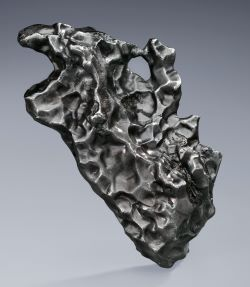
On the morning of February 12, 1947, residents of the Russian Far East witnessed one of the most dramatic meteorite falls of the twentieth century. A brilliant fireball crossed the daylight sky over the Sikhote-Alin mountain region of Primorsky Krai, leaving a long smoke and dust trail behind it before the incoming iron mass fragmented violently in the atmosphere. Explosions echoed across the landscape, thousands of pieces of extraterrestrial iron fell into the snow-covered forest, and the largest fragments struck the frozen ground with enough energy to excavate craters. What remained was an enormous strewn field filled with everything from twisted pieces of shrapnel to beautifully sculpted individual meteorites whose surfaces preserve the physical effects of their passage through Earth’s atmosphere.
The event became known as the Sikhote-Alin meteorite fall, and it remains one of the great witnessed iron meteorite falls in modern history. The Meteoritical Bulletin officially classifies Sikhote-Alin as an Iron, IIAB meteorite and records approximately 23 tonnes of recovered material. Its importance extends well beyond its impressive mass because the fall was witnessed in daylight, investigated scientifically soon afterward, and preserved in an extraordinary range of fragment shapes. Collectors can hold a sculpted individual displaying deep regmaglypts, a violently torn shrapnel fragment, or an etched slice exposing the internal iron-nickel structure, with each form preserving a different part of the meteorite’s story.
Sikhote-Alin is therefore an unusually complete teaching meteorite. Its chemistry connects it with an ancient metallic parent body, its internal structure records extraordinarily slow cooling before it reached Earth, its sculpted surfaces preserve atmospheric ablation, and its shrapnel forms record catastrophic fragmentation. The craters left in the forest provide another chapter, showing what happened when some of the surviving pieces retained enough energy to strike the ground at high velocity. Few meteorites allow collectors to see so many stages of planetary and atmospheric history in material that remains obtainable on the collector market.
The Sikhote-Alin fall occurred during daylight at approximately 10:30 in the morning on February 12, 1947. Witnesses across a broad area described an exceptionally bright fireball moving across the winter sky, followed by a persistent smoke and dust trail. The event was bright enough to attract immediate attention even against daylight, and the explosions associated with fragmentation were heard across the surrounding region. Artist P. I. Medvedev witnessed the event and later produced the famous painting showing the brilliant descending fireball and its long smoke trail, an image that has become inseparable from the history of Sikhote-Alin.
Before entering the atmosphere, the meteoroid was far larger than the fragments collectors encounter today. Historical reconstructions have produced different estimates for its original mass, and figures around many tens of tonnes are commonly cited, with some estimates approaching roughly 100 tonnes. Exact reconstruction of an object destroyed during atmospheric entry necessarily carries uncertainty, so the important point is not one precise pre-entry number but the enormous difference between the original body and the fragmented material eventually scattered across the ground.
As the meteoroid penetrated deeper into the atmosphere, aerodynamic forces and increasing pressure began breaking the iron body apart. Material was removed from exposed surfaces through ablation while mechanical stresses fractured the mass into progressively smaller pieces. Some fragments separated early enough to continue traveling independently through the atmosphere, allowing their surfaces to be sculpted and rounded by ablation. Other pieces were produced during more violent late-stage fragmentation and retained the torn, jagged forms now described by collectors as shrapnel.
The surviving fragments eventually fell across a forested strewn field in the Sikhote-Alin region. Some smaller pieces lost much of their cosmic velocity and descended without excavating major craters, while larger fragments retained enough energy to strike the frozen ground violently. Field investigations documented numerous impact pits and craters, including a largest crater measuring roughly 26 meters across. The combination of an observed atmospheric breakup, a large strewn field, and actual impact craters makes Sikhote-Alin particularly valuable for understanding what happens when a substantial iron meteoroid encounters Earth’s atmosphere.
Sikhote-Alin is an iron meteorite belonging to chemical group IIAB. Unlike ordinary chondrites, which consist primarily of silicate minerals, iron meteorites are dominated by metallic iron and nickel. Their composition represents a very different type of planetary material and is generally associated with metal that underwent segregation and extremely slow cooling within an asteroid-sized parent body during the early history of the Solar System.
The official IIAB classification places Sikhote-Alin among iron meteorites sharing characteristic chemical relationships. Nickel is an important component, along with cobalt, phosphorus, sulfur, and trace elements used in meteorite classification. The older collector literature may sometimes use slightly different group terminology because iron-meteorite classification has changed as analytical methods and group definitions have improved, which is why the current Meteoritical Bulletin classification is the best reference when labeling a specimen today.
Structurally, Sikhote-Alin has traditionally been described as a coarsest octahedrite, reflecting the extremely broad kamacite structures visible when suitable material is cut, polished, and etched. Kamacite and taenite are iron-nickel alloys that developed during extraordinarily slow cooling inside the parent body. Phosphide and sulfide minerals can also occur within the metal, adding another layer to the meteorite’s internal mineralogy.
This internal structure provides a striking contrast with what happened in 1947. The metal had spent an immense span of time cooling and crystallizing within its parent body, only to experience violent fragmentation during a matter of seconds as it entered Earth’s atmosphere. A Sikhote-Alin specimen therefore preserves processes operating at radically different timescales: planetary cooling over millions of years and atmospheric destruction occurring almost instantaneously.
Readers unfamiliar with the terminology used for irons, chondrites, achondrites, pallasites, and planetary meteorites can explore our Meteorite Classification guide for a broader explanation of how meteorites are organized scientifically.
Iron meteorites are often described casually as pieces of asteroid cores, and that idea is useful as a starting point, although the actual history of individual iron groups can be more complicated than a simple intact core breaking apart. The essential process involves early planetary bodies becoming hot enough for metal and silicate material to separate. Dense iron-nickel metal could migrate away from silicate-rich material, creating metallic reservoirs that later cooled over immense periods of time.
As the metal cooled, different iron-nickel phases developed according to temperature and composition. The structures exposed in etched iron meteorites are possible because the metal cooled extraordinarily slowly inside a larger body, allowing kamacite and taenite to develop relationships that cannot be reproduced by simply melting ordinary terrestrial iron and letting it cool quickly. The familiar Widmanstätten-type structures seen in many etched irons are therefore records of planetary cooling rather than patterns produced during atmospheric entry.
Eventually, collisions disrupted the parent body or bodies associated with the IIAB meteorites. Fragments of metal were liberated, and subsequent collisions and orbital changes could move smaller pieces through the asteroid population until some entered Earth-crossing trajectories. Sikhote-Alin’s final arrival in 1947 was therefore only the last stage of a history that began during the early development of the Solar System.
This is one of the reasons iron meteorites are so effective for teaching planetary science. They may look deceptively simple because their polished surfaces are dominated by metal, yet their chemistry and structure preserve information about differentiation, cooling, impact disruption, and the long dynamical process that eventually brings asteroid material to Earth.
One of the great pleasures of collecting Sikhote-Alin is that two authentic specimens from the same fall can look almost unrelated. Some are rounded and deeply sculpted, with smooth surfaces and prominent depressions, while others resemble torn pieces of industrial metal with jagged edges and twisted forms. These differences are not merely cosmetic; they preserve different stages of the meteoroid’s breakup.
The beautifully sculpted pieces are generally described as individuals or ablated individuals. Many display regmaglypts, the rounded thumbprint-like depressions commonly associated with iron meteorites. These forms developed as material was removed unevenly from the surface during high-speed atmospheric flight. Flow lines, lips, rounded edges, and other orientation-related features may also survive on especially well-preserved pieces, allowing collectors to study how molten surface material moved while the fragment traveled through the atmosphere.
Shrapnel specimens preserve a much more violent appearance. Their surfaces can be jagged, twisted, torn, or sharply fractured because they formed during catastrophic mechanical breakup rather than receiving enough independent atmospheric flight to become fully sculpted. Some show evidence of deformation and fragmentation that makes them look almost manufactured until their history is understood. The distinction between a sculpted individual and a shrapnel fragment gives collectors an unusual opportunity to own two pieces from the same event that document different physical processes.
Neither form is automatically “better.” A beautifully regmaglypted individual may command attention because it looks exactly like the classic image of an iron meteorite, while an exceptional shrapnel fragment can tell the atmospheric fragmentation story much more dramatically. Collectors often eventually acquire examples of both because together they make the 1947 event easier to understand.
Regmaglypts are among the most recognizable features of Sikhote-Alin individuals. These rounded depressions are often compared with thumbprints pressed into soft clay, although they were produced through aerodynamic ablation rather than physical impressions. As the fragment moved at high speed through the atmosphere, extreme heating affected its surface and material was removed unevenly, gradually sculpting the exterior.
Atmospheric heating is sometimes misunderstood as evidence that an entire meteorite becomes molten. In reality, intense heating is concentrated near the exterior during the short period of atmospheric passage. Material can melt and ablate from the surface while the interior remains comparatively cool. This is why meteorites can preserve internal structures that developed long before atmospheric entry rather than being completely melted and recrystallized on the way down.
On particularly attractive Sikhote-Alin individuals, regmaglypts may combine with ridges, flow lines, rollover lips, and other surface structures. These features can provide clues about how a fragment was oriented or whether its orientation changed during flight. Collectors often prize pieces where the atmospheric sculpting is especially well preserved because the exterior effectively records the physical interaction between extraterrestrial metal and Earth’s atmosphere.
Surface preservation also helps explain differences in value. Two specimens of similar mass can have very different collector appeal if one preserves a complete sculpted form with deep regmaglypts while the other is an ordinary fragment. Weight matters in meteorite collecting, but morphology can matter just as much.
Shrapnel fragments tell a different part of the story because their torn shapes reflect the catastrophic breakup of a large iron body under enormous atmospheric stress. Instead of gradually developing rounded aerodynamic forms during a long independent flight, many of these pieces separated late enough that their fracture surfaces remained sharp, twisted, and irregular.
The word “shrapnel” is a collector description rather than a statement that the meteorite behaved exactly like a manufactured explosive device. It is nevertheless visually appropriate because the pieces often resemble fragments of violently torn metal. Their form provides a direct reminder that even an iron meteoroid can be overwhelmed by the stresses of atmospheric entry.
Large fragments striking the ground added another stage of deformation. Pieces associated with impact pits and craters could experience additional shock and mechanical damage during collision with frozen soil and rock. The final shape of an individual Sikhote-Alin specimen may therefore reflect a combination of pre-existing fractures, atmospheric fragmentation, ablation, and ground impact rather than one single process.
For a collector, this history makes shrapnel much more interesting than simply treating it as the inexpensive alternative to a sculpted individual. A strong shrapnel specimen can be an excellent physical example of atmospheric fragmentation and impact mechanics, particularly when accompanied by reliable provenance.
Sikhote-Alin is unusual among collectible iron meteorites because the fall produced a documented field of impact pits and craters. Historical investigations recorded well over one hundred depressions of different sizes, with the largest crater approximately 26 meters across. The crater field demonstrated that some fragments remained energetic enough after atmospheric breakup to excavate frozen ground rather than simply falling at terminal velocity.
This distinction is important when discussing meteorite falls because not every meteorite creates an impact crater. Small fragments typically lose most of their cosmic velocity in the atmosphere and eventually fall under gravity at much lower speeds. Larger and denser pieces can retain considerably more energy, and Sikhote-Alin produced fragments massive enough to create genuine impact structures.
The strewn field therefore preserves a transition from atmospheric physics to impact geology. Above the forest, the meteoroid was breaking apart under aerodynamic forces; at the surface, surviving fragments transferred their remaining kinetic energy into soil, rock, vegetation, and the meteorites themselves. Studying the distribution and size of craters helped researchers reconstruct the fragmentation event and understand how different masses behaved during the final stages of descent.
For modern collectors, the crater field is also part of the provenance story. Sikhote-Alin is not an iron meteorite discovered centuries after an unknown fall. Its specimens can be connected with a specific event, date, region, atmospheric breakup, and documented impact field, giving even a modest fragment a historical context that many iron meteorites cannot match.
Natural individuals and shrapnel display what happened during atmospheric entry, but cutting and etching Sikhote-Alin reveals a much older history. A properly prepared slice exposes the internal iron-nickel structure that developed through extremely slow cooling inside its parent body, creating a visual contrast between the meteorite’s ancient planetary history and its violent arrival on Earth.
Sikhote-Alin is structurally very coarse, so its etched pattern is broader than the fine geometric pattern associated with meteorites such as Muonionalusta or Gibeon. That difference should not be interpreted as lower quality. The width and character of the metallic structure are related to composition and cooling history, and different iron meteorites preserve different internal textures.
Inclusions of sulfides and phosphides may also become visible in prepared sections. These phases contribute to the meteorite’s scientific interest but can influence long-term stability if moisture reaches reactive areas. A cut surface therefore offers information that a natural exterior cannot, although slicing inevitably sacrifices some of the meteorite’s original form.
Collectors sometimes face a genuine choice between preserving a complete individual and exposing its internal structure. With a beautifully sculpted Sikhote-Alin, keeping the meteorite intact often preserves more of the atmospheric story. With less distinctive fragments, cutting and etching can reveal an entirely different dimension of the specimen. Neither approach is inherently superior; they simply preserve different parts of its history.
Sikhote-Alin occupies an unusual position in meteorite collecting because it combines substantial availability with exceptional historical importance. The official Meteoritical Bulletin mass is approximately 23 tonnes, meaning far more material exists than from falls such as Winchcombe, where the entire recognized recovery amounts to only hundreds of grams. Sikhote-Alin is therefore not rare in the same sense as a tiny carbonaceous fall, yet that relative availability is one of its strengths because collectors can obtain genuine examples of a major witnessed event without necessarily entering the highest end of the meteorite market.
Its morphology gives the material additional appeal. Small shrapnel fragments can provide an accessible entry point for beginning collectors, while carefully sculpted individuals with deep regmaglypts appeal to advanced collections. Large complete specimens, exceptional oriented individuals, pieces with unusual atmospheric features, and historically documented material can occupy an entirely different level of the market.
The fall date also contributes to its character. A Sikhote-Alin specimen is connected with a precisely known event on February 12, 1947, rather than an ancient fall inferred from weathering or a meteorite discovered without witnesses. This allows the collector to connect the physical object with historical accounts, scientific expeditions, photographs, maps, artwork, and Soviet-era research.
The strongest collections therefore do not necessarily seek the largest piece available. A smaller specimen with exceptional morphology and excellent provenance may be more desirable than a heavier but visually ordinary fragment. As with mineral collecting, understanding what makes the specimen distinctive is more useful than judging quality by weight alone.
Comparing Sikhote-Alin with other classic irons demonstrates how much diversity exists within the category. Gibeon from Namibia is an IVA iron famous for beautifully developed etched patterns and a very different terrestrial history. Muonionalusta from northern Scandinavia is also prized for its etched structure, but it is an ancient find that spent an immense amount of time exposed to terrestrial weathering rather than a witnessed twentieth-century fall.
Campo del Cielo in Argentina provides another useful comparison because it is associated with a major prehistoric impact event and an enormous quantity of iron meteorite material. Campo specimens can be highly sculptural, but their surfaces record long terrestrial exposure in addition to atmospheric and impact processes. Sikhote-Alin, by contrast, was recovered beginning shortly after its 1947 fall, allowing collectors to examine comparatively fresh iron from a historically observed event.
These differences are why “iron meteorite” should never be treated as one uniform collecting category. Classification, fall history, weathering, morphology, internal structure, recovered mass, terrestrial age, and provenance all influence what an individual meteorite can teach us.
Sikhote-Alin’s availability has made it one of the most recognizable iron meteorites on the collector market, but appearance alone should never be considered proof of authenticity. Irregular pieces of terrestrial iron, industrial slag, manufactured metal, and artificially altered objects can all resemble meteorites to an inexperienced buyer. A trustworthy specimen should come from a dealer or collection capable of providing a clear identification and reasonable provenance.
For Sikhote-Alin, morphology can support the identification but should not replace documentation. Deep regmaglypts and sculpted surfaces are characteristic of many authentic individuals, while jagged shrapnel forms are also common, yet neither shape is exclusive to this fall. A specimen should be sold specifically as Sikhote-Alin with the recognized fall name and classification rather than merely as a “Russian iron meteorite.”
Older collection labels can add substantial historical interest. Material that passed through established meteorite collections, museums, scientific exchanges, or long-standing dealers may carry documentation connecting it to earlier generations of collecting. These labels should remain with the specimen because provenance can be difficult or impossible to reconstruct once it is lost.
Collectors should also be skeptical of dramatic claims that cannot be supported. A seller describing a specimen as crater-associated, a particular recovery type, or an unusually significant historical piece should have documentation appropriate to that claim. The meteorite itself is already remarkable enough without adding an invented story.
Readers wanting a broader foundation before purchasing meteorites can begin with our Meteorites: Ancient Space Rocks That Fall to Earth guide and then continue with Meteorite Classification to understand the terminology used by researchers and dealers.
Sikhote-Alin is dominated by iron-nickel metal, which means moisture is one of the most important long-term concerns. Even an apparently stable specimen can develop corrosion when exposed repeatedly to high humidity, condensation, salts, fingerprints, or unsuitable storage conditions. Natural individuals with intact surfaces may behave differently from cut slices because polished and etched metal exposes a fresh surface directly to the environment.
A dry display environment is therefore preferable. Small specimens can be kept in protective boxes or display cases with appropriate desiccant, while larger individuals should be protected from damp surfaces and large humidity changes. Bare metal should not be handled excessively because salts and oils from skin can remain on the surface, particularly on polished slices.
Some collectors protect prepared iron surfaces with microcrystalline wax or other conservation coatings, but coatings should be applied thoughtfully because they alter the surface and may complicate future treatment. If active corrosion develops, simply sealing the rust beneath a coating is not a complete solution. The source of moisture or contamination needs to be addressed first.
Sulfide and phosphide inclusions can create additional areas of concern in iron meteorites, particularly where a cut surface exposes them. This does not mean every Sikhote-Alin will rust aggressively, but regular inspection is worthwhile. Catching a small corrosion spot early is much easier than treating extensive deterioration after it has spread beneath a polished surface.
Few meteorites display as naturally as a sculpted Sikhote-Alin individual because the surface already tells much of the story without cutting or polishing. A simple acrylic stand or unobtrusive mineral mount allows light to move across the regmaglypts and ridges, making the atmospheric sculpting easy to see. The display label can then provide the essential information: Sikhote-Alin, Primorsky Krai, Russia; witnessed fall February 12, 1947; iron meteorite, group IIAB.
A shrapnel fragment benefits from a slightly different presentation because its importance lies in the violent fragmentation rather than smooth atmospheric sculpting. Displaying an individual and shrapnel fragment together can make an excellent educational pairing, particularly when accompanied by an etched section showing the internal metal structure. Three relatively modest specimens can therefore illustrate atmospheric ablation, catastrophic fragmentation, and planetary cooling more effectively than one enormous piece.
This museum-style approach works particularly well with meteorites because labels transform unusual pieces of metal into understandable natural-history objects. Our guide to Museum-Style Crystal, Fossil & Meteorite Displays offers additional ideas for combining specimens, labels, lighting, and stands without overwhelming the objects themselves.
Sikhote-Alin also has a place within modern metaphysical practice, particularly among people who use meteorites in Reiki, meditation, intention work, or personal collections. Its actual history provides unusually powerful symbolism because the specimen literally represents material that traveled through interplanetary space, survived catastrophic atmospheric fragmentation, and arrived on Earth during a witnessed event. Themes of transformation, resilience, decisive change, grounding, endurance, and cosmic perspective arise naturally from that history without needing to invent ancient traditions around a meteorite that fell in 1947.
Iron meteorites are often associated symbolically with strength and grounding because of their density, metallic character, and connection with differentiated planetary bodies. In chakra-oriented practices, Sikhote-Alin may be associated with the Root Chakra as a symbol of stability, physical presence, and grounding, while some practitioners connect its dramatic fall history with the Solar Plexus and themes of determination or personal agency. Others use meteorites in Third Eye or Crown meditation because contemplating an extraterrestrial object’s history can provide a powerful sense of scale and perspective.
Within Reiki or meditation, a Sikhote-Alin specimen can serve as a physical focal point rather than something that needs to be assigned a medical effect. Holding or displaying an object that spent most of its existence beyond Earth can encourage reflection on change, time, endurance, and the relationship between individual experience and the much larger history of the Solar System. These uses belong to modern metaphysical and spiritual traditions rather than scientifically demonstrated properties of iron meteorites, and individual interpretations naturally vary.
Sikhote-Alin remains one of the most effective meteorites for explaining how a large extraterrestrial body behaves during atmospheric entry. The observed fireball, atmospheric fragmentation, range of surviving specimen morphologies, strewn field, and impact craters provide a connected sequence that can be studied rather than reconstructed entirely from ancient evidence. A student can examine a sculpted individual and understand ablation, look at shrapnel and consider fragmentation, then study the crater field to see what happened when larger fragments retained substantial energy at impact.
The meteorite is equally useful for explaining planetary differentiation. Its iron-nickel composition and slowly developed internal structure point back toward processes occurring within early asteroid-sized bodies, long before the fragment entered an Earth-crossing orbit. An etched section therefore represents the ancient chapter of the story, while the exterior of a complete individual records events from only seconds before it reached the ground.
This combination gives Sikhote-Alin unusual educational depth. It connects early Solar System differentiation, metallic crystallization, asteroid collisions, orbital evolution, atmospheric entry, ablation, fragmentation, crater formation, terrestrial weathering, and modern collecting within one meteorite fall.
Sikhote-Alin is an iron meteorite classified in group IIAB. It consists predominantly of iron-nickel metal and has traditionally been described structurally as a coarsest octahedrite.
It fell on February 12, 1947, during a spectacular daylight event over the Sikhote-Alin mountain region of Primorsky Krai in the Russian Far East.
The Meteoritical Bulletin records an official mass of approximately 23 tonnes, making Sikhote-Alin one of the most massive officially recognized witnessed iron meteorite falls.
Historical estimates vary, with many reconstructions placing the pre-atmospheric mass in the range of many tens of tonnes and some estimates approaching roughly 100 tonnes. Because much of the original body was lost through ablation and fragmentation, the precise initial mass cannot be known directly.
Yes. Larger surviving fragments struck the ground with enough energy to produce numerous impact pits and craters. The largest documented crater was approximately 26 meters across.
Sculpted individuals generally separated early enough to experience substantial independent atmospheric ablation, which rounded and sculpted their surfaces. Shrapnel fragments formed during violent breakup and can retain jagged, torn, and twisted forms because they experienced a different fragmentation history.
They are called regmaglypts. They developed through uneven atmospheric ablation as material was removed from the meteorite’s surface during high-speed flight.
Cut, polished, and properly etched Sikhote-Alin can reveal a very coarse iron-nickel structure related to its extremely slow cooling history. Its pattern is much broader than the fine structures commonly associated with meteorites such as Muonionalusta.
The meteorite is finite and historically important, but with approximately 23 tonnes recorded it is not rare in the same way as meteorites represented by only a few kilograms or grams. Exceptional oriented individuals, large sculptural specimens, unusual morphologies, and pieces with strong historical provenance can nevertheless be considerably more difficult to replace.
Yes. Like other iron meteorites, it can corrode when exposed to moisture, salts, condensation, or unsuitable storage conditions. Keeping the specimen dry and inspecting it periodically are important parts of long-term care.
Modern metaphysical traditions may associate Sikhote-Alin with transformation, resilience, grounding, strength, decisive change, endurance, and cosmic perspective. These are symbolic and spiritual interpretations rather than scientifically demonstrated effects of the meteorite.
Sikhote-Alin is one of those rare meteorites whose story can be read from several different directions at once. Its iron-nickel interior reaches back to the early history of the Solar System, when heat and differentiation were reorganizing material inside young planetary bodies. Its slowly developed metallic structure records a period when the metal cooled under conditions entirely unlike anything experienced during its final arrival on Earth, while later collisions eventually freed material from its parent body and set the stage for a much longer journey through space.
Then, on February 12, 1947, that ancient history collided with human history. The incoming iron appeared over the Russian Far East as a brilliant daylight fireball before atmospheric stresses overwhelmed the body and broke it into thousands of pieces. Some fragments were sculpted during flight into rounded individuals covered with regmaglypts, others were violently torn into shrapnel, and the largest surviving masses struck the frozen landscape hard enough to excavate craters. Those different forms survive today as physical records of processes that unfolded during only a few moments.
That combination is what makes Sikhote-Alin such an important collector meteorite. A small shrapnel fragment can represent catastrophic atmospheric breakup, a deeply regmaglypted individual can preserve the effects of ablation, and an etched slice can reveal metallic structures created through extraordinarily slow cooling inside an ancient parent body. Collecting several forms is not simply collecting duplicates; it can be a way of assembling different chapters of the same planetary story.
Sikhote-Alin also demonstrates why meteorite value should not be reduced to rarity alone. Approximately 23 tonnes are officially recorded, making the material much more available than many famous falls, yet its documented history, remarkable morphology, scientific importance, and connection with one of the twentieth century’s great meteorite events keep it firmly among the classics. Provenance, condition, atmospheric features, specimen form, and the story preserved by the individual piece are ultimately more meaningful than simply asking whether the meteorite is “rare.”
Continue exploring the science behind Sikhote-Alin with our Meteorites: Ancient Space Rocks That Fall to Earth overview and Meteorite Classification guide. For comparisons with other classic iron meteorites, explore Gibeon, Muonionalusta, and Campo del Cielo, each of which preserves a very different combination of internal structure, terrestrial history, and collector appeal.
Explore the complete Grounded Lifestyles Meteorite Articles for additional guides covering meteorite science, classification, historic falls, planetary origins, identification, collecting, and care. To connect that educational material with documented specimens available to collectors, visit our Meteorites & Tektites Collection.

At Grounded Lifestyles, our love for crystals began in the peaceful flow of Reiki and energy healing sessions — where we saw how natural stones could amplify intentions, restore balance, and bring comfort. But the more time we spent with these treasures, the more curious we became about their origins. That curiosity led us into the fascinating world of geology and mineral specimen collecting. We fell in love not just with the energy of crystals, but with the science and artistry of their creation — the intricate crystal structures, the vibrant mineral hues, and the wonder of holding a piece of Earth’s history in our hands.

