

Every crystal, mineral, fossil, meteorite, and handcrafted piece is selected with purpose. Whether you’re building a museum-worthy mineral collection, searching for a meaningful gift, decorating your home with natural beauty, or beginning your journey into the world of geology, you’ll discover authentic specimens with stories worth sharing.
Over 15 shows a year throughout the Southwest. Check to see if we are coming to a show near you!
Home > Blog > Meteorites Blog | Space Rocks, Collecting & Meaning > Tatahouine Meteorite: Tunisia Real-Life “Tatooine” Space Rock
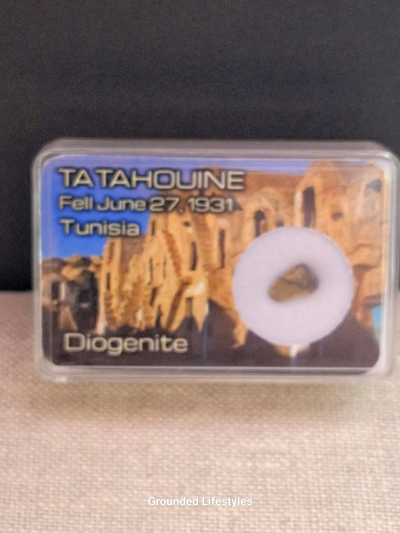
In the early hours of June 27, 1931, people near Tataouine in southern Tunisia witnessed a fireball crossing the desert sky before a shower of small stones reached the ground. The fragments were unlike the dark ordinary chondrites that make up many meteorite falls. Tatahouine is pale olive to yellow-green, unusually granular, and composed largely of individual pyroxene crystals that can give even a tiny fragment a distinctive crystalline appearance. Scientists eventually classified the material as a diogenite, placing it within the Howardite–Eucrite–Diogenite, or HED, family of achondritic meteorites.
That classification gives Tatahouine an extraordinary planetary connection. Decades of laboratory work, telescopic observations, and data returned by NASA’s Dawn spacecraft have established a strong relationship between HED meteorites and asteroid 4 Vesta, one of the largest bodies in the main asteroid belt. Instead of representing relatively primitive material like an ordinary chondrite, Tatahouine comes from a differentiated planetary body where melting separated materials and produced distinct crustal rocks. Its orthopyroxene-rich composition is consistent with rock formed deeper within that differentiated system.
The fall also occupies an unusual place where planetary science and popular culture overlap. Tatahouine takes its name from the region around the modern Tunisian town of Tataouine, and that same place name is widely associated with the inspiration for Tatooine, the fictional desert planet in Star Wars. The meteorite obviously did not come from the fictional world, but the coincidence is difficult to resist: an actual fragment of another planetary body fell beside a real desert town whose name would later become connected with one of cinema’s most recognizable imaginary planets.
For collectors, however, Tatahouine is much more interesting than the Star Wars connection alone suggests. It is a documented historic fall, a relatively uncommon type of achondrite, an important representative of the HED meteorites, and an unusually recognizable stone whose mineralogy can be seen even in small fragments. Understanding where it fits within the meteorite world turns an olive-green crumb of rock into a sample of planetary differentiation from another world.
Tatahouine is officially classified as a diogenite, a type of stony achondrite within the HED meteorite group. Achondrites differ fundamentally from ordinary chondrites because they generally lack the small rounded chondrules that characterize primitive chondritic meteorites. Instead, achondrites represent material that has been melted, recrystallized, differentiated, or otherwise geologically processed within a planetary body.
The HED family consists of howardites, eucrites, and diogenites, three groups whose relationships help scientists reconstruct the geology of their parent asteroid. Eucrites are broadly basaltic rocks associated with crustal volcanism. Diogenites are dominated by magnesium-rich orthopyroxene and are generally interpreted as samples of deeper plutonic material. Howardites are breccias containing mixtures of eucritic and diogenitic material that were broken up and recombined by impacts on the parent body’s surface.
Tatahouine belongs to the diogenite branch of this family and consists overwhelmingly of orthopyroxene. Its pale greenish crystals give the meteorite a very different appearance from the black matrix of a carbonaceous chondrite such as Winchcombe or the metallic surface of an iron meteorite such as Sikhote-Alin. Minor minerals can occur alongside the pyroxene, but it is the abundance and character of the orthopyroxene that define Tatahouine’s appearance and geological importance.
Because diogenites represent igneously processed material, Tatahouine provides evidence that its parent body became hot enough early in Solar System history for substantial melting and differentiation to occur. It therefore belongs to a very different chapter of planetary evolution from primitive meteorites that largely escaped melting.
Readers unfamiliar with the distinction between chondrites, achondrites, irons, pallasites, and planetary meteorites can begin with our Meteorite Classification guide.
One of the most important developments in modern meteorite science has been the increasingly strong connection between HED meteorites and 4 Vesta. Vesta is a large asteroid measuring hundreds of kilometers across and is massive enough to have experienced internal heating, differentiation, volcanism, and extensive impact processing. It is often described as a protoplanet because it preserves evidence of processes similar to those occurring during the early development of rocky planets.
Long before a spacecraft visited Vesta, astronomers noticed that spectra measured from the asteroid resembled laboratory spectra of HED meteorites. This suggested that the meteorites and asteroid shared similar surface minerals. NASA’s Dawn spacecraft later orbited Vesta and mapped its surface composition, geology, topography, and enormous impact basins, greatly strengthening the connection between the HED meteorites and this specific asteroid.
Diogenites such as Tatahouine are generally interpreted as material excavated from deeper within Vesta’s differentiated crust than most eucrites. This does not mean every diogenite must have formed at exactly the same depth or under identical conditions, because Vesta’s crust has experienced billions of years of impacts, heating, excavation, mixing, and reworking. The broader picture, however, is clear: Tatahouine represents igneous rock from a differentiated asteroid rather than primitive unprocessed Solar System dust.
This makes Tatahouine especially useful for understanding what differentiated asteroids looked like internally. On Earth, plate tectonics, weathering, volcanism, erosion, and metamorphism continually recycle ancient crust. Vesta lacks those same active geological systems, allowing rocks excavated by impacts to preserve aspects of planetary differentiation dating back to the beginning of Solar System history.
Tatahouine’s mineralogy reflects an environment in which molten or partially molten rock cooled slowly enough for relatively large orthopyroxene crystals to develop. Diogenites are often described broadly as orthopyroxenites because orthopyroxene makes up most of the rock, with smaller amounts of other minerals depending on the particular specimen.
The formation of this material required significant early heating of the Vesta parent body. Short-lived radioactive isotopes present during the earliest Solar System provided enough heat for some small planetary bodies to melt partially or extensively soon after they formed. Dense metallic material migrated inward while silicate melts differentiated into chemically distinct rock types, eventually producing crustal and deeper plutonic materials.
Tatahouine’s comparatively coarse pyroxene crystals are consistent with relatively slow crystallization compared with rapidly cooled surface lava. This is why diogenites are generally associated with deeper crustal or intrusive environments rather than simply representing volcanic flows exposed at the surface.
Later impacts excavated this material. Vesta’s southern hemisphere contains enormous impact basins, including Rheasilvia, whose formation removed tremendous quantities of rock and launched fragments into space. Some of that debris entered independent orbits around the Sun, while smaller Vesta-related asteroids and fragments gradually evolved onto trajectories that could eventually intersect Earth.
Tatahouine therefore represents only the final surviving piece of a much larger geological sequence: asteroid formation, internal heating, differentiation, crystallization at depth, impact excavation, interplanetary transport, atmospheric entry, and finally recovery in Tunisia.
Tatahouine is particularly valuable because it is a witnessed fall rather than a meteorite found with no known arrival date. On June 27, 1931, a bright meteor was observed over southern Tunisia, and numerous small fragments were subsequently recovered from the area near what was then commonly referred to as Foum Tatahouine.
The Meteoritical Bulletin records an official recovered mass of approximately 12 kilograms, although that total consisted of many separate fragments rather than one intact stone. The meteorite apparently fragmented extensively during atmospheric entry, producing numerous relatively small pieces.
This fragmentation helps explain why collector specimens are so often small. Tatahouine is naturally granular and tends to separate along the boundaries between its large orthopyroxene grains. Unlike a coherent ordinary chondrite that may survive as a rounded stone with a continuous fusion crust, Tatahouine can break into angular mineral-rich fragments whose appearance is unlike what many beginning collectors imagine a meteorite should look like.
Its witnessed-fall status adds scientific and historical value because the arrival date and location are known. Researchers do not have to estimate how long the meteorite has been exposed to Earth’s environment, as they must with ancient finds such as Muonionalusta. Every authentic Tatahouine specimen belongs to a specific documented meteorite event in June 1931.
Many meteorites are visually dark, particularly when fresh fusion crust covers their exterior. Tatahouine can surprise collectors because its interior is commonly pale olive-green, yellow-green, or greenish gray and visibly crystalline. Individual pyroxene grains may catch the light, producing a subtle sparkle across the broken surface.
The rock can also appear unusually friable or granular. Its large orthopyroxene crystals and tendency to break along grain boundaries mean that some specimens behave almost more like loosely bound mineral aggregates than dense conventional rocks. Rough handling can detach grains, particularly from already weathered or fractured fragments.
This texture gives Tatahouine an educational advantage because the mineralogy can be appreciated directly. A collector does not necessarily need a polished thin section or sophisticated analytical equipment to recognize that the specimen is composed predominantly of crystalline silicate material.
At the same time, appearance cannot authenticate a meteorite on its own. Terrestrial pyroxene-rich rocks can also be greenish and crystalline, which is why provenance remains essential. A tiny olive-colored fragment offered simply as “Tataouine desert meteorite” without documentation deserves skepticism regardless of how convincing it looks.
Tatahouine’s story contains more than slow crystallization inside Vesta. Its mineral grains also preserve evidence that the rock experienced impact shock before arriving on Earth. Vesta has been bombarded repeatedly throughout Solar System history, and diogenitic material excavated from its deeper crust could experience major shock events as impacts fractured, launched, and mixed rock across the asteroid’s surface.
Tatahouine has traditionally been described as relatively unbrecciated compared with many HED meteorites, meaning its individual mineral grains were not assembled into the obvious fragment-rich breccias characteristic of howardites. That does not mean it escaped impacts. Shock effects and grain-boundary fracturing demonstrate that the material still experienced violent events during its extraterrestrial history.
Those fractures may have contributed to its behavior during atmospheric entry. A rock already divided by mineral grain boundaries and ancient shock features can break readily when exposed to aerodynamic stress, helping produce the many small fragments associated with the 1931 fall.
The resulting specimens therefore preserve two distinct forms of fragmentation: ancient impacts affecting the material on or near Vesta, followed much later by atmospheric breakup above Tunisia.
A common oversimplification says that one giant impact knocked Tatahouine directly off Vesta and sent it straight toward Earth. In reality, the pathway from an asteroid to our planet is usually much more complicated.
Impacts can launch fragments from Vesta’s surface with enough velocity to escape the asteroid’s gravity. Once in independent heliocentric orbit, those fragments may spend millions of years within the asteroid population. Collisions can fragment them further, while gravitational interactions and orbital resonances gradually alter their trajectories.
Eventually some pieces migrate onto near-Earth or Earth-crossing orbits. Only then does collision with our planet become possible.
This long orbital history is why meteorites should not be imagined as rocks that simply fall directly from their parent asteroid. By the time Tatahouine reached Earth’s atmosphere in 1931, the fragment may have passed through several generations of collisions and orbital evolution since leaving its original geological setting.
For a broader introduction to these pathways, see Meteorites: Ancient Space Rocks That Fall to Earth.
One of the best ways to appreciate Tatahouine is to compare it with the other members of the HED family. Eucrites are broadly basaltic rocks associated with Vesta’s crust and volcanic history. They can resemble terrestrial basalts in some respects because both formed from silicate melts that cooled and crystallized into igneous rock.
Diogenites such as Tatahouine are dominated by orthopyroxene and generally represent deeper plutonic material. Their large crystals indicate a different cooling environment from the finer-grained volcanic rocks represented by many eucrites.
Howardites contain fragments of both eucritic and diogenitic material mixed together by impacts. They can be thought of as regolith breccias assembled from debris churned and recombined across Vesta’s battered surface.
Together, these meteorites provide something close to a geological cross-section through a differentiated asteroid. Instead of relying entirely on remote sensing, scientists can analyze actual pieces of crustal, deeper crustal, and impact-mixed material in laboratories on Earth.
That is what makes the HED-Vesta connection so powerful. Meteorites collected from deserts, ice fields, and witnessed falls can be compared with spacecraft observations of a specific asteroid hundreds of millions of kilometers away.
NASA’s Dawn spacecraft entered orbit around Vesta in 2011 and transformed understanding of the asteroid. The mission mapped its surface in detail, studied its elemental and mineral composition, measured gravity, documented enormous impact basins, and revealed an object that occupies a fascinating middle ground between ordinary asteroids and rocky planets.
For meteorite science, one of Dawn’s most important achievements was strengthening the connection between Vesta and HED meteorites. Spectral and compositional measurements from the spacecraft agreed closely with laboratory studies of HED samples, giving scientists much greater confidence that meteorites such as Tatahouine represent actual pieces of Vesta-related geology.
That connection turns Tatahouine into something unusual within a collection. The parent body is not merely inferred as an unknown vanished asteroid. Collectors can look at spacecraft images of Vesta, examine its giant impact basins, and then hold a meteorite belonging to the same geological family.
The connection is not as direct as possessing a Lunar or Martian meteorite whose source planet is known independently through planetary geology, but it is among the strongest asteroid-meteorite relationships established in planetary science.
The similarity between Tataouine, Tatahouine, and Tatooine has made the meteorite particularly appealing beyond the scientific community. Star Wars was famously filmed at several locations in Tunisia, and the real Tunisian town of Tataouine is widely cited as the inspiration for the name of Luke Skywalker’s desert home planet.
The exact process by which George Lucas selected individual fictional names has accumulated a considerable amount of folklore over the decades, so it is better to treat the Tataouine connection as a widely recognized naming association rather than inventing a precise moment when the name was supposedly chosen. What is certain is that Tunisia played a major role in the visual creation of Tatooine and that the real place name closely parallels the fictional one.
The meteorite’s official name adds another linguistic layer. Tatahouine is the established scientific meteorite name, while Tataouine is the modern spelling commonly used for the Tunisian town. Historical transliterations of Arabic place names into French and English were not always standardized, and the Meteoritical Bulletin also recognizes Foum Tatahouine and Tataouine as synonyms associated with the meteorite. There is no need to reduce that naming history to an unsupported story about a simple clerical typo.
For science communication, the connection is still irresistible. Tatahouine is not a meteorite from the fictional Tatooine, but it is a genuine extraterrestrial rock that fell near the real Tunisian place associated with the fictional planet’s name. That provides an unusually effective gateway from science fiction into actual planetary geology.
Tatahouine is a desirable collector meteorite because it combines several qualities that do not often occur together. It is an observed historic fall, represents an uncommon achondrite class, has a strong connection with asteroid Vesta, possesses an unusual and recognizable mineral texture, and carries a popular cultural story that introduces meteorite science to audiences who might not otherwise encounter it.
The official recorded mass is approximately 12 kilograms, which means the supply is inherently limited, although that figure alone should not be turned into exaggerated claims about investment potential. Some material resides in institutional collections, some has been consumed through scientific analysis, and some has circulated among private collectors for decades.
Because fragments are often small and naturally friable, micro-specimens are common. A tiny well-documented Tatahouine can be much more meaningful than a larger anonymous green stone because provenance establishes its connection with the 1931 fall.
Collectors should look for identification from reputable meteorite dealers, older collection labels, institutional provenance where available, or other documentation connecting the fragment with accepted Tatahouine material. Appearance is supportive but should never replace provenance.
As with other meteorites, the specimen should be purchased for what it actually represents rather than because of speculative claims about future prices. Scientific importance, provenance, condition, specimen size, fusion crust where preserved, and the visibility of its distinctive orthopyroxene-rich texture are more meaningful factors.
Tatahouine provides an interesting comparison with Lunar Meteorites and Martian Meteorites because all three allow collectors to own material associated with known planetary bodies rather than anonymous asteroids.
The evidence linking Lunar meteorites with the Moon comes from mineralogy, chemistry, isotopic composition, and comparison with samples returned by Apollo and Luna missions. Martian meteorites are identified partly through their chemistry and gases trapped within them that match measurements of the Martian atmosphere.
The HED connection with Vesta developed differently. Astronomers compared the spectral signature of the asteroid with HED meteorites, and the relationship became substantially stronger once the Dawn spacecraft directly mapped Vesta’s surface composition and geology.
A collection containing a diogenite such as Tatahouine alongside Lunar and Martian material therefore demonstrates three different ways planetary scientists connect meteorites with identifiable parent worlds.
Tatahouine also makes a dramatic contrast with iron meteorites such as Muonionalusta, Sikhote-Alin, and Campo del Cielo. Those meteorites consist largely of iron-nickel metal and preserve histories involving metallic differentiation and slow crystallization.
Tatahouine is instead silicate-rich rock derived from the differentiated outer rocky portions of an asteroid. Its orthopyroxene crystals tell a plutonic igneous story rather than a metallic cooling story.
The difference is immediately obvious when specimens are placed together. A dense metallic iron meteorite can feel surprisingly heavy for its size, while Tatahouine resembles a fragile crystalline terrestrial rock until its origin is explained.
This comparison is valuable for beginning collectors because it breaks the misconception that meteorites should all be magnetic lumps of dark iron. Meteorites can represent metal, basaltic crust, deep plutonic rock, primitive carbon-rich material, planetary regolith, and many other environments from across the Solar System.
Tatahouine requires different care from an iron meteorite because corrosion is not the primary concern. Its weakness is mechanical. The granular orthopyroxene-rich material can crumble along grain boundaries, and small fragments may lose tiny mineral grains if repeatedly handled.
A protective acrylic specimen box, membrane box, or capsule is usually preferable to loose display. The container protects the fragment from impact while also preserving any tiny grains that separate naturally over time.
The specimen should remain dry and clean, but aggressive treatments are unnecessary. Washing, scrubbing, oiling, coating, or attempting to polish a scientifically meaningful fragment can remove surface material or alter its appearance.
Handling should be limited, particularly with micro-specimens. If a Tatahouine fragment comes with an original label or collection card, that documentation should remain with the specimen because provenance may ultimately be more valuable than a small difference in specimen size.
Unlike durable iron fragments, Tatahouine is poorly suited to exposed jewelry. Encapsulated fragments can be incorporated into pendants or similar designs, but drilling, grinding, tumbling, or repeatedly exposing the meteorite to impact sacrifices material from a finite historic fall. From a collector perspective, an intact documented fragment is generally more meaningful than one heavily modified for wear.
Within modern metaphysical traditions, Tatahouine naturally lends itself to themes of cosmic perspective, transformation, patience, resilience, exploration, and connection between worlds. Its actual geological history provides a strong symbolic foundation because the material crystallized within a differentiated asteroid, was excavated by impacts, traveled independently through space, survived atmospheric entry, and eventually landed in the Tunisian desert.
People working with meteorites through Reiki, meditation, or intention-setting may use Tatahouine as a focus for considering long timescales and personal perspective. Its journey from deep within another planetary body to Earth can symbolize moving beyond familiar boundaries while retaining an underlying sense of structure and identity.
The connection with Vesta may also appeal to practitioners interested in the symbolism of ancient planetary material, while the unusual Star Wars association gives Tatahouine a modern cultural theme involving imagination and the relationship between real exploration and fictional worlds.
Some people associate meteorites broadly with Third Eye or Crown Chakra practices because of their extraterrestrial origin and connection with expanded perspective. Tatahouine’s earthy greenish coloration may lead others to incorporate it into different symbolic systems, although chakra associations vary widely among practitioners.
These interpretations belong to modern spiritual and metaphysical practice rather than scientifically demonstrated properties of orthopyroxene or meteorites. The verified planetary history remains separate from personal symbolic meaning.
Tatahouine is an exceptional educational meteorite because one specimen can introduce several major concepts in planetary science. Its achondritic classification leads naturally into differentiation, its orthopyroxene-rich mineralogy demonstrates plutonic igneous rock from an asteroid, and its relationship with Vesta connects laboratory meteorite science directly with spacecraft exploration.
A particularly effective display pairs Tatahouine with a eucrite and howardite. Together, the three specimens represent different components of the HED family and allow viewers to compare crustal, deeper plutonic, and impact-mixed material associated with Vesta.
Images from NASA’s Dawn mission can add another dimension. A photograph of Vesta’s enormous south-polar impact basin beside a Tatahouine specimen helps explain how rocks buried within a differentiated asteroid can eventually be excavated and launched into space.
Tatahouine can also serve as the bridge between planetary science and broader public interest. The Star Wars connection attracts attention, but the real scientific story quickly becomes more interesting: the specimen is an actual piece of differentiated planetary material from the asteroid belt rather than a fictional relic.
Tatahouine is a diogenite, a stony achondrite belonging to the Howardite–Eucrite–Diogenite meteorite family. It consists predominantly of orthopyroxene.
The witnessed fall occurred on June 27, 1931, near Tataouine in southern Tunisia.
The Meteoritical Bulletin records an official mass of approximately 12 kilograms.
The HED meteorite family is strongly linked with 4 Vesta through mineralogical, chemical, spectral, and spacecraft observations. NASA’s Dawn mission substantially strengthened this connection.
A diogenite is an achondritic meteorite dominated by orthopyroxene. Diogenites are generally interpreted as plutonic rocks formed deeper within the differentiated crust of their parent body than basaltic eucrites.
Its pale olive or greenish appearance comes primarily from the abundant orthopyroxene crystals that dominate the meteorite.
The meteorite consists of relatively coarse mineral grains and can fracture along grain boundaries. Ancient shock and atmospheric fragmentation also contributed to the broken nature of many pieces.
Tatahouine is the official meteorite name, Tataouine is the modern name of the Tunisian town and region associated with the fall, and Tatooine is the fictional Star Wars planet whose name is widely associated with the Tunisian place name.
No. The meteorite fell in 1931, decades before Star Wars was created. The connection comes from the Tunisian location and the similarity between the real place name Tataouine and fictional Tatooine.
Its granular, fragile texture makes exposed jewelry impractical. Small fragments can be protected inside sealed capsules or enclosed settings, but intact collector specimens are generally better preserved in specimen boxes.
It is much less abundant than common ordinary chondrites and has a finite recorded mass of approximately 12 kilograms. Historic provenance, larger fragments, good preservation, and well-documented specimens can make individual pieces particularly desirable.
Modern metaphysical interpretations commonly connect meteorites such as Tatahouine with cosmic perspective, transformation, exploration, resilience, and connection between worlds. These meanings are symbolic spiritual traditions rather than scientifically demonstrated effects.
Tatahouine is compelling because its modest appearance hides an extraordinary planetary history. Its pale green orthopyroxene crystals formed within a differentiated asteroid billions of years ago, recording an environment in which silicate material melted, separated, and crystallized into distinct rocks. Later impacts excavated that deeper material and eventually launched fragments away from the parent body, beginning a journey that ended with a witnessed meteorite fall over southern Tunisia in 1931.
The connection with Vesta gives Tatahouine particular scientific importance. NASA’s Dawn mission showed that the mineralogy and composition of Vesta closely match the HED meteorite family, allowing scientists to connect rocks studied in Earth laboratories with geological terrain mapped directly on an asteroid. Tatahouine is therefore not simply “a meteorite from somewhere in the asteroid belt.” It belongs to one of the strongest parent-body relationships known for asteroid meteorites.
For collectors, its unusual texture is part of the appeal. Tatahouine does not resemble a sculpted iron meteorite, polished pallasite, or dark ordinary chondrite. Its crystalline greenish grains reveal the mineral character of the rock directly, while its fragility reminds us that meteorites do not all survive Earth’s atmosphere and environment in the same way. A tiny well-documented fragment can represent far more planetary history than its size suggests.
The association with Star Wars adds an entertaining cultural layer without needing to overshadow the science. A real meteorite fell near Tataouine decades before Tatooine appeared on movie screens, giving collectors a rare opportunity to connect an actual extraterrestrial object with a place that later helped shape our fictional image of distant worlds. The real story, however, is even better than the fictional one: Tatahouine is genuine igneous rock from a differentiated body elsewhere in our Solar System.
Continue exploring meteorites from identifiable planetary bodies through our guides to Lunar Meteorites and Martian Meteorites, or compare Tatahouine with the metallic histories preserved by Muonionalusta, Sikhote-Alin, and Campo del Cielo. For the larger framework connecting these very different materials, continue with Meteorite Classification and Meteorites: Ancient Space Rocks That Fall to Earth.
Explore the complete Grounded Lifestyles Meteorite Articles for additional guides covering meteorite science, planetary parent bodies, historic falls, classification, identification, collecting, and care. To connect the educational side of meteorite collecting with documented specimens available through Grounded Lifestyles, visit our Meteorites & Tektites Collection.
At Grounded Lifestyles, our love for crystals began in the peaceful flow of Reiki and energy healing sessions — where we saw how natural stones could amplify intentions, restore balance, and bring comfort. But the more time we spent with these treasures, the more curious we became about their origins. That curiosity led us into the fascinating world of geology and mineral specimen collecting. We fell in love not just with the energy of crystals, but with the science and artistry of their creation — the intricate crystal structures, the vibrant mineral hues, and the wonder of holding a piece of Earth’s history in our hands.

