

Every crystal, mineral, fossil, meteorite, and handcrafted piece is selected with purpose. Whether you’re building a museum-worthy mineral collection, searching for a meaningful gift, decorating your home with natural beauty, or beginning your journey into the world of geology, you’ll discover authentic specimens with stories worth sharing.
Over 15 shows a year throughout the Southwest. Check to see if we are coming to a show near you!
Home > Blog > Meteorites Blog | Space Rocks, Collecting & Meaning > Libyan Desert Glass: Geology, Impact Origin, History & Collecting
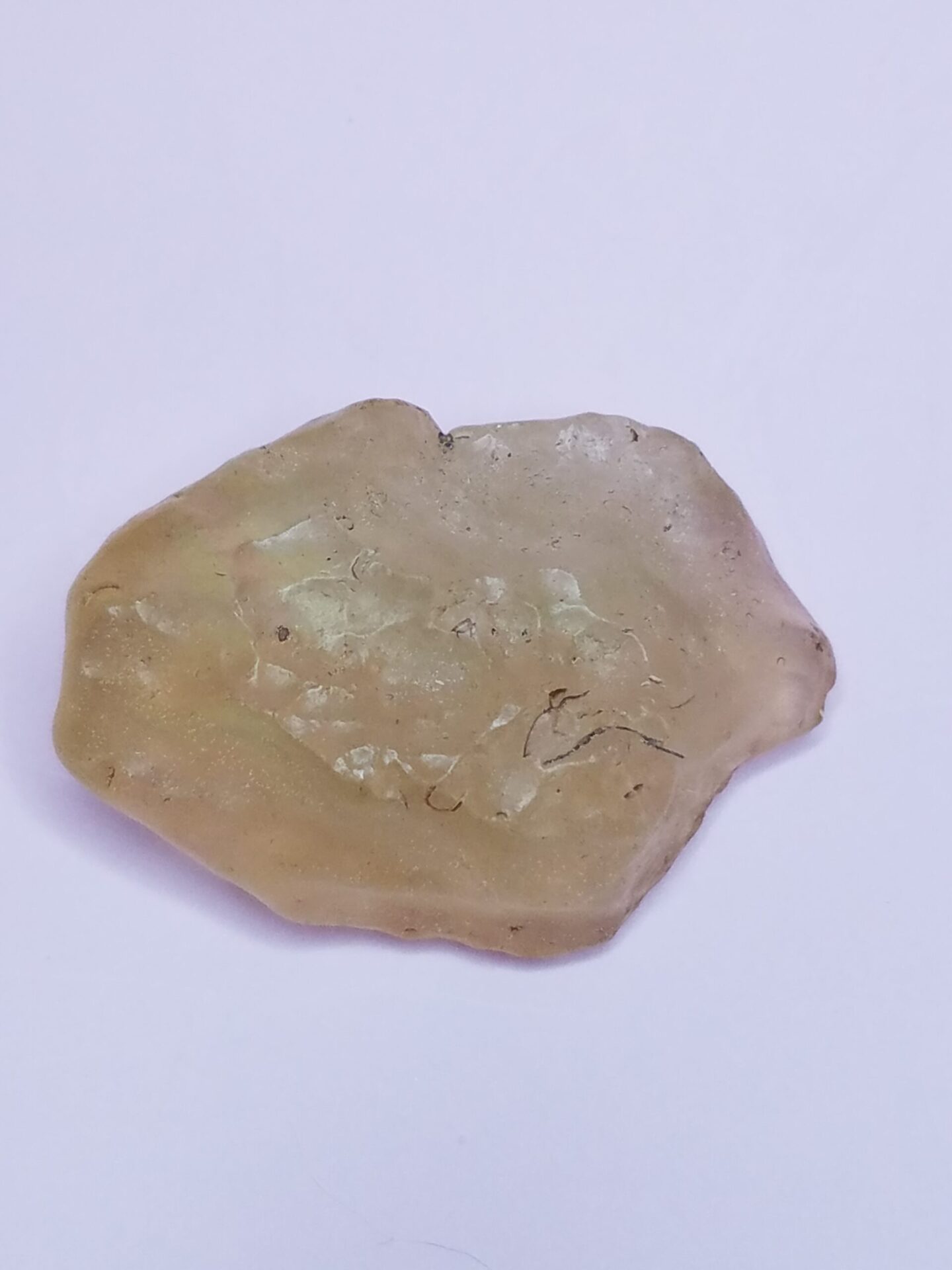
Across one of the most isolated landscapes on Earth, pieces of pale yellow natural glass lie scattered among the dunes and gravel corridors of Egypt’s Great Sand Sea. Some are nearly transparent and resemble honey-colored gemstones, while others are cloudy, frosted by desert weathering, streaked with darker material, or large enough to fill the palm of a hand. Known today as Libyan Desert Glass, or LDG, this unusual material has attracted geologists, archaeologists, gem collectors, meteorite enthusiasts, and metaphysical practitioners for nearly a century, yet one of the most basic questions about it remains unanswered: exactly where did the impact that created it occur?
The evidence that Libyan Desert Glass formed during an extraordinary impact-related event has become increasingly strong. Its chemistry connects it with silica-rich terrestrial sandstone and desert material rather than an extraterrestrial rock, while microscopic mineral transformations reveal temperatures and pressures far beyond those of ordinary fires or volcanic processes. Researchers have identified evidence of extreme heating, shock-altered zircon, high-pressure mineral transformations, and traces of meteoritic material within portions of the glass. What scientists have not found is the crater that should complete the geological story.
That combination makes Libyan Desert Glass particularly compelling. It is not a meteorite because the glass itself is overwhelmingly made from Earth material, and it does not fit comfortably within the traditional definition of a classic tektite such as Moldavite or an Australasian tektite. Instead, LDG occupies its own important place among natural impact glasses, preserving the effects of a catastrophic event that occurred roughly 29 million years ago in what is now the Sahara.
Its history did not end with the impact. Long before modern scientists examined it under microscopes, prehistoric people discovered the glass and fashioned it into tools, and thousands of years later a remarkable yellow-green scarab carved from the same material was incorporated into one of the treasures buried with Tutankhamun. Today, Libyan Desert Glass continues to move between scientific collections, mineral cabinets, jewelry, and modern metaphysical practice, connecting planetary science with human history in a way few natural materials can match.
Libyan Desert Glass is an exceptionally silica-rich natural glass found primarily in the southwestern portion of Egypt’s Great Sand Sea, near the modern border with Libya. Despite the name, the best-known and extensively studied occurrence lies on the Egyptian side of the border, where fragments have been found across broad interdune corridors between enormous north-south trending sand dunes.
Most Libyan Desert Glass consists of approximately 96 to 99 percent silica, making it considerably richer in silica than most volcanic glasses and many classic tektites. Its probable source material was not an extraterrestrial body but silica-rich terrestrial sandstone, sand, and associated sediments present in the region before the glass formed. Geochemical studies have shown a close relationship between LDG and mature sandstones of the region, particularly quartz-rich material derived from what is commonly associated with the Nubia Group.
The glass is generally pale yellow, golden yellow, yellow-green, or nearly colorless, although individual pieces can contain cloudy white areas, dark brown bands, blackish inclusions, bubbles, flow structures, and mineral remnants. In transmitted light, some specimens glow with a warm honey or lemon color that gives LDG an appearance quite different from the dark brown and black glasses commonly associated with Australasian tektites.
Despite being called “glass,” LDG is entirely natural. It is not ancient manufactured glass, melted bottle glass, or ordinary desert slag. Its composition, age, inclusions, geological distribution, and extreme formation conditions place it firmly within the world of naturally occurring impact-related materials.
Libyan Desert Glass formed approximately 28 to 29 million years ago, during the Oligocene Epoch. Various dating studies have produced values within this general range, with approximately 28.5 to 29 million years commonly used when discussing the material.
To place that age in perspective, LDG existed millions of years before humans, mammoths, or the modern Sahara. The landscape of northeastern Africa was dramatically different at the time, and the sediments eventually involved in the event had their own much longer geological history before being subjected to the intense heating and pressure that transformed them into glass.
Once formed, the glass spent tens of millions of years exposed to geological and climatic change. Pieces were fractured, transported, buried, re-exposed, abraded, and sculpted by windblown sand. The Sahara itself shifted repeatedly between wetter and drier conditions, and erosion gradually concentrated pieces of LDG within the landscape where modern explorers eventually encountered them.
The weathered exterior visible on many specimens is therefore not simply a frozen surface from the moment the glass formed. It represents a combination of original melt characteristics and millions of years of terrestrial alteration.
The Great Sand Sea stretches across western Egypt and eastern Libya and contains some of the largest dune systems in the Sahara. Within its southwestern reaches, long parallel dunes can rise dramatically above wide gravel and sand corridors. Libyan Desert Glass occurs principally in these interdune areas rather than being distributed uniformly across the entire desert.
Scientific expeditions during the twentieth century mapped a broad LDG occurrence extending over thousands of square kilometers. Pieces were found resting on or near the surface, sometimes in surprisingly large sizes. Early expeditions reported abundant glass throughout particular corridors, occasionally associated with prehistoric artifacts demonstrating that people had discovered and worked the material long before European scientific expeditions reached the region.
The modern scientific story began in the early 1930s when Patrick A. Clayton, working with the Egyptian Desert Survey, brought the unusual glass to wider scientific attention. Reports soon appeared describing transparent to translucent yellow-green silica glass unlike anything expected from the surrounding desert.
Early researchers immediately recognized similarities with tektites and impact-produced glasses, but the lack of an obvious crater created a mystery that would persist for generations.
The simplest answer is that extraordinarily high temperatures melted silica-rich terrestrial material and transformed it into glass, but determining what produced those temperatures has occupied researchers for decades.
Many possibilities were proposed over the years, including volcanic activity, lightning, unusual terrestrial fires, atmospheric explosions, cometary events, and direct meteorite or asteroid impact. Several of those explanations became increasingly difficult to support as the chemistry and mineralogy of LDG were studied more closely.
The source material appears overwhelmingly terrestrial. Chemical studies show strong similarities between the glass and mature silica-rich sandstone from the region, while isotopic evidence also supports melting of local crustal material rather than formation from an extraterrestrial glass body.
What required explanation was the extraordinary energy needed to produce the melt.
Silica-rich sandstone does not simply become vast quantities of glass because the desert becomes hot. Temperatures had to rise sufficiently to melt quartz-rich material, and mineral inclusions within the glass record conditions reaching well beyond ordinary surface processes.
That evidence gradually shifted the argument toward an extraterrestrial impact.
One of the important clues came from zircon, a durable zirconium silicate mineral capable of surviving many geological processes.
Researchers studying LDG identified zircons that had partially broken down into baddeleyite and silica, a transformation requiring extremely high temperatures. Early work demonstrated that temperatures exceeded roughly 1,600°C in portions of the melt, providing powerful evidence that an extraordinary high-energy event had occurred.
Other high-temperature materials, including lechatelierite—silica glass produced through melting of quartz—also support extreme thermal conditions.
These discoveries helped rule out many ordinary geological explanations. The Great Sand Sea does not contain the kind of volcanism necessary to account for such an enormous volume of silica glass, while ordinary surface fires or desert temperatures are nowhere near sufficient.
For many years, however, one possibility remained: perhaps an asteroid or comet exploded in the atmosphere above the desert, producing an enormous thermal pulse without actually striking the ground.
That became known as the airburst hypothesis.
The airburst idea gained attention partly because no convincing source crater had been discovered. If LDG formed during a conventional impact, scientists reasonably expected to find an impact structure somewhere near the glass field, yet decades of fieldwork and satellite investigation failed to identify a crater capable of explaining the enormous volume and distribution of the glass.
A sufficiently energetic atmospheric explosion offered a possible solution. An incoming asteroid or comet might detonate above the surface, producing extreme heat capable of melting desert material while leaving no conventional crater.
More recent mineralogical evidence, however, has made a simple thermal airburst increasingly difficult to reconcile with the glass.
Researchers examining zircon within LDG have found evidence for transformations requiring not only exceptional temperature but also extreme pressure. High-pressure zircon-related phases and evidence associated with reidite transformations point toward shock conditions produced when an extraterrestrial body struck Earth’s surface.
Further microscopic work has reinforced this interpretation by documenting zirconium oxide polymorphs requiring pressures far beyond those expected from atmospheric heating alone.
The modern picture therefore leans strongly toward a hypervelocity surface impact, even though the crater responsible remains unidentified.
That distinction matters. A fireball or airburst can produce enormous heat and blast effects, but shock minerals preserve a pressure history that heat alone cannot explain.
The absence of a confirmed crater remains the greatest unresolved part of the Libyan Desert Glass story.
Several candidate structures have been proposed over the decades, but none has gained broad acceptance as the source. Some are too small, too distant, the wrong age, or lack the geological evidence needed to connect them convincingly with LDG.
This does not mean the impact did not occur. Craters can be buried beneath younger sediments, destroyed by erosion, concealed beneath enormous dune systems, or located outside the portions of desert most thoroughly examined. Over nearly 29 million years, even a large impact structure can become extremely difficult to recognize at the surface.
The source could also lie outside the center of the modern glass distribution because erosion and landscape change have moved material since formation.
For collectors, this mystery adds an unusual dimension to LDG. Moldavite can be connected with Germany’s Ries crater, Ivory Coast tektites with Bosumtwi, and North American tektites with Chesapeake Bay. Libyan Desert Glass preserves convincing evidence of a major impact-related event while withholding the most obvious piece of evidence—the crater itself.
That unanswered question keeps LDG scientifically relevant rather than reducing it to a geological curiosity whose entire story has already been solved.
Another unresolved question concerns the nature of the object responsible for the event.
Researchers have identified evidence of a meteoritic component within portions of Libyan Desert Glass. Platinum-group element patterns in darker material have been interpreted as evidence that extraterrestrial matter became incorporated into the terrestrial melt.
That supports an impact-related origin, but identifying the exact impactor is considerably more difficult. Over the years, both asteroidal and cometary explanations have been suggested.
A particularly unusual carbon-rich object known as the Hypatia stone, discovered within the broader LDG region, has generated additional speculation about a cometary connection because some studies found unusual extraterrestrial characteristics. Hypatia is scientifically fascinating, but the relationship between that object and the event that created LDG is not established strongly enough to use it as proof that a comet created the glass.
The responsible approach is therefore to say that Libyan Desert Glass formed during an extraterrestrial impact event while acknowledging that the precise impactor has not been conclusively identified.
Libyan Desert Glass is frequently called a tektite, particularly in gemstone, crystal, and metaphysical markets, but its geological classification deserves more precision.
True tektites such as Moldavite, australites, indochinites, bediasites, Georgiaites, and Ivory Coast tektites represent terrestrial material melted during hypervelocity impacts and transported away from the impact site as ejecta. They occur within recognized strewn fields and display formation histories involving ballistic transport.
LDG is undoubtedly impact-related natural glass, but its relationship with the unknown source crater and its apparent formation and distribution differ from the classic tektite model. Researchers frequently discuss it separately as Libyan Desert Glass or impact glass, rather than placing it unambiguously within one of the traditional tektite families.
That is the terminology we prefer at Grounded Lifestyles.
Calling LDG impact glass does not make it less extraordinary than Moldavite. It simply describes its geological status more carefully.
Our Tektites vs. Meteorites guide explains the difference among meteorites, recognized tektites, impact glass, and tektite-like natural glasses in greater detail.
Moldavite and Libyan Desert Glass are often sold together because both are natural glasses associated with extraterrestrial impacts, yet their appearances, compositions, and geological histories are dramatically different.
Moldavite formed approximately 14.8 million years ago when the Ries impact in Germany melted terrestrial material and launched glassy ejecta into what is now the Czech Republic and surrounding regions. It is typically green and contains significantly less silica than LDG.
Libyan Desert Glass is almost twice as old and dramatically richer in silica, often approaching the composition of nearly pure fused quartz. Its colors are generally pale yellow, golden, greenish yellow, or almost colorless, and its source crater remains unknown.
A fine Moldavite may be valued for intricate etched sculpture and green transparency, while an attractive LDG specimen may be prized for its warm transmitted color, clarity, natural wind-polished exterior, flow structures, or contrasting inclusions.
Both tell stories about extraterrestrial impacts, but they should not be treated as interchangeable forms of the same glass.
Because LDG contains such a high proportion of silica, its physical properties differ somewhat from many other natural glasses.
Its specific gravity is typically around 2.2, making it relatively light for a stone-like material of its size, while measured refractive indices generally fall around 1.46. These values are consistent with its extremely silica-rich composition.
Like other natural glasses, it is amorphous rather than crystalline and displays conchoidal fracture when broken. Fresh fracture surfaces can be exceptionally sharp.
Hardness figures in gemological references generally place natural LDG in approximately the 5 to 6 range, although scratch testing a collector specimen is neither necessary nor recommended because it damages the material and provides little definitive identification value.
Many specimens contain bubbles, internal flow structures, cloudy zones, mineral inclusions, or dark streaks. Cristobalite has been documented within some samples, along with iron-rich areas and other mineral remnants that record the extraordinary conditions under which the glass formed.
The characteristic yellow and yellow-green colors of LDG contribute enormously to its appeal.
Pure silica glass would be essentially colorless, so the color reflects minor elements, oxidation states, inclusions, and variations inherited from the original terrestrial material and subsequent melt processes.
Iron plays an important role in many natural glasses, even when present only in relatively small amounts. Variations in oxidation state and concentration can shift color from very pale straw yellow through honey, lemon, golden yellow, greenish yellow, brownish zones, and occasionally darker areas.
Some specimens are almost water-clear when held against light, while others are cloudy or richly colored. A single piece may contain several visual environments, with clear glass giving way to white inclusions, dark streaks, bubbles, or swirling internal structures.
For collectors, that variation means LDG should not be judged solely by one idealized “correct” shade. Natural diversity is part of the material’s character.
Not all Libyan Desert Glass is uniformly clear yellow.
Researchers have examined specimens containing dark brown or blackish bands and streaks, some enriched in iron and other elements. Cristobalite, wollastonite, mineral remnants, bubbles, and partially digested inclusions have also been reported.
These features can be particularly interesting in collector specimens because they preserve physical evidence of incomplete mixing within the melt.
A perfectly clear piece may appeal to someone interested in jewelry or gem quality, while a scientifically minded collector may deliberately seek material containing visible inclusions, flow banding, bubbles, or contrasting regions because those features reveal more of the glass’s formation history.
Neither is inherently “better.” They represent different collecting priorities.
A genuine LDG specimen that has remained exposed in the Sahara for millions of years may show frosting, rounded edges, shallow pits, grooves, abrasion, or sculpted surfaces caused by windblown sand and chemical alteration.
Those features should not automatically be interpreted as aerodynamic shaping from the original impact.
This distinction is similar to what we encounter with Moldavite and other natural glasses. The specimen we hold today records both its original formation and everything that happened afterward.
In the Great Sand Sea, repeated exposure to wind carrying abrasive quartz grains can gradually polish, frost, groove, and reshape a glass surface. Pieces may also break and be reworked repeatedly.
As a result, an unusually smooth or sculptural specimen may be interesting specifically because of its long desert history rather than because it froze into that exact form during the impact event.
The human relationship with LDG reaches much farther back than ancient Egypt’s pharaohs.
Archaeological evidence demonstrates that prehistoric people found the natural glass and worked it into tools. A documented handaxe made from Libyan Desert Glass was recovered within the Great Sand Sea, providing direct evidence that people recognized the material’s useful fracture properties.
That makes sense from a technological perspective. Like obsidian, silica-rich glass breaks with conchoidal fracture and can produce extremely sharp edges.
The occurrence of worked fragments and artifacts also tells us something about ancient movement through a region that is now extraordinarily inhospitable. People entered, crossed, and used resources from landscapes that later became some of the driest places on Earth.
LDG therefore belongs not only to planetary geology but also to archaeology and the story of how humans learned to recognize useful natural materials.
The most famous human use of Libyan Desert Glass appears in the treasures associated with Pharaoh Tutankhamun.
Among the objects discovered in his tomb is an elaborate pectoral containing a large yellow-green scarab. For many years the scarab material was described as a form of chalcedony, but later non-destructive analytical work connected it with Libyan Desert Glass.
The object is remarkable for more than its beauty.
The LDG occurrence lies hundreds of kilometers from the Nile Valley, meaning the material had to be recognized, collected, transported, traded, or otherwise transferred across a formidable desert landscape before reaching the artisans who produced the pectoral.
Exactly how the glass reached the royal workshops is not known, nor can we confidently say that ancient Egyptians understood its impact origin. They clearly did not possess modern planetary science, and we should be careful not to project modern “cosmic glass” interpretations backward into Egyptian belief.
What we can say is that the pale translucent material was distinctive enough to be selected for a highly important royal object.
The scarab itself already carried powerful Egyptian symbolism involving transformation, rebirth, solar cycles, and renewal. Knowing today that the material was created during a catastrophic impact nearly 29 million years earlier adds another extraordinary layer to the object, even though that geological history would have been unknown to its makers.
LDG appeals to several kinds of collectors at once.
Meteorite and impact collectors value it for its relationship with a major extraterrestrial collision. Mineral and natural-glass collectors appreciate its unusual composition and geological setting, while archaeological interest adds another dimension to historically documented material.
Appearance also plays a significant role. Transparent golden pieces can be exceptionally attractive under transmitted light, while larger natural individuals with sculptural shapes appeal to display collectors. Pieces containing unusual inclusions, dark streaks, bubbles, or flow structures may appeal particularly to collectors interested in the science.
Provenance should be taken seriously. Because Libyan Desert Glass comes from a geographically defined occurrence, documentation connecting a specimen with the Great Sand Sea adds confidence and collector value.
Older labels and established collection histories should be preserved rather than discarded merely because they look worn or outdated.
There is no single ideal form of Libyan Desert Glass because the material can be collected for several different reasons.
Someone seeking visual beauty may prefer translucent lemon-yellow or honey-colored pieces with attractive natural surfaces. Another collector may deliberately choose a specimen with unusual dark inclusions, flow textures, bubbles, or partially cloudy areas because those features reveal more about the melt.
Size can add interest, but larger does not automatically mean better. A smaller specimen with strong transparency, exceptional form, or excellent provenance may be more desirable than a much larger but visually undistinguished piece.
Condition should also be evaluated realistically. Natural chips, fracture surfaces, and abrasion are expected in material that has spent millions of years within an active desert environment. Fresh modern damage is different from old weathered breakage, and experienced collectors learn to recognize the difference.
Above all, the specimen should be represented accurately as Libyan Desert Glass from the Great Sand Sea, without needing exaggerated stories about rarity or an unproven specific crater.
As LDG has become better known in gem, meteorite, and metaphysical markets, authenticity has become more important.
Ordinary manufactured yellow glass can imitate the basic color remarkably well, especially in photographs. Surface treatment can also be used to make modern glass appear weathered or natural.
Appearance alone is therefore not sufficient for expensive specimens.
Natural LDG often displays combinations of internal flow, irregular bubbles, mineral inclusions, variable transparency, natural abrasion, and surface weathering that are difficult to reproduce convincingly as an entire geological package. Gemological measurements such as refractive index and specific gravity can provide supporting evidence, while chemical or microscopic analysis can offer much stronger identification when necessary.
Provenance remains one of the most practical protections for collectors. Material with an established dealer history, old collection label, or documentation tied to recognized LDG material is preferable to an anonymous piece accompanied only by an elaborate certificate printed by the seller.
A certificate is only as meaningful as the expertise and evidence behind it.
The color and translucency of LDG make it attractive for jewelry, and the material can be faceted, cabochon cut, drilled, or wire wrapped.
Cutting reveals a different side of the glass because polished surfaces emphasize clarity, color, internal flow, bubbles, and inclusions that may be difficult to see through a naturally weathered exterior.
At the same time, cutting permanently removes the original desert surface, so collectors often prefer intact natural individuals when geological character is the priority.
Because LDG is glass rather than a crystalline gemstone such as sapphire, it should be worn thoughtfully. It can chip along thin edges, scratch with enough abrasion, and fracture if struck against a hard surface. Pendants and earrings are generally less exposed to impact than rings or bracelets.
A natural specimen and a cut gem therefore serve different purposes. Neither is automatically superior; one preserves more geology, while the other reveals optical qualities of the glass.
Libyan Desert Glass is relatively stable under ordinary indoor conditions, but its natural surfaces and edges still deserve careful treatment.
Loose dust can usually be removed with a soft brush or gentle air movement. When more cleaning is necessary, mild methods are preferable to aggressive chemicals, abrasive compounds, ultrasonic cleaning, or prolonged soaking.
Natural weathered surfaces are part of the specimen’s geological history and should not be “improved” by polishing unless the intention is deliberately to create lapidary material.
Collectors should also protect LDG from hard impacts. Glass can fracture unpredictably, particularly around existing bubbles, inclusions, thin edges, or old internal stress.
Display away from locations where a specimen may be knocked from a shelf, and keep original labels or provenance records with the piece.
Saffordite provides an excellent comparison because both materials are unusual natural glasses that have acquired strong collector and metaphysical followings.
Their geology, however, is fundamentally different.
The evidence for Libyan Desert Glass points strongly toward formation during a hypervelocity extraterrestrial impact event involving extreme temperature and pressure.
Saffordite, by contrast, is best understood as terrestrial volcanic glass whose weathered surfaces can resemble tektites.
Putting the two together demonstrates why natural glass should never be classified from appearance alone. Two pieces may both be translucent, sculpted, ancient, and fascinating while recording completely different geological processes.
That distinction is explored more broadly in our Tektites vs. Meteorites guide.
Libyan Desert Glass is also fundamentally different from a meteorite.
A meteorite is extraterrestrial material that traveled through space and survived atmospheric entry. LDG consists overwhelmingly of terrestrial silica-rich material transformed because an extraterrestrial object struck Earth.
This means that the meteorite or asteroid responsible for the LDG event and the glass produced by that event are not the same thing.
The distinction becomes easier to see when LDG is displayed beside an iron meteorite such as Sikhote-Alin or Campo del Cielo. The iron specimen is actual extraterrestrial material, while the yellow glass represents Earth changed by the energy of an extraterrestrial collision.
For a broader introduction to the extraterrestrial side of that relationship, see Meteorites: Ancient Space Rocks That Fall to Earth.
Libyan Desert Glass has developed a substantial following within modern metaphysical practice, where it is commonly associated with transformation, manifestation, personal power, confidence, clarity, creativity, and connection with ancient wisdom.
Its geological story naturally lends itself to themes of transformation. Ordinary terrestrial silica-rich material was subjected to an event of extraordinary energy and became something completely different while remaining fundamentally made from Earth.
For people who use physical objects as symbolic tools, that history can represent profound change brought about by unexpected events, the ability to emerge from disruption in a new form, or the conversion of pressure and intensity into clarity.
Its golden color has also led many contemporary practitioners to associate LDG with the Solar Plexus Chakra, where it may symbolize confidence, will, personal direction, motivation, and self-definition. Some traditions also connect it with the Crown Chakra because of its relationship with an extraterrestrial impact and the broader idea of cosmic perspective.
Within meditation or Reiki practice, Libyan Desert Glass may be used as a focal object for intention-setting, manifestation, or contemplating transformation. These practices belong to modern metaphysical traditions rather than scientifically established physical effects of the glass.
That distinction does not diminish its symbolic power. In this particular case, the actual geology already provides an unusually strong metaphor: Earth material subjected to catastrophic energy nearly 29 million years ago survived as luminous golden glass that people would eventually discover, shape, study, collect, and assign meaning to.
The presence of LDG in Tutankhamun’s pectoral has naturally encouraged metaphysical interpretations connecting the material with ancient Egyptian spirituality.
Some of those connections are reasonable at a symbolic level, while others go far beyond available historical evidence.
The scarab itself was a powerful Egyptian symbol associated with renewal, regeneration, transformation, and the movement of the sun. The pectoral containing the LDG scarab carries complex royal and religious symbolism.
What we cannot establish is that ancient Egyptians selected the glass because they knew it came from a cosmic impact, believed it possessed modern crystal-healing properties, or used it in the same way contemporary metaphysical practitioners do.
Those are modern interpretations.
The more responsible—and in many ways more interesting—approach is to allow two histories to coexist. Ancient Egyptian artisans used a beautiful and unusual natural material within a highly symbolic object, while modern science has revealed a geological origin those artisans could never have known.
Libyan Desert Glass is extremely silica-rich natural glass found primarily in the Great Sand Sea of western Egypt near the Libyan border. Evidence strongly supports formation during a major extraterrestrial impact event approximately 29 million years ago.
No. A meteorite is extraterrestrial material that reaches Earth’s surface. Libyan Desert Glass is overwhelmingly terrestrial material melted during an extraterrestrial impact event.
It is frequently marketed as a tektite, but many researchers distinguish it from classic tektites because its formation and distribution do not fit the conventional distal ballistic tektite model as neatly. Impact glass is a more conservative geological description.
Approximately 28 to 29 million years old.
Its principal occurrence is within the Great Sand Sea of western Egypt near the border with Libya, particularly in large interdune corridors.
The strongest current evidence favors a hypervelocity extraterrestrial impact that melted silica-rich terrestrial material. High-pressure mineral evidence makes a simple atmospheric airburst increasingly difficult to support.
No source crater has yet been confirmed. Finding it remains one of the major unresolved questions surrounding LDG.
A cometary impact has been proposed, but the exact type of impactor has not been conclusively established. It is safer to refer to an extraterrestrial impactor rather than state that a comet definitely created the glass.
Hypatia is an unusual extraterrestrial-rich carbonaceous object found within the broader LDG region. Its exact relationship with the event that formed Libyan Desert Glass remains uncertain and should not be treated as proven.
Minor elements, particularly iron and its oxidation state, along with inclusions and melt conditions, contribute to colors ranging from nearly colorless through pale yellow, lemon, honey, golden yellow, and greenish tones.
It occurs within a restricted geological region and is far less widespread than ordinary volcanic glass. However, “rare” is not a standardized price category, and substantial quantities have been recovered historically. Quality, size, provenance, transparency, inclusions, surface character, and availability all influence collector desirability.
Yes. The best-known example is the yellow-green scarab in a pectoral found in Tutankhamun’s tomb, while archaeological evidence shows that prehistoric people also worked LDG into tools.
No. Moldavite is a Central European tektite associated with the approximately 14.8-million-year-old Ries impact. LDG is approximately 29 million years old, dramatically richer in silica, yellow rather than typically green, and has no confirmed source crater.
Color alone is insufficient. Natural inclusions, bubbles, flow structures, surface weathering, gemological properties, chemistry, and most importantly reliable provenance can all support identification. High-value pieces may warrant professional gemological or analytical examination.
Yes. It can be cut, polished, drilled, faceted, or wire wrapped, although natural collector specimens are often left unaltered to preserve their original surfaces.
Modern metaphysical traditions commonly associate LDG with transformation, manifestation, confidence, personal power, creativity, clarity, and Solar Plexus energy. These are spiritual and symbolic traditions rather than scientifically demonstrated medical properties.
Few natural materials combine planetary science, archaeology, gemology, and collecting as effectively as Libyan Desert Glass. Its pale golden color makes it visually attractive even before its history is understood, but learning the geology changes the way a specimen is viewed.
The glass began as terrestrial silica-rich material nearly 29 million years ago, was subjected to extreme heat and shock during an extraterrestrial impact, survived tens of millions of years of erosion and climatic change, was discovered and worked by prehistoric people, and eventually became part of one of the most famous royal treasures of ancient Egypt.
Modern research has solved important parts of that story while leaving others open. We now have convincing evidence of extreme impact conditions and terrestrial source material, yet the crater remains missing and the exact nature of the impactor remains uncertain.
That combination of what we know and what we still do not know is part of what makes LDG such an exceptional collector material.
Libyan Desert Glass is sometimes described simply as a yellow tektite from the Sahara, but that description leaves out almost everything that makes the material important.
It is an exceptionally silica-rich natural glass created when terrestrial material experienced temperatures and pressures associated with a major extraterrestrial impact nearly 29 million years ago. Zircon and other mineral inclusions preserve evidence of extreme conditions, while geochemistry links the melt to local silica-rich sandstone and also preserves traces suggesting involvement of extraterrestrial material.
Yet the crater remains missing.
Somewhere within, beneath, or beyond the modern Great Sand Sea landscape lies the final piece of a geological story that scientists have been reconstructing since the glass entered scientific literature in the 1930s. Whether that structure has been buried beneath sediment, concealed beneath dunes, heavily eroded, or simply not yet recognized remains an open question.
The human history is nearly as remarkable. Prehistoric people recognized the glass as workable material and fashioned it into tools, while thousands of years later a piece of LDG became the golden scarab at the center of a royal pectoral placed in Tutankhamun’s tomb. Neither culture could have known that the material had been created during an extraterrestrial collision millions of years earlier.
For today’s collector, those layers of history are inseparable. A piece of Libyan Desert Glass is simultaneously an impact specimen, an unusual natural glass, a record of the Sahara’s changing landscape, a material used by ancient people, and a modern collector object whose formation still contains unanswered questions.
That is also why accurate classification matters. Libyan Desert Glass does not need to be forced into the meteorite or classic tektite category to make it more impressive. Its own geological story is extraordinary enough.
To understand where LDG fits among impact glasses, recognized tektites, volcanic glass, and meteorites, continue with our Tektites vs. Meteorites guide. For the extraterrestrial objects responsible for impact events themselves, explore Meteorites: Ancient Space Rocks That Fall to Earth or our more practical Meteorites 101 guide.
You can also compare LDG with Saffordite, an Arizona volcanic glass whose tektite-like appearance demonstrates why natural glasses should be classified through geology rather than appearance alone.
Browse the complete Grounded Lifestyles Meteorite Articles for additional guides to meteorites, impact glasses, tektites, planetary geology, collecting, identification, and care.
To explore Libyan Desert Glass, meteorites, genuine tektites, and other impact-related collector specimens available through Grounded Lifestyles, visit our Meteorites & Tektites Collection. You can also browse the broader Grounded Lifestyles Shop for minerals, fossils, natural history specimens, crystals, jewelry, and other collector material.

At Grounded Lifestyles, our love for crystals began in the peaceful flow of Reiki and energy healing sessions — where we saw how natural stones could amplify intentions, restore balance, and bring comfort. But the more time we spent with these treasures, the more curious we became about their origins. That curiosity led us into the fascinating world of geology and mineral specimen collecting. We fell in love not just with the energy of crystals, but with the science and artistry of their creation — the intricate crystal structures, the vibrant mineral hues, and the wonder of holding a piece of Earth’s history in our hands.

