Every crystal, mineral, fossil, meteorite, and handcrafted piece is selected with purpose. Whether you’re building a museum-worthy mineral collection, searching for a meaningful gift, decorating your home with natural beauty, or beginning your journey into the world of geology, you’ll discover authentic specimens with stories worth sharing.
Over 15 shows a year throughout the Southwest. Check to see if we are coming to a show near you!
Home > Blog > Minerals Blog | Crystal Guides, Geology & Metaphysical Meaning > Watermelon Tourmaline
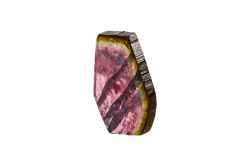
Watermelon tourmaline is one of Earth’s most iconic bi-color gemstones. With its deep pink center surrounded by a rim of green—mimicking the cross-section of a watermelon—it captivates gem collectors, mineral enthusiasts, jewelry designers, metaphysical practitioners, and scientists alike. Each piece is a geological fingerprint of the precise chemical shifts that occurred during crystal growth, revealing a record of changing fluid chemistry inside ancient pegmatite systems.
This distinctive zoning pattern forms only under rare circumstances, requiring the precise alternation of manganese-rich and iron-rich mineralizing conditions. The result is one of the most sought-after expressions of elbaite tourmaline—colorful, eye-catching, and highly collectible.
Watermelon tourmaline appears in slices, polished sections, crystals on matrix, terminated prisms, and gem-quality faceted stones. Its vibrant hues and natural color gradients have made it a staple in luxury jewelry and a favorite centerpiece in fine mineral collections. Metaphysically, watermelon tourmaline symbolizes harmony, emotional balance, and heart-centered expansion, connecting the pink and green ray energies of the Heart Chakra.
Watermelon tourmaline is a bi-color variety of elbaite, belonging to the tourmaline supergroup. What distinguishes it is its zoned color distribution, usually:
This color pattern is the result of growth zoning—changes in chemistry as the crystal formed.
Tourmaline grows from volatile-rich fluids inside LCT (lithium-cesium-tantalum) pegmatites. As these fluids evolve, their chemistry changes.
The crystal begins forming under conditions rich in manganese (Mn³⁺), producing:
When manganese oxidizes to Mn³⁺, the color becomes deeper.
As conditions shift, other elements become dominant, sometimes creating:
This is often called the “rind separator.”
Tourmaline later grows in a more iron-rich environment, producing:
This two-stage chemistry creates the watermelon slice effect.
Watermelon tourmaline typically forms as:
Slices are iconic because they reveal the full zoning pattern.
Watermelon tourmaline forms only when:
This sensitivity makes watermelon tourmaline a rare and valuable example of nature’s chemical artistry.
Most bi-color tourmaline is:
But true watermelon requires a radial pattern visible in cross-section, which is much rarer.
Watermelon tourmaline appears in several forms depending on its growth environment.
Thin cross-sections showing:
These are the most iconic form, prized by collectors and jewelers.
Found attached to:
Matrix enhances value significantly.
Elongated crystals with visible pink-to-green color along prism sides.
Not as visually striking as slices but still collectible.
These highlight internal zoning and often enhance color vibrancy.
Faceted or cabbed gems where zoning appears more blended.
High clarity stones are extremely rare.
While bi-color tourmaline occurs worldwide, true watermelon specimens are concentrated in a few legendary regions.
Brazil is the world’s most iconic source of watermelon tourmaline.
Brazilian watermelon tourmaline is the gold standard for collectors.
These regions produce:
Afghan watermelon slices are smaller but exceptionally vivid.
Nigeria yields:
Nigerian material is highly valued for jewelry.
Mozambique produces:
This locality ties naturally to your Paraíba Tourmaline article.
Historical pegmatites produced small amounts of watermelon tourmaline.
These are prized for their American mineral heritage.
Value is determined by several tightly interlinked factors.
Highest-value traits include:
Saturation is more important than size.
Crystals and slices with:
sell for premium prices.
Watermelon is prone to internal stress, making clear specimens rare.
Collectors prefer slices with:
Irregular shapes may still be valuable but command lower premiums.
Large slices are rare because:
Premium size categories:
High-grade crystals on matrix dramatically increase value.
Matrix types:
These command the strongest prices in the mineral collector market.
Faceted watermelon tourmaline is extremely rare and valuable.
Key factors:
Some watermelon tourmaline includes:
These pieces are highly sought-after.
Watermelon tourmaline’s unique beauty led many ancient cultures to associate it with unity and emotional harmony.
Many traditions believed bi-color tourmaline:
Pink and green together represented emotional and physical renewal.
Brazilian mines brought watermelon tourmaline to Western markets.
By the early 1900s, it appeared in:
Its unique coloration made it a favorite among artistic movements.
Today, watermelon tourmaline is:
Watermelon tourmaline symbolizes balance, emotional clarity, compassion, and heart-centered alignment.
Both pink and green resonate with the Heart Chakra.
Together they symbolize emotional harmony.
Watermelon tourmaline encourages:
It’s widely used for centering energy during transitions.
Metaphysically, watermelon tourmaline symbolizes the blending of:
The pink-green dynamic supports:
Watermelon tourmaline resonates strongly with:
Watermelon tourmaline appears in:
Care Notes:
Use watermelon tourmaline:
Collectors especially seek:
Watermelon tourmaline is challenging to cut.
Lapidary artists must consider:
Cabochons and slices are most common.
Watermelon zoning visually records:
Watermelon tourmaline displays:
Depending on axis:
This makes cutting orientation critical.
Common inclusions include:
Inclusions can add character but decrease gem-value.
The pink center and green outer ring that resemble a slice of watermelon.
Yes—true radial zoning is very rare compared to vertical bi-color tourmaline.
In backlit stands or cases to show zoning.
Prolonged sunlight may lighten some pink zones.
Yes, though slices are fragile and best protected in bezels.
Through manganese-then-iron chemical shifts inside pegmatite chambers.
Brazil is historically the finest, though Afghanistan and Nigeria produce top-tier pieces.
Watermelon tourmaline is one of the most recognizable expressions of the remarkably diverse tourmaline family. Explore our Tourmaline Collection for available tourmaline specimens in a range of colors and forms, or browse our broader Mineral Collection to discover crystals and mineral specimens from classic localities around the world. As you continue exploring tourmaline varieties, localities, and related minerals, explore these articles Rubellite, Indicolite, Paraiba, Dravite, Black Tourmaline. Explore our E-Book library for deeper exploration on various topics.

At Grounded Lifestyles, our love for crystals began in the peaceful flow of Reiki and energy healing sessions — where we saw how natural stones could amplify intentions, restore balance, and bring comfort. But the more time we spent with these treasures, the more curious we became about their origins. That curiosity led us into the fascinating world of geology and mineral specimen collecting. We fell in love not just with the energy of crystals, but with the science and artistry of their creation — the intricate crystal structures, the vibrant mineral hues, and the wonder of holding a piece of Earth’s history in our hands.