
Every crystal, mineral, fossil, meteorite, and handcrafted piece is selected with purpose. Whether you’re building a museum-worthy mineral collection, searching for a meaningful gift, decorating your home with natural beauty, or beginning your journey into the world of geology, you’ll discover authentic specimens with stories worth sharing.
Over 15 shows a year throughout the Southwest. Check to see if we are coming to a show near you!
Home > Blog > Crystal Healing Blog | Benefits, Chakras & Reiki Stones > Chakras and Corresponding Crystals
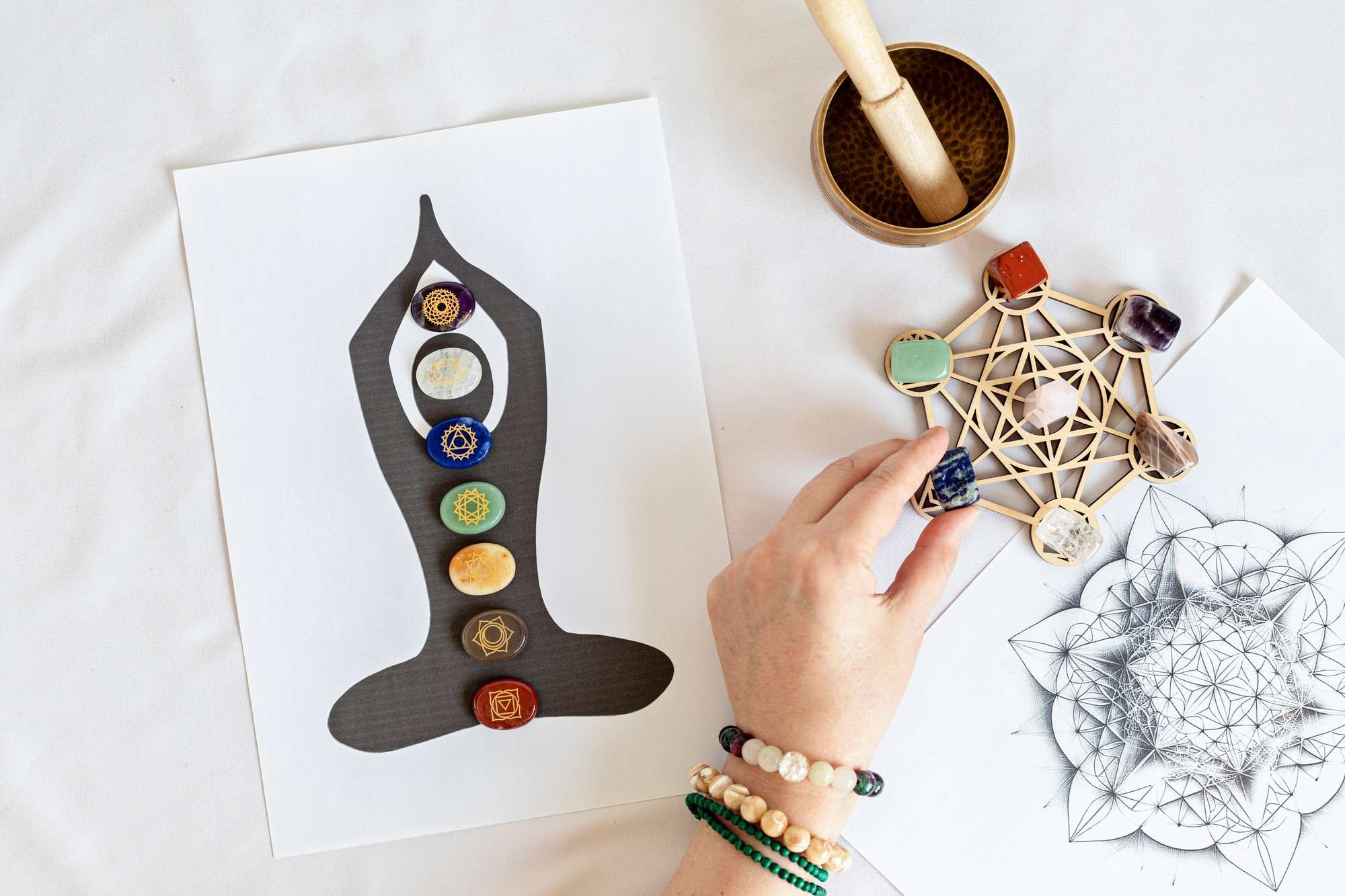
The seven-chakra system has become one of the most recognizable frameworks in modern yoga, meditation, Reiki, and crystal practice. Images of a human figure surrounded by seven colored circles appear on everything from meditation charts and yoga studios to crystal kits, jewelry, books, and social media posts, usually accompanied by lists of stones said to correspond with each energetic center.
The familiar modern system begins with the Root Chakra at the base of the body and moves upward through the Sacral, Solar Plexus, Heart, Throat, Third Eye, and Crown Chakras. Red is commonly associated with the Root, orange with the Sacral, yellow with the Solar Plexus, green or pink with the Heart, blue with the Throat, indigo with the Third Eye, and violet or white with the Crown.
What is often missing from these charts is the history behind them.
Chakra traditions are much older and more complicated than the seven-color diagrams commonly used today. Concepts of subtle centers, channels, breath, internal energy, visualization, mantra, and meditative transformation developed through multiple South Asian religious and yogic traditions rather than appearing as one standardized system. Different texts and lineages described different numbers of chakras and different relationships between them. The seven-chakra structure familiar to many Western practitioners today represents one influential modern interpretation rather than the only historical chakra system.
Crystals were also not historically assigned to the chakras in the precise color-coded lists commonly circulated today. Modern crystal healing developed its own system of correspondences by combining mineral color, symbolism, chakra themes, intuitive practice, astrology, New Age spirituality, and earlier esoteric traditions.
That does not make modern chakra-crystal practice meaningless. It simply tells us what kind of practice it is.
For many people, crystals provide tangible objects around which to build meditation, reflection, intention-setting, Reiki, visualization, or other spiritual routines. A red jasper placed near the lower body may symbolize stability, while rose quartz over the heart may represent compassion and connection. Blue Lace Agate may become a reminder to communicate carefully, while amethyst at the brow may represent reflection and intuition.
Those meanings belong primarily to spiritual and metaphysical traditions rather than anatomy or medical science.
Understanding that distinction allows chakra practice to remain meaningful without requiring unsupported claims that a blocked chakra causes illness or that a crystal physically corrects the body’s energy system.
The Sanskrit word cakra, usually written in English as chakra, means “wheel” or “disc.” Within various South Asian yogic and Tantric traditions, chakras became part of complex descriptions of a subtle body containing channels, centers, energies, deities, sounds, visualizations, and other elements used within spiritual practice.
These concepts were not originally medical diagrams of physical structures that could be dissected or identified anatomically. They belonged to systems of meditation, ritual, visualization, transformation, and spiritual development.
Historical chakra systems were also not uniform. Different traditions identified different numbers of subtle centers and described them in different ways. The familiar seven-chakra arrangement became especially influential in modern yoga and Western esoteric practice, but it should not be treated as though every historical Hindu, Buddhist, or yogic tradition used one identical diagram.
Modern chakra practice has developed even further.
Today, people may work with chakras through yoga, breathing exercises, meditation, visualization, sound, Reiki, color, aromatherapy, crystals, journaling, affirmations, or other personal spiritual practices.
For readers interested in the broader relationship between crystal traditions and modern metaphysical practice, Crystal Healing: History, Science, Metaphysical Beliefs & Modern Practice provides a useful foundation.
Chakras are important within spiritual and yogic traditions, but science has not established them as anatomical organs or measurable biological energy centers comparable with the heart, nervous system, glands, or blood vessels.
That distinction becomes particularly important when chakra language is connected with health.
It is common to see statements claiming that a blocked Solar Plexus Chakra causes digestive disease, a blocked Third Eye causes headaches, or a blocked Heart Chakra produces physical cardiovascular problems. Those claims move beyond spiritual symbolism into medical territory and are not supported simply by the existence of chakra traditions.
Someone can still use the Solar Plexus Chakra as a framework for reflecting on confidence, personal agency, or motivation without claiming that the chakra controls digestive organs. Similarly, the Heart Chakra can represent compassion, grief, connection, or forgiveness without being treated as a physical structure responsible for heart disease.
This approach respects the spiritual system while keeping medical claims separate.
Within modern metaphysical practice, balancing a chakra generally refers to bringing greater attention or harmony to the themes associated with that center.
For someone working with the Root Chakra, that may involve reflecting on stability, security, home, boundaries, and connection with the physical world. Heart Chakra work may involve compassion, relationships, grief, or forgiveness, while Throat Chakra practice may focus on communication and personal expression.
The phrase chakra imbalance therefore works best as a spiritual or reflective description rather than a diagnosis.
A person who feels unable to communicate honestly might choose to explore Throat Chakra symbolism. Someone navigating a major change may find Root Chakra practices useful because the themes of grounding and stability resonate with what they are experiencing.
The chakra becomes a framework for attention.
Crystals can then provide physical objects that represent those themes.
The now-familiar rainbow sequence of red, orange, yellow, green, blue, indigo, and violet is deeply embedded in contemporary chakra practice, but it should not automatically be presented as an unchanged ancient Indian color system.
Modern Western interpretations helped standardize these rainbow correspondences, and they are now widely used because they create an intuitive visual progression through the seven centers.
That modern history does not prevent the colors from being useful.
Color provides an easy symbolic connection between crystals and chakra themes. Red jasper naturally fits a Root Chakra system built around red. Citrine and yellow jasper align visually with a yellow Solar Plexus Chakra, while blue minerals such as aquamarine, sodalite, and Blue Lace Agate naturally fit a blue Throat Chakra.
The important point is that these are correspondences developed within modern metaphysical systems, not scientific properties demonstrating that a red mineral physically resonates with an anatomical chakra.
Many modern chakra charts assign a specific sound frequency to each center, commonly using numbers such as 396 Hz, 417 Hz, 528 Hz, 639 Hz, 741 Hz, 852 Hz, or 963 Hz.
Those numerical assignments are popular in modern sound-healing and spiritual communities, but they should not be presented as scientifically measured chakra frequencies or ancient features of the original chakra traditions.
A hertz is a real unit of physical frequency representing one cycle per second. Scientists can measure the frequency of sound waves, electromagnetic radiation, electrical oscillations, and crystal resonance modes.
No accepted scientific measurement has established that the Root Chakra physically oscillates at 396 Hz or that the Crown Chakra has a measurable frequency of 963 Hz.
That does not mean someone cannot meditate with a 528 Hz tone or use a particular sound as part of a chakra practice. It simply means the number should be described as part of a modern spiritual or sound practice, not as an established measurement of an anatomical energy center.
Our article Do Crystals Have Frequency? The Science of Vibration, Resonance & Crystal Energy explains the difference between physical frequency, crystal resonance, piezoelectricity, Schumann resonances, and metaphysical uses of the word vibration.
Understanding that distinction is particularly valuable when working with chakras because frequency language appears so frequently in modern chakra charts.
Crystals fit naturally into modern chakra practice because both systems rely heavily on color, symbolism, intention, and personal meaning.
A practitioner may select a stone because its color corresponds with a chakra, because its traditional metaphysical associations match the chakra’s themes, or simply because the stone feels personally appropriate.
For example, black tourmaline is commonly used with the Root Chakra because modern crystal traditions associate it with grounding, stability, and boundaries. Rose quartz is frequently connected with the Heart Chakra because of its pink color and long-standing metaphysical associations with compassion and affection. Blue Lace Agate and aquamarine are commonly linked with the Throat Chakra because blue has become the dominant modern color correspondence for communication and expression.
This system is internally meaningful even though the mineral itself was not historically assigned to the chakra thousands of years ago.
Modern traditions evolve.
The important thing is to describe those traditions accurately.
A chakra-crystal practice does not need to be complicated or theatrical. The simplest approach is to choose one chakra whose symbolism matches something you want to explore, select a crystal associated with that theme, and use the stone as a focus during quiet reflection or meditation.
You might hold the crystal, place it nearby, or rest it gently on the body if doing so is comfortable and safe. Some practitioners arrange several stones along the body’s central axis while lying down, while others prefer to work with one chakra at a time.
There is no scientific requirement that the crystal touch a precise anatomical location for the practice to “work.”
The object is serving primarily as a physical and symbolic focus.
If emotions arise during meditation, there is no need to interpret every sensation as blocked energy leaving the body. Thoughts and emotions naturally emerge when people become quiet and attentive. Notice what appears, return to your breathing if that is part of the practice, and allow the experience to remain exploratory rather than diagnostic.
You can also use a journal after the meditation to record what came to mind. Over time, that may reveal recurring themes far more clearly than trying to interpret every physical sensation as evidence of a chakra opening or closing.
The Root Chakra, commonly known as Muladhara in modern seven-chakra practice, is positioned symbolically at the base of the spine or pelvic floor and is associated with foundations, stability, security, belonging, and connection with the physical world.
Modern chakra systems commonly represent Muladhara with the color red, although grounding stones in black, brown, smoky, and deep earthy colors are also frequently used.
Rather than describing a Root Chakra as medically “blocked,” it can be more helpful to think about situations in which its symbolic themes become especially relevant. Moving to a new home, changing jobs, experiencing financial uncertainty, beginning a new relationship, ending an old one, or simply feeling disconnected from everyday routines can all make themes of security and stability feel more important.
Crystals commonly associated with the Root Chakra include black tourmaline, red jasper, smoky quartz, garnet, hematite, obsidian, onyx, ruby, and bloodstone.
Black tourmaline is particularly popular because its dark color, substantial appearance, and modern association with protection and boundaries fit naturally with the idea of grounding. Red jasper provides a different visual language through its earthy red color, while smoky quartz combines the familiarity of quartz with darker tones associated with steadiness and release.
A simple Root Chakra practice might involve holding black tourmaline or red jasper while sitting with both feet against the floor and considering what currently provides stability in your life. Instead of imagining that the stone is repairing an invisible structure, let it represent the question: What helps me feel anchored when circumstances around me are changing?
Our Black Tourmaline Guide to Schorl explores one of the most popular Root Chakra stones through both geology and modern metaphysical tradition, while our Tourmaline collection includes natural examples of this remarkably diverse mineral group.
The seed mantra commonly associated with Muladhara in modern chakra practice is Lam.
The Sacral Chakra, or Svadhisthana, is commonly placed in the lower abdomen and represented by the color orange in contemporary chakra systems. Its symbolic themes include creativity, pleasure, emotional expression, relationships, sensuality, adaptability, and the ability to experience enjoyment.
Modern metaphysical practice often links the Sacral Chakra with times when a person feels creatively stagnant, disconnected from enjoyment, resistant to change, or uncertain about emotional expression. These themes should be approached as areas for reflection rather than evidence that a physical energy center is malfunctioning.
Orange and peach-colored stones dominate modern Sacral Chakra correspondences, including carnelian, orange calcite, sunstone, peach moonstone, amber, and orange or golden varieties of other minerals.
Carnelian is one of the most recognizable choices. Its orange-to-red coloration comes from iron oxides within chalcedony, giving the stone both geological interest and a visual connection with the warm color traditionally assigned to Svadhisthana.
Someone using carnelian in a Sacral Chakra practice might hold the stone while reflecting on a creative project that has been postponed or abandoned. Rather than waiting for the crystal to generate creativity, the stone can become the cue to spend ten minutes writing, sketching, designing, gardening, cooking, or returning to something that once felt enjoyable.
The metaphysical correspondence becomes more useful when it encourages action.
The seed mantra commonly associated with Svadhisthana is Vam.
The Solar Plexus Chakra, Manipura, is generally associated with the upper abdomen in the modern seven-chakra model and represented by yellow. Its major themes include confidence, personal agency, motivation, decision-making, identity, and the ability to act with intention.
Older chakra lists often describe physical symptoms such as digestive problems as signs that Manipura is blocked. That interpretation should not be used as a medical explanation. Digestive symptoms have many potential causes and deserve appropriate evaluation rather than being attributed automatically to an energetic center.
The symbolic themes, however, can still be valuable.
Someone who repeatedly postpones decisions, doubts every choice, or struggles to follow through on goals may find the Solar Plexus framework useful for reflecting on confidence and personal agency.
Common crystal correspondences include citrine, tiger’s eye, pyrite, yellow jasper, yellow calcite, golden topaz, and yellow fluorite.
Citrine is particularly popular because its yellow-to-golden color fits the modern Solar Plexus palette, while its contemporary metaphysical associations include optimism, confidence, abundance, creativity, and motivation. Natural citrine is considerably less common than heat-treated amethyst sold under the citrine name, which is another reminder that knowing the actual mineral adds depth to metaphysical practice.
A Solar Plexus meditation might involve holding citrine or tiger’s eye while identifying one decision that has been delayed. Instead of asking the crystal to provide confidence, consider what information is actually missing and what action could reasonably be taken next.
The stone becomes a symbol of agency rather than a replacement for it.
The seed mantra associated with Manipura is Ram.
The Heart Chakra, or Anahata, occupies a central position in the familiar seven-chakra sequence and is commonly associated with love, compassion, grief, forgiveness, relationships, connection, and emotional openness.
Modern chakra imagery usually represents Anahata with green, although pink has also become strongly associated with Heart Chakra crystal work.
That combination explains why rose quartz, green aventurine, jade, malachite, rhodonite, peridot, emerald, watermelon tourmaline, and other green or pink stones are frequently used in Heart Chakra practices.
Rose quartz is perhaps the most recognizable modern Heart Chakra stone because its pale pink color aligns naturally with symbolism involving tenderness, compassion, and affection. Green stones introduce another dimension, with green often associated with renewal, growth, nature, and balance.
A Heart Chakra practice can become particularly meaningful when its themes are turned inward as well as outward. Compassion is not only about relationships with other people. It can also involve noticing how harshly we evaluate our own mistakes, limitations, appearance, productivity, or decisions.
Rather than placing rose quartz over the chest and expecting it to remove emotional pain, use the stone to represent a question: What would a more compassionate response to this situation look like?
That does not erase grief, repair a relationship automatically, or remove difficult emotions. It creates a framework within which those experiences can be examined.
Watermelon tourmaline is another particularly interesting Heart Chakra stone because its natural pink-and-green color zoning visually combines both colors associated with the chakra. Grounded Lifestyles currently carries natural examples in our Tourmaline collection, where the geology behind those colors is just as fascinating as their metaphysical symbolism.
The seed mantra associated with Anahata is Yam.
The Throat Chakra, Vishuddha, is commonly associated with communication, honesty, listening, personal expression, and the ability to communicate thoughtfully.
Blue has become its dominant color in modern chakra systems, leading to crystal correspondences that include aquamarine, Blue Lace Agate, sodalite, lapis lazuli, turquoise, blue kyanite, chrysocolla, and blue calcite.
It is tempting to interpret a Throat Chakra “blockage” as a literal energetic obstruction causing physical throat problems, but the symbolic interpretation is both safer and more useful.
Nearly everyone knows what it feels like to avoid saying something that needs to be said, to speak too quickly out of frustration, to feel intimidated during an important conversation, or to discover that listening is more difficult than talking.
Those are ideal situations for Throat Chakra reflection.
Blue Lace Agate is particularly well suited to this because modern crystal traditions associate it with gentle, deliberate communication. Its pale blue banding also gives the stone a visually quiet quality that reinforces those associations.
Before a difficult conversation, hold the stone long enough to ask what you actually need to communicate, what you might regret saying simply out of frustration, and whether you are prepared to listen to the other person’s complete response.
That is a practical interpretation of Throat Chakra work.
Chrysocolla is another stone commonly connected with expression and communication, and copper-mineral specimens can make the geological side of that symbolism especially interesting. Grounded Lifestyles’ Bisbee material, for example, demonstrates how vivid blue and blue-green secondary copper minerals form in oxidized portions of historic copper deposits.
The seed mantra associated with Vishuddha is Ham.
The Third Eye Chakra, Ajna, is associated in modern practice with intuition, insight, perception, imagination, contemplation, and the ability to look beyond an immediate reaction.
It is commonly represented by indigo, deep blue, or violet, which explains the popularity of amethyst, lapis lazuli, azurite, labradorite, iolite, sodalite, and similar stones in Third Eye practice.
Older metaphysical charts sometimes list headaches, poor concentration, or other physical symptoms as signs that Ajna is blocked. Those symptoms should not be treated as evidence of a chakra problem. Persistent headaches or changes in concentration can have many ordinary physical, environmental, psychological, or medical causes.
Third Eye symbolism is more useful when approached as reflection.
Intuition does not have to mean predicting the future or receiving supernatural information. In everyday life, it can also refer to becoming more attentive to patterns, recognizing an emotional reaction before acting on it, or allowing enough quiet for a complicated situation to be considered from more than one perspective.
Amethyst fits naturally into this kind of practice because contemporary metaphysical traditions already associate it with contemplation and spiritual awareness.
Azurite is also frequently connected with the Third Eye because of its intense blue coloration and associations with insight and inner vision. From a geological perspective, azurite is a copper carbonate hydroxide that forms as a secondary mineral in oxidized copper deposits, giving it an entirely different story from amethyst despite their overlapping metaphysical use.
A Third Eye practice might involve holding one of these stones during meditation and examining a question from several perspectives without immediately forcing an answer.
The purpose is not to make the stone reveal hidden information. It is to create a setting in which reflection receives more room than reaction.
The mantra commonly associated with Ajna is Om.
The Crown Chakra, Sahasrara, is placed symbolically at or above the crown of the head and is associated with spiritual connection, transcendence, consciousness, meaning, contemplation, and one’s relationship with something larger than the individual self.
Modern chakra systems commonly use violet, white, or sometimes clear imagery for Sahasrara, which has led to correspondences with clear quartz, amethyst, selenite, apophyllite, moonstone, and other white, clear, or violet stones.
Clear quartz is especially prominent because modern crystal traditions describe it as an amplifier and general-purpose stone. Its transparency and crystal form lend themselves easily to symbolism involving clarity, illumination, and expanded awareness.
Its real mineralogy is equally compelling. Quartz is crystalline silicon dioxide, SiO₂, and its ordered crystal structure produces measurable physical properties including piezoelectricity under suitable conditions. These real properties are fascinating, but they should not be used as proof that a quartz point physically opens the Crown Chakra.
Our Quartz collection demonstrates how diverse one mineral can be, including clear quartz, amethyst, smoky quartz, rose quartz, citrine, and other varieties.
A Crown Chakra meditation might involve sitting quietly with clear quartz or amethyst and reflecting on questions of meaning, purpose, gratitude, spirituality, or connection. For one person, that may involve religious belief. For another, it may involve nature, family, community, creativity, or the sense of perspective that comes from understanding Earth’s immense geological history.
The practice does not require everyone to define spirituality in the same way.
Sahasrara is often approached differently from the lower six chakras, and some historical systems treat the crown in ways that do not map neatly onto the familiar modern seven-center chart. This is another reminder that the contemporary system is a living interpretation rather than a single unchanging ancient template.
No.
Color matching is one of the simplest and most popular methods in modern crystal practice, but it is not the only way to choose a stone.
Black tourmaline is commonly used for the Root Chakra despite being black rather than red. Rose quartz is frequently used for the Heart Chakra even though green is also strongly associated with that center. Clear quartz appears throughout modern chakra layouts because practitioners often view it as symbolically versatile.
Personal association can matter as much as chart correspondence.
If smoky quartz makes you feel more grounded than red jasper, there is no spiritual rule requiring you to choose the red stone simply because an infographic tells you to. If aquamarine reminds you to communicate more gently, it may be more meaningful for your Throat Chakra practice than another blue mineral.
A correspondence chart should provide possibilities rather than become a rigid rulebook.
Some practitioners prefer to work with all seven chakras during a single meditation.
If you choose this approach, find a comfortable position where you can remain relaxed without straining. Crystals can be placed nearby or, if comfortable, gently positioned around the corresponding symbolic areas of the body. A Root Chakra stone might be placed near the feet or lower body, while a Crown Chakra stone may be positioned above the head rather than balancing it precariously on the body.
The stones do not need to touch the skin.
Once the layout is arranged, allow your attention to move slowly through the seven centers. Instead of trying to determine whether each chakra is “open” or “closed,” consider the themes represented by each one.
Where does life currently feel stable?
Where do you want more creativity?
Where are you avoiding a decision?
Where could compassion be extended?
What needs to be communicated?
What requires deeper reflection?
What gives your life meaning?
Those questions can turn a chakra layout into a structured meditation rather than a search for invisible problems.
For many people, focusing on one chakra is more useful than working with all seven simultaneously.
Choose the center whose themes most closely match what is currently happening in your life and spend several days or weeks exploring it through meditation, journaling, yoga, crystal work, or another spiritual practice.
If communication is the recurring issue, work with the Throat Chakra. If the problem involves boundaries or stability, explore Root Chakra themes. If you are struggling with self-criticism or a difficult relationship, Heart Chakra reflection may be more relevant.
The purpose is not to diagnose yourself with a blocked energy center.
It is to give your attention a framework.
Crystals can make meditation easier for people who find completely abstract practices difficult because the stone gives the hands or eyes something tangible on which to focus.
Hold the stone comfortably and notice its weight, temperature, texture, color, and structure before moving into its symbolic meaning. This creates a natural bridge between geology and metaphysical practice.
A piece of rose quartz is simultaneously a real quartz mineral and a modern symbol of compassion.
Black tourmaline is both an iron-rich borosilicate mineral and a widely used metaphysical symbol of grounding.
Amethyst is genuinely purple quartz and also carries centuries of changing cultural and spiritual associations.
Neither identity needs to erase the other.
This approach is central to the broader philosophy behind Grounded Lifestyles: learn what the mineral actually is, then explore what people have believed and experienced around it.
Reiki practitioners often incorporate crystals into sessions by positioning stones around the body, selecting them according to chakra colors, or using them as objects of intention.
Within Reiki and other energy-work traditions, a practitioner may describe these stones as supporting energetic balance or amplifying intention.
Those descriptions belong to metaphysical practice.
There is no established scientific evidence that a quartz crystal physically detects a blocked chakra, stores Reiki energy as a measurable frequency, or transfers a corrective energetic signal into the body.
That distinction does not prevent someone from finding the ritual meaningful.
Our article The Role of Reiki in Crystal Energy Work explores how these practices developed and how crystals can be incorporated without confusing quartz physics with Reiki theory.
Yoga and chakra traditions have historical connections, but modern yoga classes vary enormously in how much emphasis they place on subtle-body concepts.
Some practitioners use physical postures as part of chakra-focused practice, while others work primarily through mantra, breath, visualization, meditation, or devotional techniques.
If yoga poses are included in chakra practice, they should be chosen according to the person’s physical ability rather than because a chart declares one posture mandatory for opening a particular center.
The previous version of this article recommended advanced inversions such as Headstand and Shoulderstand for chakra work. Those poses can place significant demands on the neck, shoulders, balance, and cardiovascular system and are not appropriate as casual instructions for every reader.
You do not need to perform an advanced inversion to work symbolically with the Crown, Third Eye, or Throat Chakra.
A comfortable seated meditation is enough.
One reason crystals fit so naturally into chakra practice is that minerals provide an extraordinary range of natural color.
Iron can produce reds, yellows, greens, and purples depending on mineral chemistry and oxidation state. Copper contributes brilliant blues and greens to minerals such as azurite, malachite, chrysocolla, and turquoise. Manganese contributes pinks and reds to several minerals, while trace elements and structural defects create still more variation.
The chakra system gives those colors symbolic meaning.
Mineralogy explains how the colors formed.
These are different questions, and they complement each other beautifully when neither is used as false proof of the other.
A green mineral does not scientifically heal the Heart Chakra because it reflects green wavelengths of light, but green can still represent renewal, growth, nature, compassion, or balance within someone’s personal practice.
No.
A complete seven-stone layout is visually appealing and can provide structure for meditation, but it is not a requirement.
Many practitioners use clear quartz throughout chakra work because they associate it with clarity or amplification. Others prefer a small number of stones with strong personal meaning.
Someone might use black tourmaline whenever grounding is needed, rose quartz for Heart Chakra reflection, and amethyst for meditation without ever creating a full seven-stone set.
More stones do not automatically create a more powerful practice.
Meaning and consistency usually matter more than quantity.
Jewelry provides one of the easiest ways to keep a symbolic stone nearby throughout the day.
Someone working with communication themes may choose an aquamarine or blue gemstone pendant. Rose quartz or green stone jewelry can represent Heart Chakra intentions, while black tourmaline bracelets or pendants are often worn by people who associate the stone with grounding and protection.
The value is not dependent on the jewelry sitting precisely over an anatomical chakra location.
The piece can function as a portable reminder of the intention associated with it.
Our Crystal & Gemstone Jewelry collection includes natural stone jewelry for people who prefer a wearable connection with the minerals they use in personal or spiritual practice.
Energetic cleansing is part of many modern crystal traditions, but it is a spiritual practice rather than a mineralogical requirement.
Some practitioners like to cleanse stones before changing intentions or after using them during Reiki, meditation, or chakra work. Others simply return the crystals to their display area until the next session.
If you choose to cleanse a stone physically or spiritually, know what mineral you have before applying water, salt, sunlight, heat, oils, or other substances.
Minerals vary significantly in hardness, cleavage, solubility, chemical stability, and sensitivity to light or moisture.
Smoke, sound, visualization, or simple intention are popular metaphysical cleansing methods partly because they avoid immersing a mineral in substances that may damage it.
The physical specimen should always be protected even when its spiritual meaning is the focus.
Modern spiritual practice frequently connects the chakras with an aura or subtle energy field surrounding the body.
Historically, subtle-body traditions have taken many forms, while contemporary metaphysical systems commonly describe chakras as interacting with layers of an energetic field extending beyond the physical body.
These concepts belong to spiritual and esoteric traditions rather than established anatomy.
Electromagnetic activity generated by the heart, brain, nerves, and muscles is measurable, but those physical signals should not automatically be presented as proof of the metaphysical aura.
People may still find aura and chakra models useful for meditation, visualization, Reiki, or spiritual practice.
The important distinction is the same one we use throughout Grounded Lifestyles: describe measurable phenomena as measurable phenomena and spiritual interpretations as spiritual interpretations.
“Blocked chakra” is one of the most common phrases in modern energy work, but it is best understood within the spiritual framework in which it is being used.
There is no clinical test showing that a chakra is physically blocked.
Within metaphysical practice, the phrase usually indicates that the themes represented by that chakra feel difficult, neglected, excessive, or unresolved.
A person struggling to establish boundaries may describe the Root Chakra as blocked. Someone avoiding honest communication may interpret that experience through the Throat Chakra, while grief or relationship difficulties may be explored through Heart Chakra symbolism.
Used this way, chakra language becomes a framework for reflection.
Problems arise when a spiritual interpretation replaces medical evaluation. Persistent physical symptoms should not automatically be attributed to blocked energy.
There is no instrument that measures the percentage balance of a chakra.
Within spiritual practice, balance generally describes a sense that the themes associated with a particular center are being expressed in a healthy and sustainable way.
Root balance might symbolically mean feeling more stable and connected with daily life. Sacral balance may represent creative engagement and emotional flexibility. Solar Plexus balance can symbolize agency without domination, while Heart balance can involve compassion without abandoning boundaries.
Throat balance might mean communicating honestly while also listening. Third Eye balance may represent reflection without becoming detached from practical reality, and Crown balance may involve spiritual connection while remaining engaged with everyday life.
Seen this way, balance is not a permanent state that a crystal switches on.
It is something a person continually practices.
The familiar modern seven-chakra system consists of the Root or Muladhara, Sacral or Svadhisthana, Solar Plexus or Manipura, Heart or Anahata, Throat or Vishuddha, Third Eye or Ajna, and Crown or Sahasrara Chakras. These centers are part of subtle-body traditions that developed within South Asian yogic and Tantric contexts, although historical traditions did not all describe the same number or arrangement of chakras.
Chakras have not been scientifically established as anatomical organs or measurable biological energy centers. They belong to spiritual, yogic, and metaphysical traditions. People may still find chakra systems useful for meditation, symbolism, reflection, and spiritual practice without treating them as physical anatomy.
Modern crystal traditions commonly associate black tourmaline, red jasper, smoky quartz, garnet, hematite, obsidian, onyx, and other red, black, brown, or earthy stones with the Root Chakra. Black tourmaline is especially popular because its metaphysical symbolism emphasizes grounding and boundaries.
Carnelian is one of the most popular modern Sacral Chakra stones, along with orange calcite, sunstone, peach moonstone, amber, and other orange or peach-colored materials. These correspondences are part of modern crystal practice rather than ancient standardized mineral assignments.
Citrine, tiger’s eye, pyrite, yellow jasper, yellow calcite, and other golden or yellow stones are commonly connected with the Solar Plexus Chakra. They are generally used symbolically for themes involving confidence, agency, motivation, and purposeful action.
Rose quartz is one of the most widely used Heart Chakra crystals, while green aventurine, jade, malachite, rhodonite, peridot, emerald, and watermelon tourmaline are also popular. Pink and green have both become strongly associated with Heart Chakra symbolism in contemporary practice.
Blue Lace Agate, aquamarine, sodalite, lapis lazuli, turquoise, blue kyanite, chrysocolla, and blue calcite are commonly associated with the Throat Chakra. Modern practitioners use these stones symbolically for communication, truth, listening, and personal expression.
Amethyst is one of the most popular Third Eye stones, along with lapis lazuli, azurite, labradorite, iolite, and sodalite. These minerals are generally used within modern metaphysical practice to symbolize intuition, reflection, insight, and perception.
Clear quartz, amethyst, selenite, apophyllite, and other white, clear, or violet stones are widely associated with the Crown Chakra. Their use is symbolic and spiritual rather than evidence that the stones emit a scientifically measured Crown Chakra frequency.
There is no established scientific evidence that individual chakras physically oscillate at the numerical frequencies commonly listed on modern charts. Frequencies such as 396 Hz, 528 Hz, and 963 Hz belong primarily to contemporary sound-healing and metaphysical systems. They should not be presented as scientifically measured chakra frequencies.
Color symbolism existed in historical spiritual traditions, but the standardized modern rainbow sequence of red, orange, yellow, green, blue, indigo, and violet is not simply an unchanged ancient system carried intact into the present. Contemporary Western chakra practice helped standardize the familiar rainbow arrangement now seen on most chakra charts.
The precise crystal-to-chakra correspondence lists common today are largely features of modern crystal-healing and New Age practice. Historical South Asian chakra traditions did not use the same standardized charts assigning black tourmaline to the Root, citrine to the Solar Plexus, rose quartz to the Heart, and so forth.
Within metaphysical practice, crystals may be used symbolically during chakra meditation, Reiki, visualization, or intention-setting. Science has not demonstrated a measurable chakra blockage that a stone physically removes. The practice is better understood as spiritual or reflective rather than medical.
There is no established medical evidence that blocked chakras cause disease. Chakra symbolism may provide a framework for reflecting on emotional or spiritual themes, but persistent physical or psychological symptoms should not automatically be attributed to an energetic blockage.
No. Color correspondence is one popular method, but personal symbolism and intention also play important roles in modern chakra practice. Black tourmaline, for example, is widely used for the red-associated Root Chakra, while pink rose quartz is frequently used alongside green stones for the Heart Chakra.
Yes. Contemporary metaphysical systems often associate a single stone with several chakras depending on its color, traditional meaning, or the intention of the practitioner. Clear quartz is particularly versatile, while tourmaline occurs in enough colors that different varieties may be connected with several chakra themes.
There is no universal required duration. A few quiet minutes may be enough for one person, while another may prefer a longer meditation. Comfort and consistency matter more than achieving a particular number of minutes.
No. Crystals can be held, placed nearby, arranged around the body, worn as jewelry, or simply used as visual objects during meditation. There is no scientific or universal spiritual requirement that they touch a precise location.
The chakra system has survived and evolved because it gives people a language for exploring experiences that can otherwise be difficult to organize: stability, creativity, confidence, compassion, communication, intuition, spirituality, and meaning.
Its history is richer than the simplified rainbow diagrams often suggest. Chakra concepts emerged within diverse South Asian yogic and Tantric traditions that developed subtle-body practices involving internal centers, channels, meditation, mantra, visualization, and transformation. Those traditions were never completely uniform, and the familiar seven-chakra model represents one influential system among a much larger history.
Modern crystal healing added another layer by connecting minerals with chakra colors and themes. Black tourmaline became associated with grounding, carnelian with creativity, citrine with confidence, rose quartz with compassion, Blue Lace Agate with communication, amethyst with insight, and clear quartz with spiritual clarity.
These correspondences do not need to be ancient mineral prescriptions or medically measurable energy relationships in order to be meaningful within a modern spiritual practice.
A crystal can provide color, texture, geology, beauty, symbolism, and a physical object around which an intention is built. Chakra meditation can offer a structured way to examine what areas of life currently deserve attention. Reiki, yoga, journaling, breathwork, visualization, and other practices may be incorporated according to the beliefs and preferences of the individual.
The key is knowing which conversation you are having.
When we discuss quartz structure, piezoelectricity, mineral chemistry, or physical frequency, we are talking about measurable science. When we discuss chakras, energetic balance, spiritual symbolism, or crystal correspondences, we are discussing traditions of belief and practice.
Neither needs to impersonate the other.
For a broader foundation, continue with Crystal Healing: History, Science, Metaphysical Beliefs & Modern Practice. To understand why crystals genuinely vibrate while chakra frequency charts should not be confused with measured physics, read Do Crystals Have Frequency? The Science of Vibration, Resonance & Crystal Energy. Readers interested in energy-work traditions can also explore The Role of Reiki in Crystal Energy Work.
If you want to explore the physical minerals commonly incorporated into chakra practices, browse our Quartz collection, Tourmaline collection, Tumbled Stone collection, and Crystal & Gemstone Jewelry.
A grounded approach to chakra practice does not require abandoning spirituality. It means learning the history, understanding the minerals, recognizing where modern interpretations entered the tradition, and allowing crystals to serve as meaningful companions to reflection without asking them to prove something they were never scientifically shown to do.

At Grounded Lifestyles, our love for crystals began in the peaceful flow of Reiki and energy healing sessions — where we saw how natural stones could amplify intentions, restore balance, and bring comfort. But the more time we spent with these treasures, the more curious we became about their origins. That curiosity led us into the fascinating world of geology and mineral specimen collecting. We fell in love not just with the energy of crystals, but with the science and artistry of their creation — the intricate crystal structures, the vibrant mineral hues, and the wonder of holding a piece of Earth’s history in our hands.