Description
Orange Celestite – Forks of the Credit, Ontario
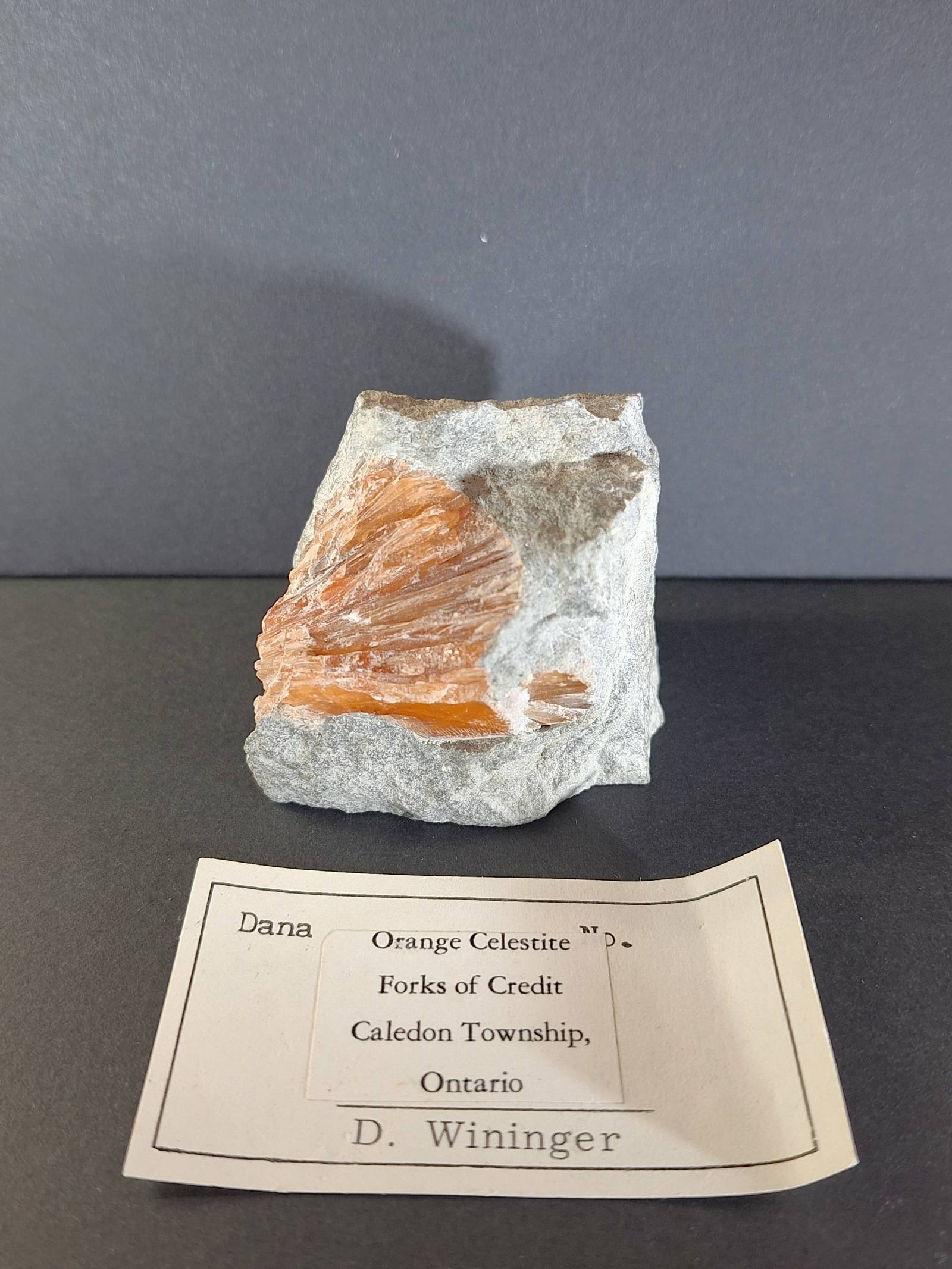
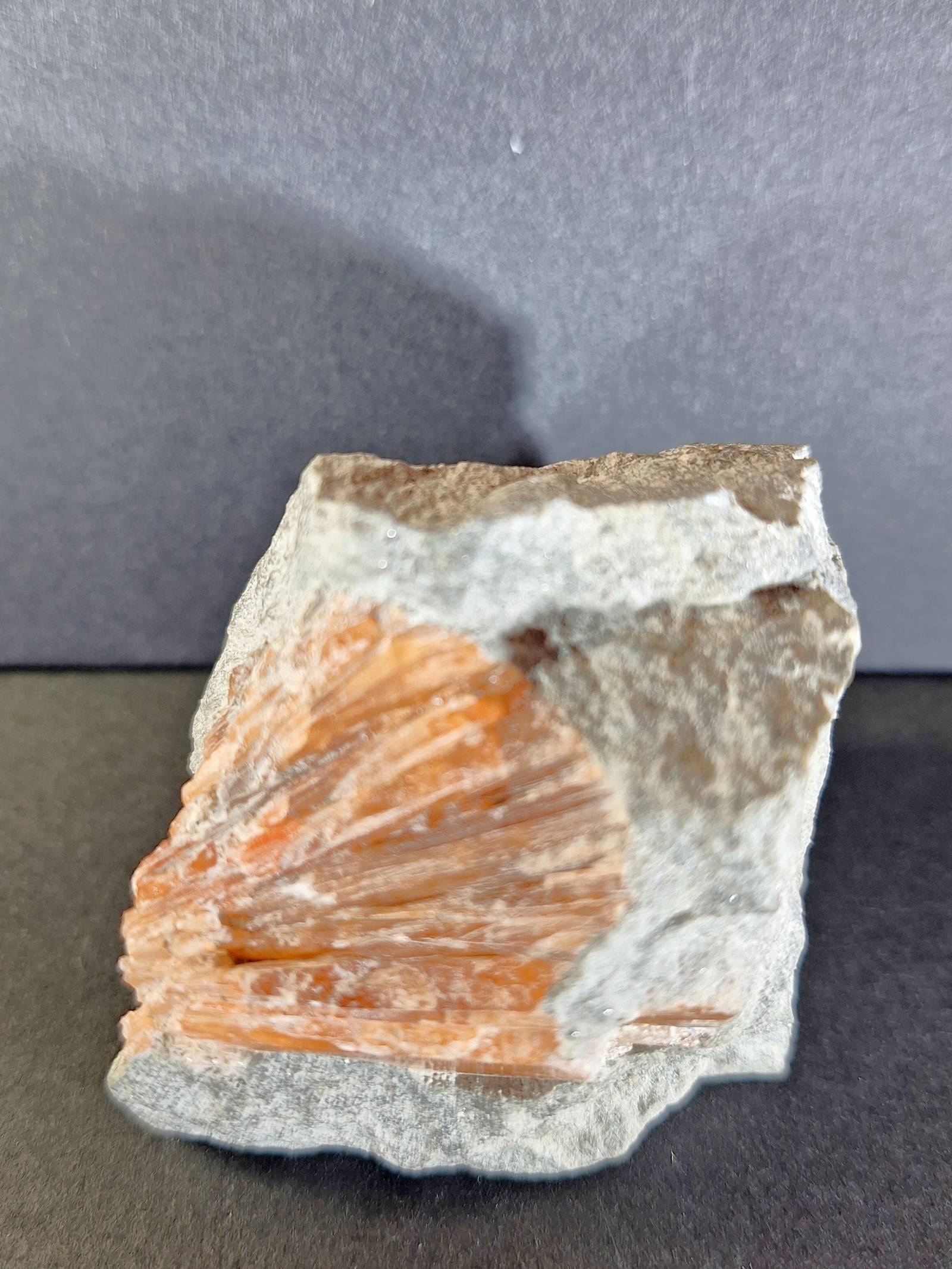
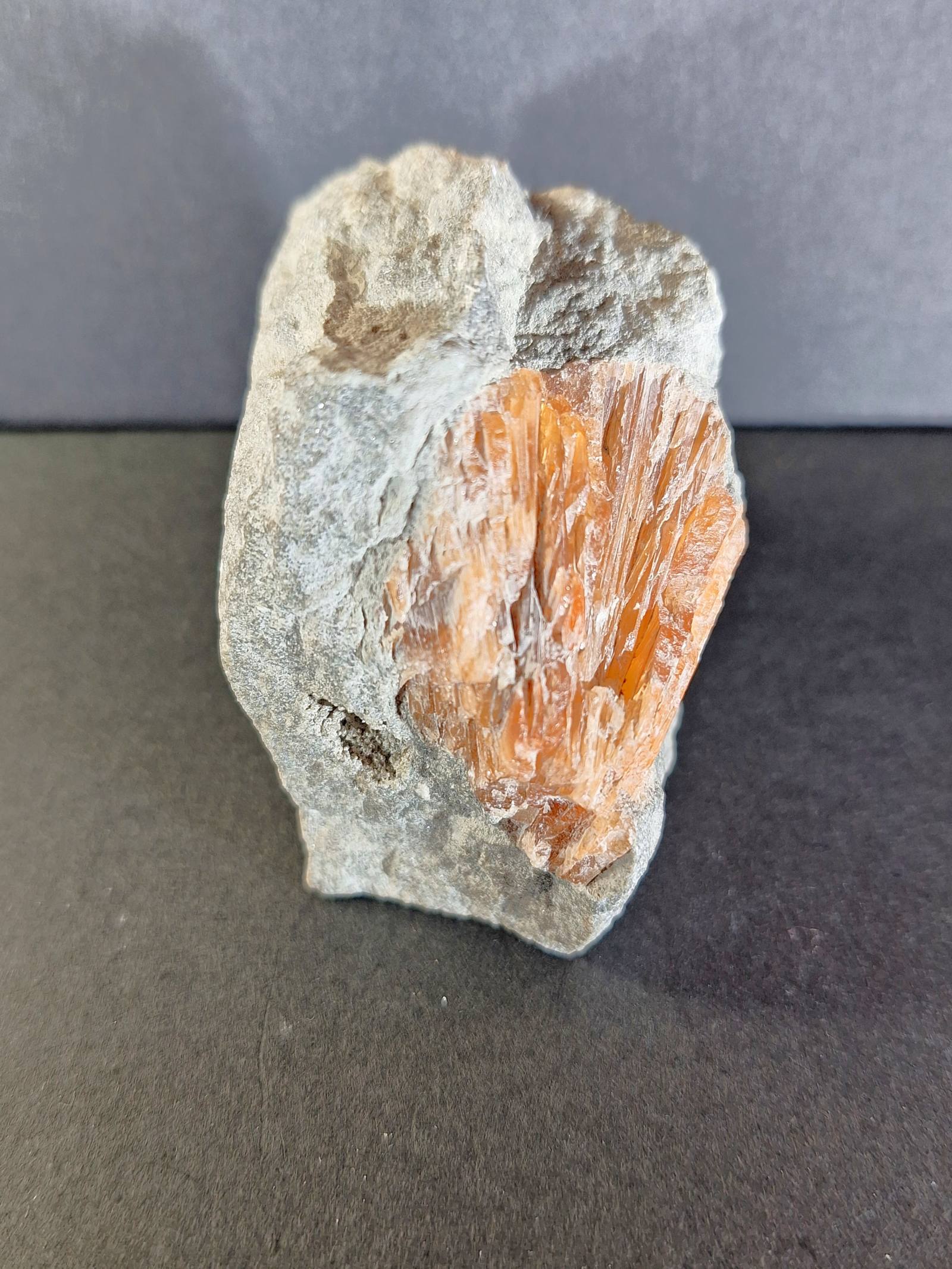
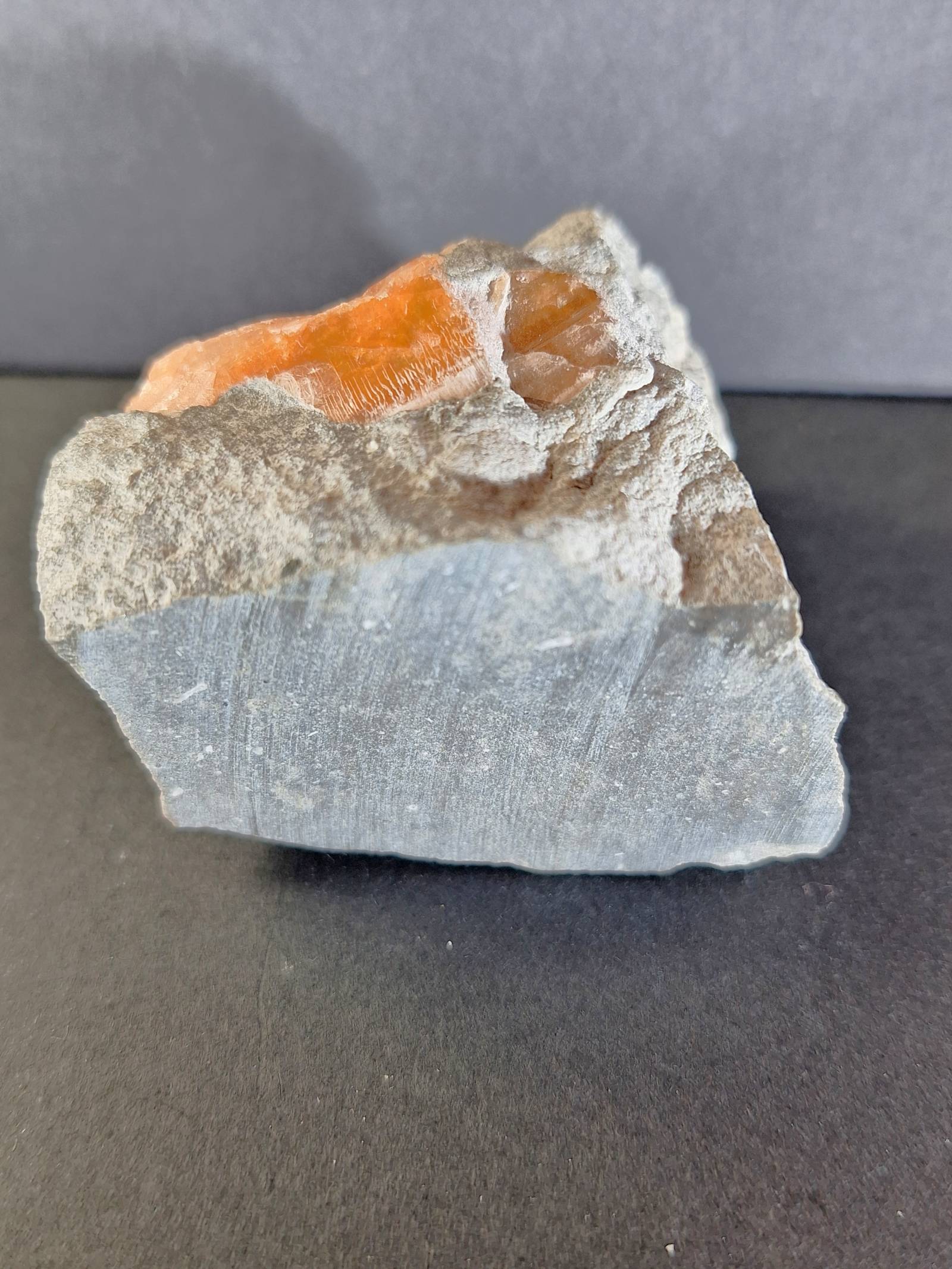
An orange fan of tightly grouped celestite blades spreads across the face of a pale gray matrix, creating a striking contrast between translucent peach-orange mineral and fine-grained host rock. The crystal blades overlap in a radiating pattern and show fine parallel ridges; a smaller patch of similar material appears nearby. Rather than an isolated loose crystal, this is a locality specimen that preserves the relationship between celestite and the rock in which it formed. An original paper label reading “Orange Celestite / Forks of Credit / Caledon Township, Ontario / D. Wininger” accompanies the specimen.
Historic Locality and Collection Provenance
The Forks of the Credit quarries in Caledon Township, Peel Region, are a documented celestine locality in southern Ontario. Mineral records identify celestine at the Yorke quarry within this district and at other Caledon occurrences. Historic quarry exposures brought strontium-bearing mineral seams into view, giving collectors an opportunity to preserve specimens of an orange variety quite unlike the pale blue celestite commonly encountered in shops.
Mineralogy and Crystal Growth
Celestite, also called celestine, is strontium sulfate, SrSO₄. It belongs to the orthorhombic crystal system and has a Mohs hardness of about 3 to 3.5. It may form tabular, bladed, or radiating aggregates where strontium-rich fluids interact with sedimentary rocks. Orange coloration can arise from trace impurities or included material, but the coloring agent in this specimen has not been tested. Its distinctive fan-shaped crystal aggregate provides an especially clear example of the mineral’s bladed growth.
Why the Matrix Matters
The pale host rock is an important part of the specimen’s appearance. It gives the orange blades a contrasting background and helps show how the crystals developed within a confined mineral-bearing opening or seam. Fine parallel ridges along the orange surfaces become easier to see under gentle side lighting, while the smaller orange patch provides a second point of interest. The old paper label is worth preserving alongside the stone: it records a precise historic collecting district and links the piece to the Wininger collection. Together, the mineral, matrix, and label tell a more complete story than a detached orange crystal could provide.
Traditional Crystal Associations
In modern crystal traditions, celestite is associated with tranquility, reflection, and thoughtful communication. Some collectors place celestite near a meditation space as a symbolic reminder to slow down and consider their intentions. These associations belong to spiritual practice rather than mineral science.
Care and Display
Celestite is relatively soft, brittle, and has good cleavage. Keep the crystal blades away from impacts and abrasion; do not soak or scrub the matrix. Display out of prolonged strong sunlight, which can affect the appearance of some celestite specimens, and use a soft dry brush for light dust.
Specimen size: 2.25×1.5×1.75 inches. Locality: Forks of the Credit, Ontario. Provenance: Donald Wininger Collection, assembled during the 1950s–1960s. The individual specimen photographed is the one offered.
Only logged in customers who have purchased this product may leave a review.


Reviews
There are no reviews yet.