Every crystal, mineral, fossil, meteorite, and handcrafted piece is selected with purpose. Whether you’re building a museum-worthy mineral collection, searching for a meaningful gift, decorating your home with natural beauty, or beginning your journey into the world of geology, you’ll discover authentic specimens with stories worth sharing.
Over 15 shows a year throughout the Southwest. Check to see if we are coming to a show near you!
Home > Blog > Minerals Blog | Crystal Guides, Geology & Metaphysical Meaning > Jade History Meaning and Value
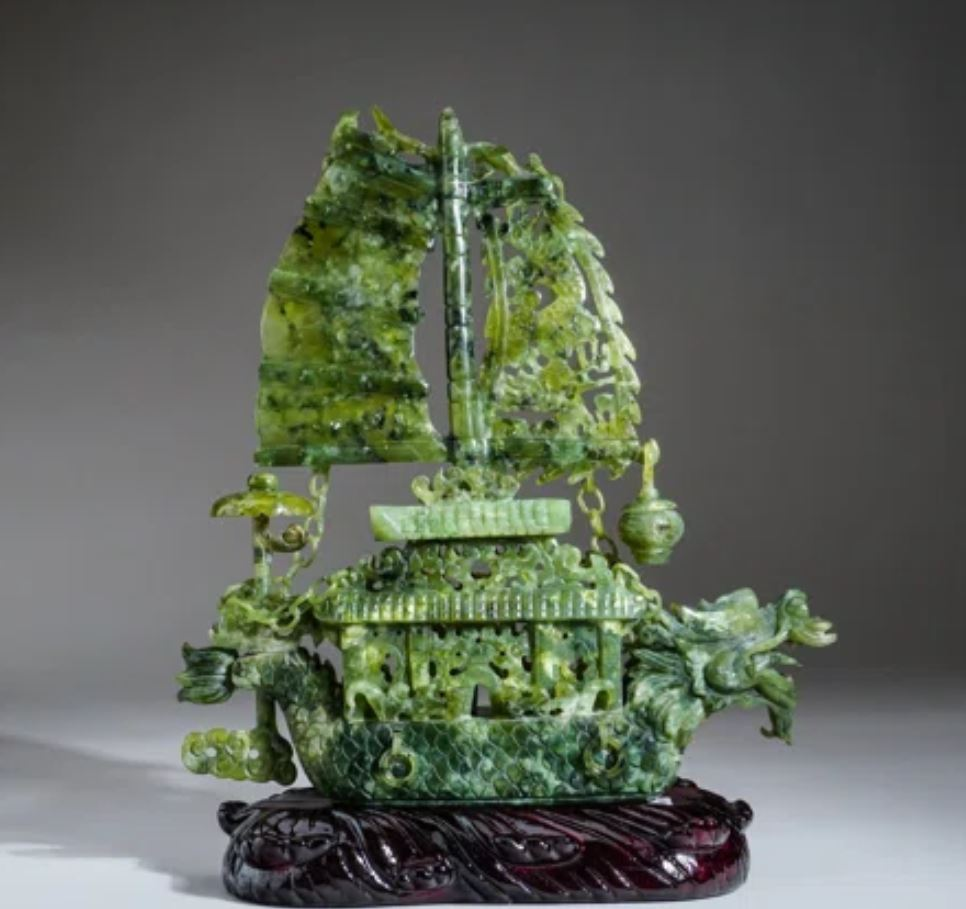
Jade has been carved, worn, exchanged, treasured, and passed between generations for thousands of years. Long before it became associated primarily with jewelry and decorative objects, jade was valued because it combined beauty with extraordinary toughness. Early cultures fashioned it into tools and weapons, while generations of increasingly skilled artisans transformed the same durable material into ceremonial objects, personal ornaments, sculptures, vessels, seals, jewelry, symbolic carvings, and objects intended to be handed down through families.
Its cultural importance became particularly profound in China, where jade came to represent qualities including virtue, purity, wisdom, integrity, loyalty, longevity, prosperity, and status. Jade also developed important traditions among Indigenous cultures in Mesoamerica and New Zealand, demonstrating that its appeal was never limited to a single civilization or period of history. Different cultures encountered exceptionally durable and beautiful stone and developed their own relationships with it.
For today’s collector or buyer, however, jade can be surprisingly complicated. The word does not refer to one simple green mineral. The two principal materials traditionally recognized as jade are jadeite jade and nephrite jade, which differ in mineral composition, geological formation, appearance, geographic sources, and market value even though they share the toughness and carving potential that made jade famous.
Understanding those differences becomes especially important when purchasing jade. Color alone cannot establish identity, the familiar Type A, B, and C terminology describes treatment rather than overall quality, and many attractive green materials sold under names containing the word “jade” are actually serpentine, quartz, glass, or other materials.
Whether you are interested in a mineral specimen, an old carving, a Feng Shui object, a bracelet, or a jade pendant, knowing what the material actually is gives you a much better foundation for judging its quality, authenticity, workmanship, treatment, and value.
For most collectors and jewelry buyers, jade refers primarily to jadeite jade and nephrite jade. These are not varieties of one another, nor are they simply different grades of the same mineral.
Jadeite is a pyroxene mineral with the ideal chemical formula NaAlSi₂O₆. Nephrite, by comparison, is an exceptionally fine-grained material composed primarily of interlocking amphibole minerals in the tremolite-actinolite series. Modern gemological nomenclature can also recognize certain omphacite-rich material within the broader jade classification, but jadeite and nephrite remain the two names most buyers will encounter.
Unlike a quartz point or tourmaline crystal, where individual crystal faces may be obvious, jade is typically composed of extremely fine interlocking crystals. This microscopic structure is responsible for one of jade’s defining characteristics: exceptional toughness.
That distinction is important because toughness and hardness are not the same thing. Hardness measures a mineral’s resistance to scratching, while toughness describes how well a material resists breaking, chipping, or fracturing. Jade is not among Earth’s hardest gemstones, but its interlocking structure makes it remarkably resistant to breakage. This helps explain why people were making tools and weapons from jade long before it became primarily associated with jewelry and ornamental carving.
For a closer look at mineral hardness and why it does not tell the entire story of durability, see our Mohs Scale guide.
Although jadeite and nephrite have both been called jade for generations, collectors should understand what distinguishes them.
Jadeite jade is predominantly a pyroxene material and generally falls around 6.5 to 7 on the Mohs hardness scale. It can occur in green, white, lavender, yellow, orange, reddish orange, gray, brown, black, and other colors. The finest jadeite can combine intense color, fine texture, and attractive translucency, creating material capable of commanding extraordinary prices in the international gemstone market.
Nephrite jade consists mainly of tightly interwoven tremolite-actinolite amphiboles and generally has a Mohs hardness around 6 to 6.5. Its fibrous interlocking structure gives it exceptional toughness. Nephrite occurs in numerous shades of green as well as white, cream, yellow, brown, gray, and nearly black.
It is tempting to simplify the distinction by saying jadeite is the valuable jade and nephrite is the inexpensive variety, but that is inaccurate. Exceptional nephrite can be highly desirable, particularly when it has fine texture, beautiful color, an important locality, outstanding workmanship, historic significance, or strong provenance. Likewise, low-quality jadeite can be relatively inexpensive.
They are better understood as two different materials that share a remarkable combination of toughness, polish, beauty, and carving potential.
The geological conditions responsible for jade are as unusual as the material itself.
Jadeite is strongly associated with high-pressure, relatively low-temperature metamorphic environments, particularly those connected with subduction zones. At convergent plate boundaries, one tectonic plate can descend beneath another, carrying rocks, water, and mineral components deep into Earth. The unusual combination of intense pressure, comparatively moderate temperature, and chemically active fluids can create conditions favorable for jadeite-bearing rocks.
Jadeite deposits are frequently associated with serpentinite bodies and can occur as veins, lenses, or other masses within these complex metamorphic environments. Material formed deep within a subduction system must eventually be transported back toward Earth’s surface through tectonic processes before erosion can expose it.
Nephrite follows a somewhat different geological pathway. It commonly forms through metamorphic and metasomatic reactions involving chemically active fluids interacting with existing rocks. Important deposits can develop where serpentinite interacts with surrounding rocks or where fluids alter dolomite-rich material under suitable conditions.
The geology is therefore more complex than simply saying that all jade forms under pressure in a subduction zone. Jadeite and nephrite can originate through different mineral reactions, even though both ultimately develop the dense, interlocking structures that make jade such an exceptional carving material.
Collectors interested in metamorphism, mineral transformation, and the processes that create collectible minerals can continue through the Grounded Lifestyles Minerals articles.
One of the most important properties of jade is also one of the easiest to misunderstand.
Diamond is considerably harder than jade, and quartz is generally harder than nephrite, yet neither comparison tells us how well a material survives impact. Jade’s extraordinary reputation comes from its toughness, which results from a dense network of microscopic interlocking crystals.
In nephrite, tiny amphibole fibers form an interwoven structure that makes it difficult for a crack to move cleanly through the material. Jadeite develops its own tightly interlocking granular structure. Instead of behaving like a brittle crystal that may cleave or fracture along a preferred direction, good jade can withstand considerable mechanical stress.
For prehistoric craftspeople, this property was invaluable. Jade could be laboriously shaped into axe heads, blades, adzes, tools, and weapons that resisted breaking during use. Once artisans began exploiting its ability to accept a smooth polish and retain intricate carving, jade’s practical durability became inseparable from its aesthetic and symbolic importance.
That toughness also helps explain why ancient jade objects survive today. Pieces created hundreds or thousands of years ago can retain extraordinary detail when they have been preserved properly.
Green is the color most people associate with jade, but authentic jade occurs in a much broader range.
Jadeite can be white, green, lavender, yellow, orange, reddish orange, gray, brown, black, or combinations of several colors. Nephrite ranges through creamy whites, grays, yellows, browns, blacks, and numerous shades of green.
Different trace elements and mineralogical conditions influence these colors. Chromium is particularly important in producing the intense green associated with fine jadeite, while iron and other elements contribute to various greens, yellows, browns, and darker shades.
This color diversity is important for buyers because green alone does not identify jade. A vivid green carving might be jadeite, nephrite, serpentine, aventurine, dyed quartz, glass, or another imitation. Conversely, genuine jade may be white, lavender, brown, yellow, black, or another color that a new collector might not immediately associate with jade.
Identification should therefore begin with the material itself rather than assumptions based on color.
The term Imperial Jade is associated with exceptionally fine green jadeite, particularly material combining vivid, attractive green color with fine texture and good translucency.
The combination is what matters. A piece is not exceptional simply because it is very dark green, nor does bright green automatically mean Imperial quality. Fine jadeite is evaluated through the relationship between color, transparency, texture, evenness, proportions, and other quality factors.
This is also a term collectors should approach carefully when shopping. “Imperial” carries enormous commercial weight, and truly exceptional natural jadeite can reach extraordinary prices. An inexpensive mass-produced object with intense green color and no treatment disclosure should not automatically be accepted as Imperial Jade simply because a seller uses the term.
When the price or claimed quality becomes significant, independent gemological identification becomes increasingly worthwhile.
Myanmar has historically been the world’s most important source of fine jadeite, particularly the intensely colored material associated with the upper end of the jade market.
Jadeite occurs there in complex geological environments associated with serpentinite and high-pressure metamorphism. Rough jadeite can also present a distinctive challenge because weathering and alteration may create an outer skin that conceals the quality of the material inside.
A boulder that appears relatively ordinary externally may contain valuable green jadeite, while another that seems promising can reveal fractures, uneven color, coarse texture, or little gem-quality material once opened. Evaluating rough jade can therefore require considerable experience.
This uncertainty is part of the reason jade rough has developed such a distinctive trading history. Unlike a transparent faceting crystal that reveals much of its quality before cutting, a jade boulder can conceal a considerable amount of information beneath its exterior.
Nephrite occurs across a wider range of geographic locations, and several regions have developed important histories of production and carving.
China has one of the world’s longest relationships with nephrite. Much of the jade associated with early Chinese history was nephrite rather than jadeite, and pale material—including highly regarded white nephrite—was used for some of China’s most sophisticated historical carvings.
British Columbia is another important source and has supplied substantial quantities of green nephrite to the international carving market. Canadian material ranges from dark green to brighter shades and is used for carvings, jewelry, decorative objects, and rough specimens.
Siberian nephrite is also highly regarded, with some material displaying vivid and attractive green coloration. Other important deposits occur elsewhere, including New Zealand, where nephrite is deeply connected with Māori traditions.
Locality can therefore add another dimension to collecting jade. The source does not automatically determine quality, but different deposits can produce distinctive colors, textures, inclusions, geological associations, and cultural histories.
Few gemstones are as deeply connected with a civilization as jade is with China.
Jade objects in China extend back thousands of years, long before jadeite became widely available there. Early artisans primarily worked nephrite, transforming the exceptionally tough material through patient grinding and abrasion into ritual objects, ceremonial blades, ornaments, pendants, tools, symbols of authority, and objects associated with burial practices.
As Chinese jade traditions developed, the material became associated with philosophical and moral qualities. Characteristics such as durability, smoothness, translucency, beauty, and purity were compared with desirable human virtues, and jade became connected with ideas including wisdom, integrity, benevolence, loyalty, righteousness, and social status.
The bi, a flat jade disk with a central opening, is among the best-known forms from ancient Chinese tradition and became associated with heaven and ceremonial practice. Countless other forms carried meanings connected with rank, protection, spirituality, family, prosperity, and identity.
This history is particularly important for collectors because an old Chinese jade object cannot be evaluated simply according to the market price of its raw material. Workmanship, age, symbolism, cultural context, condition, provenance, and authenticity may contribute as much to its significance as the quality of the jade itself.
Jade developed independently as a material of extraordinary importance in ancient Mesoamerica.
Olmec, Maya, and other cultures fashioned jadeite and related green materials into beads, pendants, masks, plaques, ear ornaments, ceremonial objects, and items associated with elite status. Green coloration could carry symbolic associations with vegetation, water, fertility, maize, life, renewal, and power.
Important jadeite deposits occur in Guatemala’s Motagua Valley region, providing a geological source for jade used by ancient Mesoamerican civilizations.
The Mesoamerican jade tradition is important because it demonstrates that humanity’s attraction to jade was not simply transmitted from one cultural center. Different societies independently encountered beautiful, durable green material and developed sophisticated artistic, social, and spiritual relationships with it.
In New Zealand, nephrite and several other culturally significant greenstones are associated with the broader tradition of pounamu. Pounamu holds profound significance within Māori culture and has been fashioned into tools, weapons, ornaments, pendants, and treasured objects that may pass between generations.
Such objects can carry histories associated with family, ancestry, status, relationships, and place. Their significance cannot be understood solely through mineral composition or market price.
For collectors, this is an important reminder that geology tells us what a material is, but it does not necessarily tell us what an object means. Jade and jade-like greenstones have accumulated cultural significance over thousands of years, and culturally important material deserves to be approached with appropriate context and respect.
Jade’s long association with prosperity, protection, harmony, longevity, virtue, and good fortune naturally contributed to its use in symbolic carvings. Today, jade remains popular in Feng Shui objects, decorative spheres, money frogs, animals, pendants, and other carved forms in which the symbolism of the material is combined with the traditional meaning of the object itself.
The money frog, sometimes called the three-legged toad, is traditionally associated with wealth, prosperity, and abundance. When carved from jade, the prosperity symbolism of the figure is combined with jade’s longstanding associations with good fortune, harmony, and enduring value.
Jade spheres and more elaborate carved balls are interpreted somewhat differently. The sphere’s continuous form can symbolize wholeness, harmony, continuity, and balance, while complex nested or pierced carvings demonstrate the tremendous skill required to work such a tough material.
This relationship between stone and subject is part of what makes carved jade interesting even beyond its decorative appeal. A collector can consider the mineral composition, color, texture, polish, and workmanship while also exploring the cultural or symbolic tradition represented by the carving.
Grounded Lifestyles carries jade in several decorative forms, including our Jade Feng Shui Ball and Jade Money Frog. For additional stone animals, symbolic figures, and mineral carvings, explore our Crystal Animals & Figurines collection.
Jade’s toughness is an advantage once a carving is finished, but it makes the material demanding to work.
Traditional jade carving relied heavily on abrasion. Rather than simply slicing through the stone with a conventional metal blade, artisans used abrasive materials with increasingly sophisticated tools to grind, drill, shape, smooth, and polish the jade over long periods.
Modern diamond tools have made the process faster, but successful jade carving still requires careful planning. A skilled carver studies color distribution, translucency, fractures, inclusions, texture, and the natural shape of the rough before deciding how to orient a design.
Color variation that might reduce the desirability of a simple cabochon can become an artistic advantage in a carving. A darker area may become an animal’s eye, a leaf, a garment, a wave, or another deliberate part of the composition. Skilled carving therefore involves working with the natural characteristics of the stone rather than simply imposing a predetermined design on it.
For collectors, this means workmanship can contribute substantially to value. A modest piece of jade transformed by exceptional carving may be more desirable than better raw material used for an uninspired or poorly finished object.
Readers interested in the broader process of transforming rough mineral material can explore our Lapidary 101 guide.
Jade cannot be accurately valued through a single price-per-carat formula. Quality varies enormously, and the factors that matter can change depending on whether the object is a cabochon, bangle, bead strand, carving, antique, or piece of rough.
For fine jadeite, color, transparency, texture, treatment status, size, proportions, condition, and workmanship all influence value. The most highly prized green jadeite combines vivid color with attractive translucency and a fine, even texture. Material that is extremely dark, cloudy, heavily fractured, coarse, or uneven may be considerably less valuable even if it is technically jadeite.
Size becomes particularly important when high quality is maintained throughout a larger object. Producing a substantial carving or complete bangle from fine material requires a much larger usable area of rough than producing a small cabochon.
Nephrite follows somewhat different market patterns, but color, texture, translucency, uniformity, locality, workmanship, size, historical significance, and provenance can all influence desirability.
Carved jade adds another level to the evaluation. The value of a carving is not simply the value of the raw stone multiplied by its weight. Design, execution, artistic skill, age, condition, subject, provenance, and cultural importance can all contribute.
This is why two jade objects of similar size can have dramatically different values.
One of the most important concepts for anyone buying jadeite is understanding the familiar Type A, Type B, and Type C terminology.
These letters describe treatment status, not a quality grading system. Type A does not mean excellent quality, Type B does not mean second quality, and Type C does not mean third quality.
Type A jade has not undergone significant enhancement beyond the traditional surface waxing that may accompany normal finishing and polishing. A Type A piece can still have mediocre color, poor translucency, fractures, coarse texture, or relatively low commercial value. The designation primarily tells the buyer that significant treatment has not been used to alter the material.
Type B jade has undergone chemical bleaching, commonly involving acid, followed by polymer impregnation. The bleaching removes staining or undesirable material, while polymer fills spaces and can improve the apparent clarity or texture.
Type C jade has been artificially dyed to change or intensify its color.
Material described as B+C jade has undergone both bleaching/polymer impregnation and dye treatment.
Treatment can have a major effect on value and, in some cases, long-term stability. A beautiful treated piece may still be perfectly enjoyable as jewelry or decoration when it is priced and represented appropriately. The problem arises when treated material is sold as untreated natural jade.
Disclosure is therefore an important part of buying jade responsibly.
Some treatments create visual clues, but appearance alone cannot reliably identify every treatment.
Artificial color may sometimes concentrate around fractures or grain boundaries, while polymer-treated material can develop characteristics visible under magnification. Sophisticated treatments, however, may be difficult to identify without appropriate gemological testing.
Professional laboratories can use analytical methods such as infrared spectroscopy to identify polymer impregnation and other treatments that might not be apparent during ordinary visual examination.
The amount of testing appropriate for a purchase depends partly on value. Laboratory certification may make little economic sense for an inexpensive decorative carving purchased simply because you enjoy it. It becomes much more important when buying an expensive jadeite bangle, bead strand, cabochon, pendant, or supposedly exceptional untreated specimen.
The higher the price depends upon claims such as “natural,” “untreated,” “Imperial,” or “antique,” the more important independent verification becomes.
Jade has accumulated an unusually large number of imitations and confusing trade names.
Serpentine is among the most common materials mistaken for nephrite because it can display a similar green color and smooth or waxy appearance. Serpentine is a legitimate and attractive mineral material in its own right, but it should not be represented as jadeite or nephrite.
Aventurine quartz is another familiar green material that has occasionally been sold under jade-related names. Its quartz composition and characteristic sparkling inclusions distinguish it from true jade.
Chrysoprase, a green variety of chalcedony, can resemble attractive translucent green jade, while hydrogrossular garnet, vesuvianite, glass, dyed quartz, and several other materials may also be used as substitutes or confused with jade.
These materials are not necessarily inferior. Chrysoprase, serpentine, aventurine, and vesuvianite can all be collectible in their own right. The problem is inaccurate identification, particularly when a jade-related trade name causes a buyer to believe a less expensive material is jadeite or nephrite.
When identity affects the price, ask for the actual mineral or gemological identification rather than relying on the commercial name.
Maw sit sit deserves special attention because it is frequently encountered alongside jade and originates from Myanmar’s jade-producing region.
Rather than being a simple variety of jadeite, maw sit sit is a metamorphic rock composed of several minerals and can contain jadeite along with kosmochlor and other mineral components. Its vivid green and dark patterning can make it extremely attractive.
Correctly identifying it does not diminish the material. Maw sit sit has its own interesting mineralogy, appearance, locality, and collector following. The important point is simply that it should be represented accurately rather than sold as though it were ordinary fine jadeite.
The first question when buying jade should be surprisingly simple: What type of jade is it?
A knowledgeable seller should be able to distinguish jadeite from nephrite rather than relying entirely on the generic word “jade.” For jadeite, the next question should concern treatment. If a piece is represented as natural and untreated, determine whether the seller means Type A and whether independent gemological documentation exists when the price warrants it.
Then examine the object rather than the story surrounding it. Look at color under neutral lighting, paying attention to whether it appears natural and reasonably consistent. Consider translucency, texture, fractures, polish, proportions, carving quality, and condition.
With carvings, examine whether the artist used the natural characteristics of the material effectively. Color variations and inclusions can become deliberate parts of the design, and good workmanship should look thoughtful from more than one viewing angle.
For older objects, provenance becomes increasingly important. Age should not be assumed from style, surface appearance, or claims that an object “looks ancient.” Jade designs have been reproduced for generations, and surfaces can be intentionally altered to suggest age.
Finally, consider whether the price makes sense relative to the claim. Exceptional untreated Imperial-quality jadeite does not ordinarily appear as an inexpensive mass-produced object without documentation.
Jade’s toughness, smooth polish, cultural history, and comfortable feel make it exceptionally well suited to jewelry. Bangles, bead bracelets, pendants, cabochons, rings, earrings, and carved jewelry have been worn for generations.
Bangles occupy an especially important place in the jadeite market because a complete circular bangle requires a relatively large section of suitable rough. Color, texture, translucency, and structural integrity must extend through enough material to produce the entire form, making fine bangles much more demanding of the original stone than a small cabochon.
Bead strands present a similar challenge because multiple beads must be matched for color, texture, translucency, size, and overall appearance. The quality of the entire strand therefore matters rather than simply the appearance of one bead.
Pendants allow a broader range of material and carving styles. Some emphasize the natural color and polish of jade, while others combine the stone with sterling silver or symbolic carving.
Grounded Lifestyles carries jade in wearable forms including Chinese Nephrite Jade bracelets and Nephrite Jade sterling silver pendants, along with other jade jewelry as inventory changes. Browse our broader Crystal & Gemstone Jewelry collection for currently available bracelets, pendants, earrings, and other natural gemstone jewelry.
Untreated jadeite and nephrite are remarkably tough, but simple care is still preferable.
For most untreated jade, warm water, mild soap, and a soft cloth or soft brush are adequate. Harsh household chemicals are unnecessary and should be avoided, particularly when treatment status is unknown.
Treated jade requires greater caution because polymers, dyes, coatings, adhesives, or other enhancements may respond differently to heat, chemicals, or aggressive cleaning. When you do not know whether a piece has been treated, conservative cleaning is the safest approach.
Antique carvings deserve additional care. Old surface patina, residues, historic repairs, and original finishes can contribute to an object’s history and should not be aggressively removed merely to make an older piece appear new.
Jade should also be stored so that it does not repeatedly rub against harder gemstones or abrasive surfaces. Exceptional toughness does not mean that jade cannot be scratched.
A jade carving should be evaluated as both a geological material and a piece of workmanship.
Begin by considering what the material actually is. Is it jadeite, nephrite, another jade-bearing rock, or a jade look-alike? Then consider treatment, color, translucency, texture, condition, size, and the overall quality of the stone.
Next examine the carving. Look at whether details are crisp and deliberate, whether drilled or pierced sections have been finished carefully, whether the composition makes intelligent use of natural color variations, and whether the object remains visually balanced when viewed from different directions.
Symbolism can add another layer of interest. Animals, money frogs, spheres, dragons, fish, Buddha figures, flowers, and other subjects may carry cultural or metaphysical meanings beyond their decorative appearance. Buyers should distinguish between appreciating that symbolism and assuming that every modern carving is historically significant simply because it uses a traditional subject.
Grounded Lifestyles offers carved mineral pieces through our Crystal Animals & Figurines collection, including jade and other stones selected for their combination of natural material, workmanship, and symbolism.
Jade carried symbolic and spiritual meaning long before the development of the modern crystal movement. Across different traditions, it has been connected with virtue, prosperity, harmony, protection, wisdom, longevity, balance, status, and good fortune.
Within contemporary metaphysical practice, green jade is commonly associated with abundance, emotional harmony, prosperity, balanced energy, and the Heart Chakra. It may be carried, worn as jewelry, placed in the home, used during meditation, or incorporated into intention-setting practices.
The form of the jade can contribute additional symbolism. A money frog may be selected for its traditional association with prosperity, while a sphere may represent harmony or completeness. Jade bracelets and pendants allow the material to be carried or worn as a personal symbol, while larger carvings can become meaningful decorative objects within a home or meditation space.
White jade is often associated with clarity, calm reflection, and peaceful intention, while darker jade may be connected with grounding and protection. These associations belong to cultural and metaphysical traditions rather than the geological properties used to identify jade.
The distinction is particularly important with a material as historically significant as jade. Modern metaphysical practice did not invent jade’s symbolic importance; human societies had already been attributing meaning to jade and jade objects for thousands of years.
Readers interested in these traditions can continue with our Crystal Healing Guide or explore Chakras and Corresponding Crystals.
Jade is a gem and cultural term rather than the name of one simple mineral. The two principal materials traditionally called jade are jadeite jade, predominantly associated with pyroxene minerals, and nephrite jade, composed mainly of fine interlocking amphibole minerals. Modern gemological terminology can also include certain omphacite-rich material.
Jadeite and nephrite have different mineral compositions and geological origins. Jadeite belongs to the pyroxene group, while nephrite consists primarily of tremolite-actinolite amphiboles. Both develop tightly interlocking structures that make them exceptionally tough and suitable for carving.
Exceptional jadeite generally reaches the highest prices, particularly vivid green, fine-textured, semitransparent material. Fine nephrite can also be valuable, especially when it has exceptional color or texture, comes from a desirable locality, displays outstanding workmanship, or has important historical provenance.
No. Jadeite can occur in green, white, lavender, yellow, orange, reddish orange, gray, brown, black, and other colors. Nephrite occurs in white, cream, numerous greens, yellow, brown, gray, and nearly black.
Imperial Jade is a trade term associated with exceptionally fine green jadeite displaying vivid color, fine texture, and attractive translucency. It should not be used simply as another name for any bright or dark green jade.
Type A describes jade that has not undergone significant enhancement beyond traditional surface waxing associated with normal finishing. It describes treatment status rather than overall quality.
No. A piece of Type A jade can still have ordinary color, poor translucency, coarse texture, fractures, or modest commercial value. The Type A designation tells the buyer primarily that the jade has not undergone the treatments associated with Type B or Type C material.
Type B jade has been chemically bleached and polymer impregnated. These processes can improve its apparent appearance but significantly alter the material and should be disclosed to buyers.
Type C jade has been artificially dyed to alter or intensify its color. Material that has undergone both bleaching/polymer impregnation and dye treatment may be described as B+C jade.
The microscopic crystals making up jade form tightly interlocking structures that make it difficult for fractures to travel through the material. This creates exceptional toughness even though jade is not among the hardest gemstones on the Mohs scale.
Generally, no. Quartz has a Mohs hardness of 7. Jadeite is typically around 6.5 to 7, while nephrite is around 6 to 6.5. Jade’s famous durability comes primarily from toughness rather than superior scratch resistance.
Appearance can provide clues, but visual inspection alone cannot reliably distinguish all jade from imitations or identify every treatment. Gemological testing is the more reliable approach, particularly for expensive jade represented as natural, untreated, or exceptionally valuable.
No. Serpentine is a different mineral material, although some varieties resemble nephrite because of their green color and waxy appearance. A jade-related trade name does not make serpentine true jadeite or nephrite.
No. Aventurine is a variety of quartz containing reflective mineral inclusions. Although green aventurine has sometimes been marketed under jade-like names, it is mineralogically different from jade.
Maw sit sit is a metamorphic rock that can contain jadeite along with kosmochlor and other minerals. It is closely associated geographically and commercially with Myanmar jade, but it should be identified as maw sit sit rather than simply represented as ordinary jadeite.
A bangle requires a large continuous section of suitable rough. Producing one with consistently fine color, texture, translucency, and structural integrity can require considerably more high-quality jade than producing a small cabochon or pendant.
They can be. Value depends on the identity and quality of the jade, treatment status, size, workmanship, condition, age, provenance, artistic quality, and cultural or historical importance. Not every jade carving is valuable simply because it is jade.
Yes. The three-legged money frog or money toad is traditionally associated with prosperity and abundance in Feng Shui practice. Jade adds its own longstanding associations with good fortune, harmony, prosperity, and enduring value.
In contemporary Feng Shui and metaphysical traditions, spheres are commonly associated with wholeness, harmony, continuity, and balanced energy. When carved from jade, these associations are combined with jade’s traditional symbolism of prosperity, virtue, harmony, and good fortune.
Jade has carried spiritual and symbolic associations for thousands of years across multiple cultures. Contemporary metaphysical traditions commonly associate it with harmony, prosperity, protection, wisdom, balance, good fortune, and Heart Chakra practices. These are cultural and spiritual associations rather than scientifically established mineral properties.
Warm water, mild soap, and a soft cloth or brush are appropriate for most untreated jade. More conservative care should be used when treatment status is unknown or when dealing with antique pieces, dyes, polymer impregnation, coatings, adhesives, or historic repairs.
Begin by determining whether the material is jadeite or nephrite and ask whether it has been treated. Then evaluate color, translucency, texture, condition, workmanship, size, and provenance. For expensive jade represented as untreated or unusually valuable, independent laboratory documentation can provide additional confidence.
Grounded Lifestyles carries jade across several areas of our collection rather than limiting it to a single Jade category. Our inventory can include jade Feng Shui pieces and symbolic carvings through Crystal Animals & Figurines, along with jade bracelets and pendants within Crystal & Gemstone Jewelry. Jade and other collectible geological material can also be found throughout our Mineral Specimens & Crystals collection and the broader Grounded Lifestyles Shop.
Jade’s enduring appeal comes from a combination few materials can match: unusual metamorphic geology, exceptional toughness, beautiful color, thousands of years of craftsmanship, and profound cultural meaning. Understanding the differences between jadeite and nephrite, recognizing treatments and look-alikes, and evaluating color, texture, translucency, workmanship, condition, and provenance allows collectors to appreciate jade for far more than its familiar green appearance.
Grounded Lifestyles carries jade in several forms, including Feng Shui pieces, symbolic carvings, bracelets, pendants, and other decorative and wearable pieces. Explore our Crystal Animals & Figurines collection for carved stone figures, browse Crystal & Gemstone Jewelry for wearable gemstone pieces, continue through our broader Mineral Specimens & Crystals collection, or visit the Grounded Lifestyles Shop to see what is currently available.

At Grounded Lifestyles, our love for crystals began in the peaceful flow of Reiki and energy healing sessions — where we saw how natural stones could amplify intentions, restore balance, and bring comfort. But the more time we spent with these treasures, the more curious we became about their origins. That curiosity led us into the fascinating world of geology and mineral specimen collecting. We fell in love not just with the energy of crystals, but with the science and artistry of their creation — the intricate crystal structures, the vibrant mineral hues, and the wonder of holding a piece of Earth’s history in our hands.

