Description
Lavender-Gray Coyamito Agate Half from Chihuahua, Mexico
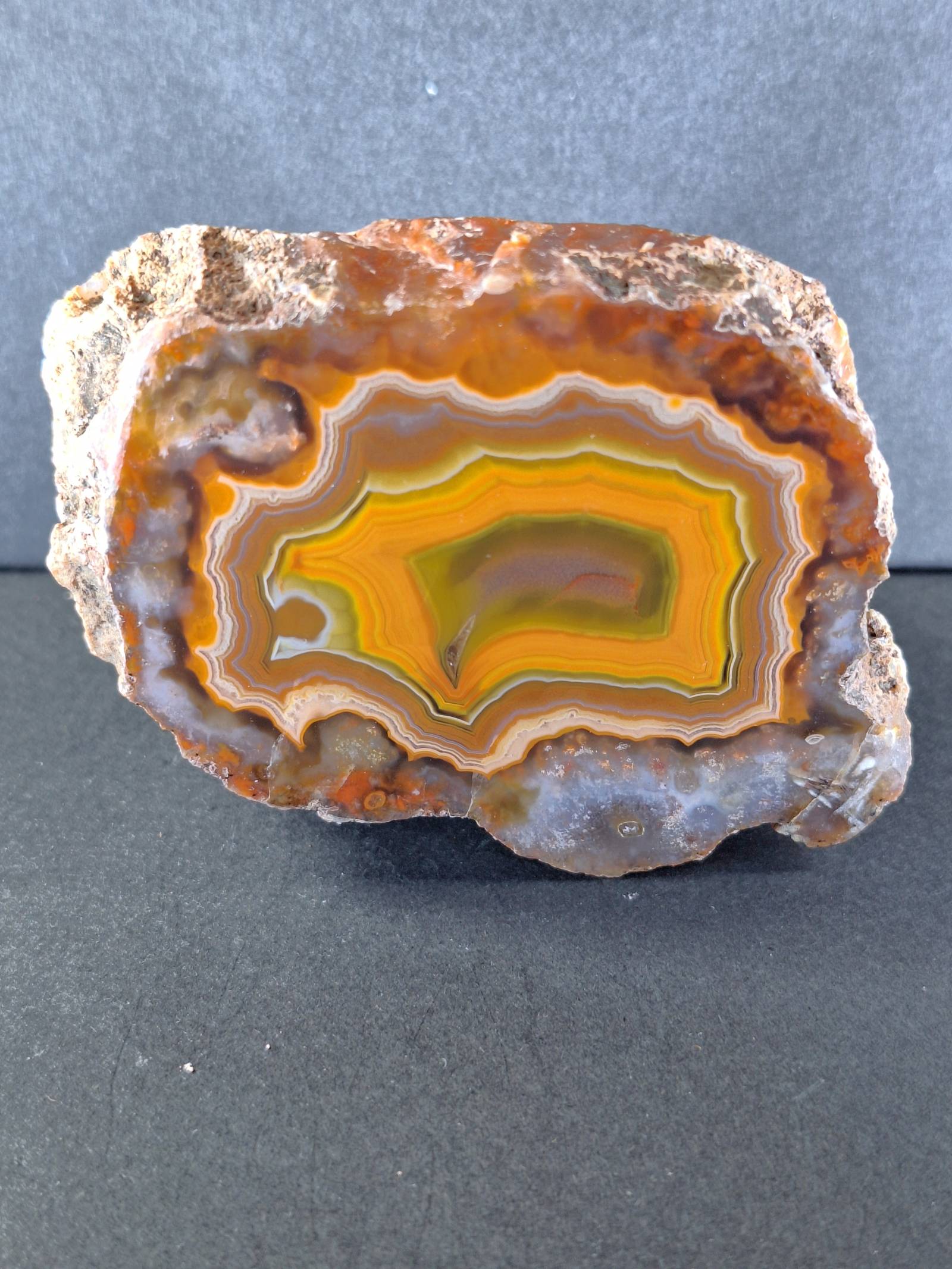
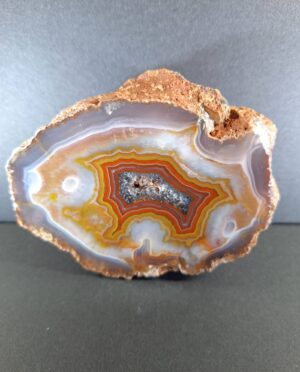
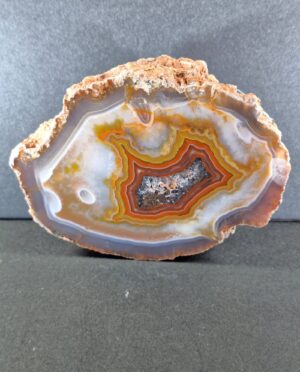
Not every exceptional agate announces itself with brilliant red or fiery orange. Some reveal their character through subtle color transitions and the remarkable precision of their internal patterns. This 2.5-inch Coyamito agate half from Chihuahua, Mexico, belongs to that quieter category, with delicate lavender-gray fortification bands surrounded by earthy brown tones and the original exterior of the nodule.
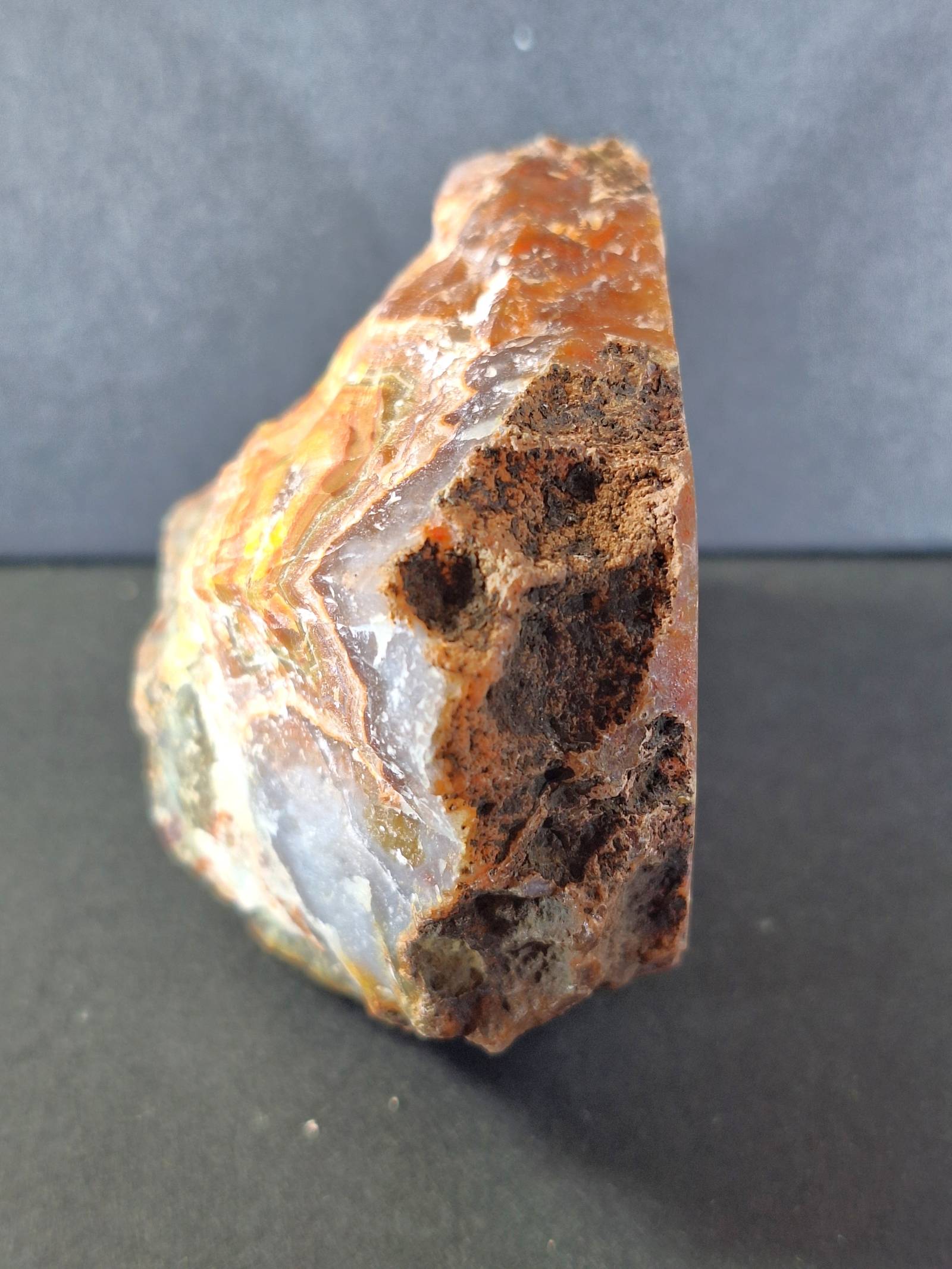
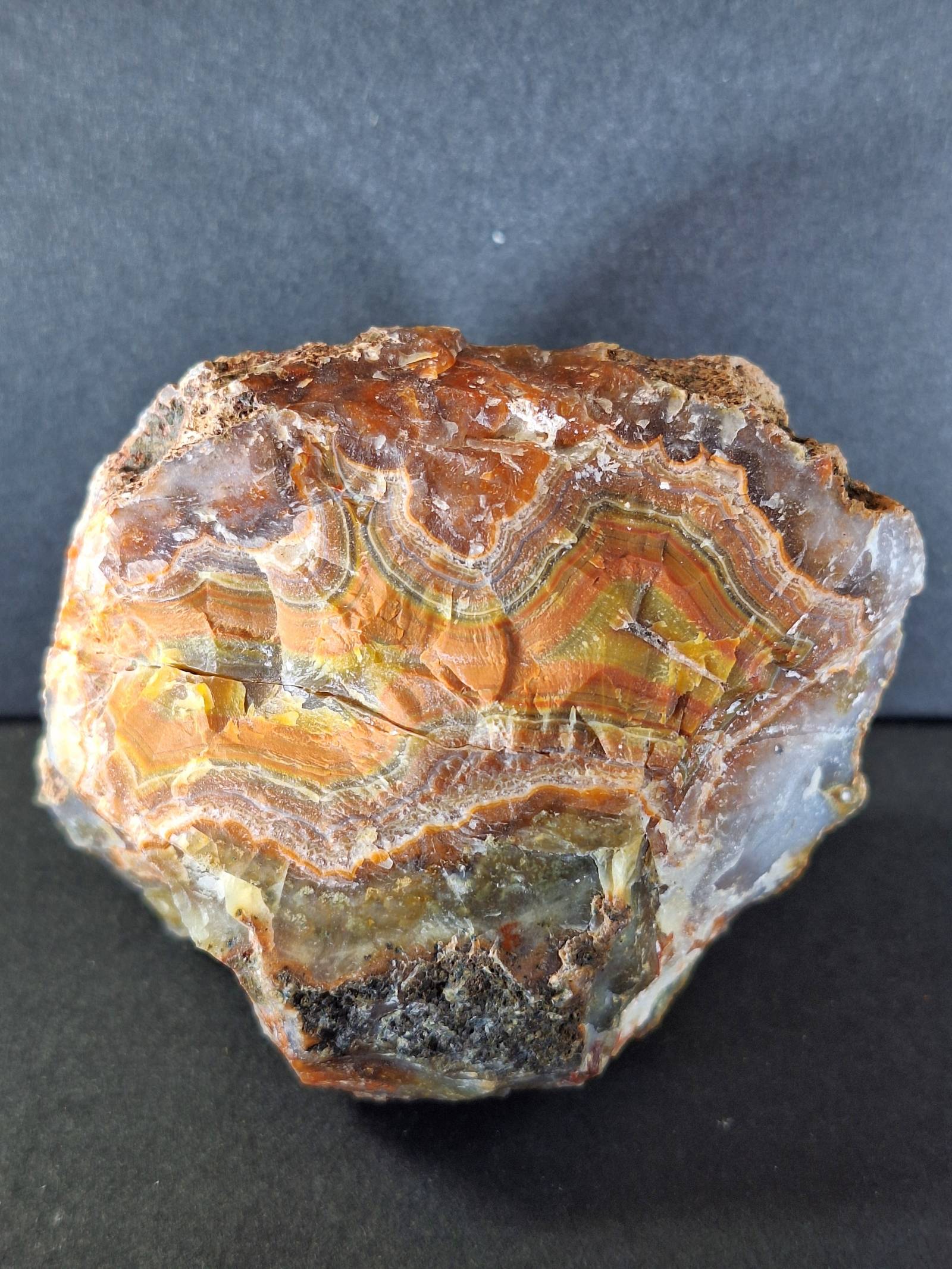
The polished face reveals a sequence of closely spaced chalcedony layers that follow the contours of the agate’s interior. Muted lavender, gray, and brown create a restrained palette, allowing the structure of the bands to become the principal attraction. The contrast between the smooth cut surface and the natural rind also preserves an important part of the stone’s identity: what was once an unremarkable-looking nodule now reveals the mineral growth hidden inside.
Fortification Banding: Nature’s Record of Mineral Growth
The intricate pattern visible in this Coyamito agate is known as fortification banding. The term describes the nested, sometimes angular outlines that resemble the defensive walls of an old fortress when seen in cross-section.
These bands developed as silica-bearing fluids deposited successive layers of chalcedony within a cavity in the host rock. Changes in the conditions of deposition influenced the thickness, texture, and appearance of the layers, creating the distinctive patterns now visible across the polished surface.
In this specimen, the relatively subdued colors draw attention to the fine details of the banding. Rather than relying on dramatic color contrast, the stone invites closer examination of how the layers curve, converge, and follow the irregular boundaries of the original cavity.
Rancho Coyamito and the Agates of Northern Chihuahua
Coyamito agate takes its name from the Rancho Coyamito area in Chihuahua, Mexico, within the Sierra del Gallego region. This locality has a long-standing reputation among agate collectors for nodules containing distinctive fortification patterns, colorful chalcedony, and occasional mineral replacement structures.
Although Coyamito is often associated with vivid combinations of red, orange, yellow, and purple, its deposits also produce more restrained examples with lavender and gray coloration. These variations are part of what makes the locality interesting: two nodules from the same general region can reveal dramatically different internal appearances.
For collectors building a locality-focused collection, this lavender-gray example provides a useful contrast to the brighter agates traditionally associated with Chihuahua. Its visual interest lies in the precision of the banding and the relationship between the polished interior and the natural outer surface.
The Mineralogy Behind the Pattern
Agate is a banded variety of chalcedony, a finely crystalline form of silica with the chemical composition SiO₂. Chalcedony belongs to the quartz family and typically has a Mohs hardness of approximately 6.5–7.
Agates commonly develop in cavities within volcanic rocks, where mineral-bearing fluids deposit silica over time. Repeated episodes of deposition can create layers that differ in color, translucency, and texture.
The gray and lavender tones visible in some Coyamito agates may reflect differences in trace constituents, inclusions, or the structural characteristics of the silica. The precise cause of coloration in any individual specimen cannot be established from appearance alone.
Traditional Symbolism and Metaphysical Associations
In contemporary crystal traditions, agate is associated with stability, patience, and emotional balance. Its layered structure is often interpreted as a symbol of gradual growth and the value of steady progress.
Lavender and gray agates are sometimes associated with reflection, intuition, and a calm, measured approach to change. Crystal enthusiasts may use such stones as visual focal points during meditation or intention-setting, appreciating their quiet colors and naturally repeating patterns.
These interpretations are traditional spiritual associations rather than scientifically established effects.
Care and Display
Display this Coyamito agate with its polished face visible so that the fine lavender-gray fortification bands can be appreciated. Soft, indirect lighting is often useful for revealing subtle differences between the individual layers without overwhelming their muted colors.
Although agate is relatively hard, the specimen should still be protected from impacts, abrasive surfaces, and sudden temperature changes. Dust it with a soft brush or microfiber cloth. If needed, clean gently with a slightly damp cloth and dry it thoroughly.
The natural rind should be handled carefully to preserve its texture, while the polished face benefits from being stored separately from harder or sharp-edged specimens.
This Coyamito agate half offers an appealing study in fine chalcedony banding, with muted lavender-gray coloration and a natural exterior that preserves the contrast between an ordinary-looking nodule and the intricate mineral structure within.
Only logged in customers who have purchased this product may leave a review.


Reviews
There are no reviews yet.