
Every crystal, mineral, fossil, meteorite, and handcrafted piece is selected with purpose. Whether you’re building a museum-worthy mineral collection, searching for a meaningful gift, decorating your home with natural beauty, or beginning your journey into the world of geology, you’ll discover authentic specimens with stories worth sharing.
Over 15 shows a year throughout the Southwest. Check to see if we are coming to a show near you!
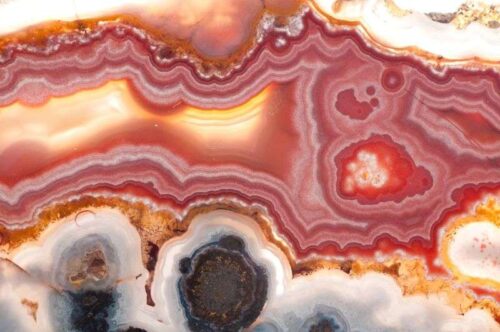
Agate is one of the most familiar materials in the mineral and lapidary world, yet it becomes more interesting rather than less interesting as a collector learns what is actually happening inside the stone. At first glance, agate may simply appear to be colorful chalcedony with bands, but those bands can preserve changes in mineral growth, microscopic structure, inclusions, cavity shape, fluid chemistry, fractures, replacement, and later crystallization. Two specimens that look somewhat alike can come from geological environments separated by hundreds of millions of years, while two agates from neighboring districts may develop completely different structures because the conditions under which their silica formed were not the same.
Mineralogically, agate is a distinctly banded variety of chalcedony, which is a fibrous microcrystalline form of silica related to quartz. Most agates fall around 6.5 to 7 on the Mohs hardness scale, giving them enough durability for jewelry, polished specimens, decorative objects, and lapidary work. That hardness does not make agate indestructible, however, because fractures, open cavities, crystal centers, thin edges, repairs, and treatments can all affect how an individual piece should be handled.
Collectors are drawn to agate for many different reasons. Some pursue locality specimens and want original labels from historic fields, while others focus on exceptional banding, eyes, plumes, tubes, sagenite, water-filled cavities, fluorescence, color, or lapidary potential. A jewelry buyer may judge a cabochon almost entirely by pattern and polish, while a geological collector may prefer an incomplete nodule because it retains host rock and provenance. There is no single correct way to collect agate, but understanding how these stones form and how trade names are used makes it much easier to recognize quality without relying on exaggerated grading language.
The term agate is most useful when applied to chalcedony displaying recognizable banding, although commercial usage is considerably broader. Classic agate contains layers that differ in translucency, color, microscopic texture, or inclusion content, producing visible bands when the stone is cut or broken. These may follow the wall of a cavity, creating nested fortifications, or develop in other arrangements depending on the geological setting.
Not every material sold with “agate” in the name is strongly banded. Moss Agate, for example, is widely accepted in the gem and collector trade even though many specimens are better described as chalcedony containing moss-like mineral inclusions rather than traditionally banded agate. Dendritic and Plume Agate can present similar classification questions because their defining character comes from included mineral structures rather than from fortification bands. Collector terminology has developed over generations, so names often survive because they are useful and recognizable even when they do not follow a strict textbook definition.
This distinction matters because variety names can describe several different things. Some identify a locality, such as Laguna, Botswana, or Lake Superior Agate. Others describe a structure, such as Fortification, Tube, Eye, or Plume Agate. Still others emphasize color or appearance, as with Blue Lace or Fire Agate. One specimen can therefore legitimately fit several descriptions at once. A Laguna Agate may also contain fortification, sagenite, eyes, and quartz, while a Botswana Agate may show fortification even though it is normally sold primarily under its locality name.
Once collectors begin thinking this way, agate classification becomes less about forcing a specimen into one box and more about describing what the stone actually preserves.
The traditional explanation of agate formation is familiar: silica-rich groundwater enters a cavity in volcanic rock, deposits one layer of silica gel, another pulse arrives later, and repeated episodes eventually build the familiar bands. That model captures the general importance of silica-bearing fluids and available space, but modern mineralogical work shows that agate formation is more complicated than one visible band representing one separate episode of fluid entering a cavity.
Agate can develop through changes involving amorphous or poorly crystalline silica precursors, fibrous chalcedony, quartz, porosity, diffusion, microscopic impurities, and self-organizing growth processes. The mineral structure may change substantially from one zone to another even when the overall chemistry remains dominated by silica, which means two adjacent bands can appear different without requiring dramatically different fluid compositions. The geometry of the cavity also influences growth because successive layers often follow surfaces established by earlier mineralization.
Many classic agates form in openings within volcanic rocks. Gas bubbles may leave vesicles in cooling lava, fractures can create additional space, and weathering or alteration can provide pathways through which silica-bearing fluids later move. Chalcedony then develops along cavity walls and grows inward, sometimes filling the opening completely and sometimes leaving a central space in which larger quartz crystals form. This transition from fibrous chalcedony to macrocrystalline quartz is visible in many familiar agate nodules and geodes.
Volcanic cavities are not the only environment in which agate occurs. Silica can also fill fractures, veins, replacement zones, sedimentary cavities, and other openings, which is why some well-known varieties do not fit the stereotypical “gas bubble in lava” model. The Blue Lace Agate from Ysterputs, Namibia, for example, occurs in a hydrothermal vein system associated with fractures and a shear zone rather than as a simple vesicle-filling nodule. Crazy Lace Agate from Mexico also demonstrates that important agate deposits can develop in geological settings quite different from the classic volcanic fields.
Readers who want a broader explanation of mineral growth from fluids, cavities, and changing chemical conditions can continue with our Science of Crystal Formation guide.
Agate banding is often treated as though it is simply a sequence of differently colored layers, but the visible pattern is partly an optical expression of microscopic structure. Differences in chalcedony texture, porosity, fiber orientation, impurity content, and translucency can separate one growth zone from another, while fine iron- or manganese-bearing particles and other mineral inclusions may add color.
In wall-lining or fortification agate, successive chalcedony zones grow inward from the cavity wall and broadly follow earlier surfaces. When the original opening contains corners, projections, or irregularities, later bands repeat those shapes and produce the nested angular forms collectors call fortification. The resulting structure can be extraordinarily fine, as seen in classic Laguna Agate, or comparatively broad and subtle.
Some agates contain nearly parallel bands instead of strong angular fortification, while others combine bands with eyes, plumes, tubes, pseudomorphs, moss-like inclusions, or open quartz centers. The diversity comes from the fact that mineral growth continues to respond to whatever structure already exists inside the cavity, including earlier crystals and fractures.
For a more detailed look at nested wall-lining structures, see our guide to Fortification Agate.
Agate can be nearly colorless or display combinations of red, orange, yellow, brown, pink, lavender, gray, black, white, green, and blue. Iron-bearing minerals and compounds contribute many warm colors, particularly reds, oranges, yellows, and browns, while other inclusions and microscopic structural differences can influence darker, paler, or less common shades.
Collectors should be cautious about simple color charts that assign one mineral to every visible band. A red zone may contain hematitic material, but red alone does not prove hematite, just as a black band cannot automatically be identified as manganese oxide from appearance alone. Mineral concentration, particle size, oxidation state, microscopic structure, and the optical behavior of the chalcedony all affect color.
This is especially important when dealing with locality materials because similar colors can occur through different geological processes. The muted gray, pink, and lavender bands of Botswana Agate do not have the same geological story as the intense reds and oranges of Condor Agate, even though both are chalcedony.
Natural color is only one part of evaluation. Band definition, translucency, internal structures, provenance, cutting, condition, and rarity of the individual pattern can be equally important.
Agate occurs on every continent, but a relatively small number of regions have become famous because of the quality, abundance, or distinctive appearance of their material. These locality names are more than marketing labels because they connect a specimen to a specific geological environment, and well-documented provenance can add considerable collector interest.
Brazil and Uruguay are among the world’s most important commercial sources of agate. Large nodules and geodes from southern Brazil and neighboring Uruguay have supplied lapidary markets for generations and commonly contain banded chalcedony, quartz, amethyst, and related silica minerals. Because this material entered international commerce in huge quantities, Brazilian agate is sometimes underestimated by collectors, but exceptional natural banding and old provenance can still make individual specimens highly desirable.
Mexico, particularly Chihuahua, contains several of the most celebrated agate districts in the world. Laguna Agate is famous for extremely fine fortification and intense color, while Crazy Lace develops a dramatically different pattern of loops, folds, brecciation, and irregular banding. Mexico also produces Fire Agate, plume-bearing material, lattice-style agates, and numerous other locality varieties.
Morocco has also become important to collectors for distinctive agates from the Atlas Mountain region, including material from Kerrouchen known for colorful fortification, unusual internal structures, and, in some specimens, fluorescence under ultraviolet light. Moroccan Agate varies considerably in pattern and appearance, making locality and provenance especially useful when evaluating collector material. Our guide to Moroccan Agate explores its geology, patterns, fluorescence, and collector appeal in greater detail.
The United States has an equally diverse agate tradition. Lake Superior Agate occurs throughout the upper Midwest and is especially associated with Minnesota, where it is the state gemstone. Montana Agate is collected from gravels associated with the Yellowstone River system and is well known for translucent chalcedony containing dendritic and scenic inclusions. Texas produced classic plume material at Woodward Ranch, while Oregon, Idaho, Arizona, California, and many other western states have long histories of agate and jasper collecting.
Botswana Agate comes principally from the Bobonong region and surrounding areas of Botswana and is recognizable for finely developed bands in gray, white, brown, pink, peach, and lavender tones. Its quieter colors make it an excellent example of why agate quality should not be judged by saturation alone.
Blue Lace Agate from Ysterputs in southern Namibia developed in a very different geological environment. The classic deposit is a hydrothermal vein occupying a shear zone and fractures within a Jurassic dolerite sill, with the chalcedony influenced by the surrounding sedimentary environment. Production from the historic mine ceased in 2017, although older material continues to circulate in collections and the gem trade.
Argentina contributes several distinctive modern collector materials, including Condor Agate from Mendoza Province and Red Fox Agate from Patagonia. Condor is especially known for intense fortification and warm color, while Red Fox can display striking botryoidal, red, orange, and contrasting structures.
These famous localities represent only a small fraction of the world’s agates. What makes them useful to collectors is that the name combines appearance with a documented geological source.
Fortification Agate is defined primarily by structure rather than locality. Its bands follow the walls of a cavity inward, creating nested angular patterns that can resemble fortress walls viewed from above. Where the cavity is irregular, each successive layer repeats those irregularities and produces progressively smaller versions toward the center.
Laguna, Botswana, Condor, Lake Superior, and numerous other agates can contain fortification. The term therefore tells us how the chalcedony grew rather than where the specimen originated.
Fine fortification is highly collectible because the pattern can become astonishingly detailed, particularly when several colors and translucent zones occur together. Band fineness alone does not establish value, however, because a coarser specimen with extraordinary eyes, inclusions, locality, or provenance may be more important than a perfectly banded but common commercial stone.
Some of the most visually recognizable “agates” are defined not by regular banding but by mineral inclusions suspended inside chalcedony. Moss Agate generally contains soft, filamentous mineral structures resembling moss, roots, clouds, or underwater vegetation, while Dendritic Agate tends to contain sharper branching inclusions that resemble trees or frost patterns.
Plume Agate develops fuller feather-like, flame-like, flower-like, or branching mineral structures that may appear to rise through translucent chalcedony. Some of the most famous plume material comes from Graveyard Point along the Oregon-Idaho border region and Woodward Ranch in Texas, although plume structures occur in many other locations worldwide.
Sagenite Agate contains needle-like or fibrous mineral inclusions enclosed in chalcedony. These can radiate from a central point, form fans, or cross one another in dense networks, and a single specimen may combine sagenitic structures with plume, moss, or fortification.
These categories often overlap. A stone may contain moss-like areas, a distinct plume, and later fortification bands in one piece, which is why experienced collectors tend to describe the structures they actually see rather than insisting on one exclusive name.
Tube Agate contains elongated cylindrical or tubular structures enclosed within chalcedony. Older explanations frequently described these as gas-escape pathways, but many tube agates formed when chalcedony grew around pre-existing needle-like minerals or elongated structures.
When those original minerals were later removed, dissolved, replaced, or surrounded by additional silica, the tubular feature remained preserved.
Cutting orientation dramatically changes their appearance. A tube cut lengthwise may appear as a long line, while the same structure cut across its width can appear as a small circular eye.
This is another example of why polished agate must be understood as a two-dimensional cross-section through a three-dimensional mineral body.
Eye structures develop when chalcedony forms concentrically around a localized feature, producing circular or oval rings that resemble an eye when cut across the right plane.
Some specimens contain one dominant eye surrounded by fortification, while others hold dozens of small eyes distributed through the stone.
The term describes the structure rather than a unique mineral variety, and eyes occur in many regional agates.
They can be particularly attractive when the cutting plane passes directly through the center, although off-center cuts may reveal how three-dimensional the original feature actually was.
Enhydro Agate contains a cavity retaining liquid, sometimes accompanied by a movable gas bubble.
These specimens are fascinating because the enclosed fluid can represent material trapped during part of the stone’s geological history, but claims that every liquid pocket contains “ancient pristine water unchanged for millions of years” are too simplistic. Fluids can interact with cavity walls, minerals can precipitate after entrapment, and the actual age and composition of the liquid may require laboratory study.
From a collector standpoint, an enhydro is most interesting when the bubble is visible, the cavity can be located reliably, and provenance is well established.
Because cutting or heating can destroy the feature, intact enhydro specimens require more cautious handling than ordinary solid agate.
Fire Agate is visually distinct from ordinary banded agate because its famous flashes of red, orange, gold, green, and occasionally violet arise from optical interference associated with thin mineral layers beneath botryoidal chalcedony.
It is especially associated with Arizona and Mexico.
The exact optical mechanism is more complicated than the old explanation that “iron oxide simply creates the colors,” and modern work supports thin-film interference involving iron-bearing layers as the primary model while acknowledging that some details remain under study.
Fire Agate also requires specialized lapidary work because the cutter must carefully expose the botryoidal layers without grinding through the thin structures responsible for the iridescence.
Blue Lace Agate from Ysterputs in southern Namibia is known for pale blue, white, and gray wavy banding, but its geology is particularly valuable because it challenges the idea that all agates form in volcanic gas cavities.
The Ysterputs deposit occupies a hydrothermal vein system associated with a shear zone and fractures in Jurassic dolerite that intruded older marine sediments. Research published in 2024 found that much of the chalcedony is the length-slow variety known as quartzine and suggested that saline fluids related to the surrounding sedimentary rocks contributed to the mineralizing environment.
That locality also produced unusual cubic chalcedony pseudomorphs that were once thought to have replaced fluorite but are now considered more likely to have formed after melanophlogite.
For collectors, Blue Lace demonstrates how much geological information can hide behind a trade name that is usually marketed almost entirely for color.
Botswana Agate is associated especially with the Bobonong region of Botswana and commonly displays fine wall-lining bands in gray, white, brown, pink, peach, and lavender.
Its subdued palette makes it useful for learning to evaluate agate structure without being distracted by extremely saturated color.
Some Botswana specimens contain exceptionally fine fortification or eyes, while others consist of broader parallel bands.
As with other locality varieties, the strongest collector specimens combine recognizable structure with reliable provenance, good condition, and an appealing overall composition rather than simply possessing one fashionable color.
Laguna and Crazy Lace Agate both come from Chihuahua, Mexico, but they represent very different collector materials.
Classic Laguna is associated with the Estación Ojo Laguna district and several individual claims, where nodules can develop extraordinarily fine fortification and strong red, pink, orange, brown, white, and translucent zones.
Crazy Lace is associated principally with Sierra Santa Lucía near Ejido Benito Juárez and is recognized for looping, folded, brecciated, and irregular patterns rather than the architectural fortification typical of Laguna.
The comparison is particularly useful because it shows how misleading it can be to treat “Mexican Agate” as one uniform category.
Condor Agate from Mendoza Province entered the international collector market during the 1990s and quickly became famous for intense reds, oranges, yellows, dark bands, and strong fortification.
Several deposits have been identified in the San Rafael region, making Condor a regional agate group rather than material from one single exhausted pocket.
Red Fox Agate comes from the Las Plumas region of Chubut Province in Patagonia and has a different geological identity.
Both can display strong warm colors, but locality and pattern distinguish them, reinforcing the importance of provenance when dealing with regional trade names.
Lattice Agate is a Mexican collector material known for intersecting pale lines and lattice-like internal structures that can create unusual geometric patterns.
The exact formation mechanism of some lattice material is still debated, which is why claims that it universally represents one specific pseudomorph should be approached cautiously.
The stone is useful for illustrating a larger principle in agate collecting: a visually descriptive trade name can remain useful even when the precise mineralogical history is not fully resolved.
Collectors should be comfortable distinguishing what can be observed directly from what remains interpretive.
Chalcedony has been dyed for centuries because its microscopic porosity can allow coloring agents to penetrate parts of the stone. GIA identifies chalcedony among gem materials commonly subjected to dyeing, and treatments can produce colors far more intense than those usually encountered naturally.
Electric blue, neon pink, intense purple, vivid green, and unusually uniform colors should raise questions, although strong color by itself does not prove treatment because some natural agates are genuinely vivid.
Dye may concentrate in fractures, porous bands, pits, or surface-reaching pathways, but visual inspection is not always conclusive.
Home solvent tests using acetone or alcohol are not a dependable universal method and can damage coatings, adhesives, fills, labels, or mounted jewelry.
For an inexpensive decorative stone, visual inspection and seller disclosure may be sufficient. For an important collector specimen whose treatment status materially affects value, professional gemological testing is far more reliable.
Our guide to identifying crystal and gemstone treatments covers dyeing, coatings, stabilization, heating, and other common alterations in more detail.
One of the most confusing parts of buying agate is the widespread use of labels such as A, AA, AAA, AAAA, premium, collector grade, or museum grade.
There is no universally accepted grading system assigning these categories to agate.
A seller may use AAA to describe intense color and a good polish, while another uses the same grade for fine banding, and a third applies it simply to the most expensive material in inventory.
These grades are therefore better understood as vendor-specific marketing categories, not independent certifications.
Collectors should evaluate the specimen itself.
Pattern, natural color, translucency, condition, polish, locality, provenance, treatment status, structural complexity, and replacement difficulty tell you far more than a string of letters on a tag.
This is particularly important when comparing regional collector material with mass-produced jewelry stones because the qualities being valued may be completely different.
A perfect bead strand may require uniformity, while an advanced agate collector may pay more for an irregular nodule containing unusual structures and an original 50-year-old locality label.
There is no single formula because different agates are collected for different reasons, but several principles appear consistently.
Pattern quality is important when the pattern is central to that variety. Laguna collectors may favor extremely fine fortification, while a Plume Agate collector looks for definition and depth in the plume rather than regular banding.
Color matters when it contributes to the composition, but more intense color is not automatically better. Natural-looking balance, contrast, and the interaction among different bands can be more important than maximum saturation.
Translucency can dramatically increase visual depth in plume, moss, sagenitic, and finely banded material because several structures become visible at different levels within the stone.
Condition matters, although natural fractures and incomplete nodules are not automatically unacceptable. What matters is whether damage interferes with the specimen’s important features and whether repairs have been disclosed.
Locality and provenance can significantly affect collector interest. An old Laguna specimen with a documented claim label tells a different story from a visually similar agate with no known source.
Cutting quality is especially important with material whose best structure depends on orientation. A mediocre cut can miss the center of a fortification or reduce a three-dimensional plume to an indistinct patch.
Finally, replacement difficulty is often more meaningful than abstract rarity. A locality may be well known and widely represented, yet one particular specimen may contain a combination of pattern, color, size, and provenance that is extremely difficult to duplicate.
The first question should be what type of agate you are buying and why. A collector seeking geology and provenance should evaluate different qualities from someone buying a pendant, cabochon, or decorative slice.
For locality material, ask how specifically the seller knows the source. “Chihuahua, Mexico” is useful, but “La Alianza Claim, Estación Ojo Laguna” is far more valuable if the documentation is genuine. Broad honest provenance is preferable to an impressive but invented exact locality.
Examine the entire specimen rather than the front polished surface alone. Look at edges, backs, natural rind, fractures, pits, and matrix. These areas can reveal treatments, repairs, cutting decisions, or geological information hidden from the display face.
Ask whether the material has been dyed, stabilized, filled, coated, heated, repaired, or otherwise treated. Not every treatment makes a stone undesirable, particularly in jewelry, but undisclosed treatment makes accurate evaluation impossible.
Be skeptical of universal rarity claims. “Old stock,” “rare,” “mine closed,” and “no longer available” are used loosely throughout the gem trade. Sometimes they are accurate, but current market scarcity does not necessarily mean a geological deposit is exhausted.
Most importantly, buy the specimen rather than the label. An ordinary stone with an impressive name is still ordinary, while an exceptional agate from a less fashionable locality can be a far more interesting addition to a serious collection.
Agate is one of the foundational lapidary materials because it combines durability with enormous pattern variation and takes an excellent polish.
The challenge is that the most interesting internal structures are hidden inside the rough.
Orientation can determine whether a saw cut reveals a complete fortification, eye, plume, tube, or scenic pattern, and even experienced cutters cannot always predict what is waiting inside.
Good rough evaluation begins with the natural exterior. Examine visible windows, broken edges, fracture directions, rind thickness, translucency, and any exposed banding before deciding how to cut.
When strong pattern appears, the best cut is not necessarily the one that preserves the most weight.
Removing additional material to reach the strongest structural plane can produce a far better finished cabochon or slab.
Our Lapidary 101 for Collectors & Creators guide covers rough selection, sawing, grinding, orientation, polishing, and common mistakes in more detail.
Agate’s hardness makes it suitable for pendants, earrings, bracelets, beads, rings, carvings, display slabs, bookends, polished freeforms, and many other uses, although the design should still account for fractures, crystal pockets, thin edges, and other structural weaknesses.
Cabochons are particularly effective because a smooth dome can emphasize banding and internal inclusions without the visual distraction of facets.
Large polished slices are ideal for studying growth structures because they expose a broad cross-section through the nodule, while matched halves allow collectors to compare related cutting planes from the same specimen.
Backlighting can dramatically change translucent agate by revealing bands or inclusions that look nearly opaque under ordinary reflected light.
For collectors who enjoy the natural history as much as the decorative side, retaining locality labels beside a displayed specimen turns the piece into a record of place as well as pattern.
Agate has a long cultural history and is widely used today in Reiki, meditation, crystal grids, intention-setting, chakra practices, and other metaphysical traditions.
Modern practitioners commonly associate agate with grounding, stability, balance, patience, protection, resilience, and gradual personal growth, although individual varieties are often assigned more specific symbolism based on their color and pattern.
Fortification Agate may be interpreted as a symbol of boundaries and structured growth, Moss Agate as growth and connection with nature, Plume Agate as creativity and development, Botswana Agate as steadiness and resilience, and Crazy Lace as adaptability and joy.
These interpretations belong to spiritual and metaphysical traditions rather than scientifically demonstrated properties of chalcedony.
That distinction does not prevent people from finding meaning in the stone.
It simply allows geology and spiritual symbolism to coexist without requiring one to prove the other.
Solid untreated agate is relatively easy to care for.
Lukewarm water, mild soap, and a soft cloth or brush are generally sufficient for routine cleaning, while harsh chemical cleaners are unnecessary.
Ultrasonic or steam cleaning should be avoided when a specimen contains fractures, open cavities, fills, coatings, repairs, attached matrix, or an unknown treatment history.
Polished agate should also be stored so it does not repeatedly rub against quartz or harder minerals because scratches across the polished surface can reduce the clarity of fine banding.
Heat should be used cautiously around unknown treatments, adhesives, and water-filled cavities.
Enhydro specimens deserve additional care because excessive heat, cutting, or impact can destroy the internal cavity or fluid feature that makes them collectible.
Agate is composed primarily of silica and is a distinctly banded form of fibrous chalcedony related to quartz.
Most agate measures approximately 6.5 to 7 on the Mohs hardness scale.
No. Volcanic cavities are a very common setting, but agate can also form in fractures, veins, sedimentary environments, replacement zones, and other geological settings.
Not necessarily. Agate banding develops through complex interactions involving silica growth, microscopic structure, impurities, porosity, and changing mineralization conditions, so one visible band should not automatically be interpreted as one independent fluid event.
Chalcedony is the broader fibrous microcrystalline silica material. Agate is generally the name applied when chalcedony develops distinct banding, although traditional collector names such as Moss Agate extend the term somewhat more broadly.
No. A, AA, AAA, and similar grades are not standardized for agate and can mean different things from one seller to another.
Yes. Chalcedony can accept dyes, and brightly colored commercial agates are sometimes treated. Treatment should be disclosed when known.
No. Many natural agates can be intensely colored, including Laguna, Condor, Lake Superior, and Fire Agate. Color should be evaluated with pattern, locality, treatment disclosure, and provenance.
There is no single answer. Exceptional Laguna, Fire Agate, historic locality material, unusual plume or sagenitic specimens, old estate pieces, and other high-quality agates can all command strong collector interest depending on pattern, condition, provenance, size, and rarity of the individual specimen.
Yes. Its hardness and polishability make it very suitable for many jewelry forms, although fractures, open cavities, thin edges, and individual treatments should still be considered.
Modern metaphysical traditions commonly associate agate with grounding, stability, balance, patience, resilience, and protection, with additional meanings assigned to individual varieties.
Agate has remained one of the most widely collected lapidary materials because there is almost no point at which the subject becomes exhausted. A beginner can appreciate color and banding immediately, while an experienced collector may spend years learning locality characteristics, microscopic structures, pseudomorphs, inclusion minerals, historical claims, treatments, and the subtle differences among individual deposits. The same stone can function as jewelry, geological specimen, lapidary rough, decorative art, educational material, or a meaningful object within Reiki and metaphysical practice.
Its geology is equally diverse. Some agates began in cavities inside ancient lava flows, while others developed in fractures, veins, replacement zones, or more unusual hydrothermal environments. Their bands are not simply colored rings laid down like paint, but expressions of evolving silica mineralization involving microscopic changes in crystal growth, porosity, impurities, and available space. Plumes, tubes, sagenitic needles, eyes, quartz centers, dendrites, water-filled cavities, and pseudomorphic structures add additional chapters to that history.
For collectors, this makes provenance increasingly important. Knowing that a stone is from Botswana, Estación Ojo Laguna, Ysterputs, Lake Superior, Graveyard Point, Woodward Ranch, Mendoza, or another documented locality transforms it from an anonymous polished object into part of a geological system with its own history. Old labels should be preserved, treatments should be disclosed, and exact localities should never be invented simply because a specimen resembles another stone seen online.
The same principle applies to buying. Ignore the temptation to judge agate through AAA labels, exaggerated rarity language, or color alone. Study the pattern, condition, transparency, cutting, provenance, treatment status, and the features that actually make the specimen different from thousands of others. The strongest collection is rarely the one containing the most expensive labels; it is the one built by someone who understands why each specimen was worth keeping.
Continue exploring individual agate structures and localities through our guides to Fortification Agate, Plume Agate, Moss Agate, Dendritic Agate, Sagenite Agate, Tube Agate, Fire Agate, Blue Lace Agate, Botswana Agate, Laguna and Crazy Lace Agate, Condor Agate, Red Fox Agate, Lattice Agate, Moroccan Agate and Enhydro Agate.
Explore the complete Grounded Lifestyles Agate Articles for additional guides covering agate geology, locality research, identification, collecting, and lapidary work. When you are ready to move from learning about agates to examining actual specimens, visit our Agate Collection for natural agates, polished pieces, slices, and collector material selected for pattern, geology, locality, provenance, and individual character.

At Grounded Lifestyles, our love for crystals began in the peaceful flow of Reiki and energy healing sessions — where we saw how natural stones could amplify intentions, restore balance, and bring comfort. But the more time we spent with these treasures, the more curious we became about their origins. That curiosity led us into the fascinating world of geology and mineral specimen collecting. We fell in love not just with the energy of crystals, but with the science and artistry of their creation — the intricate crystal structures, the vibrant mineral hues, and the wonder of holding a piece of Earth’s history in our hands.