
Every crystal, mineral, fossil, meteorite, and handcrafted piece is selected with purpose. Whether you’re building a museum-worthy mineral collection, searching for a meaningful gift, decorating your home with natural beauty, or beginning your journey into the world of geology, you’ll discover authentic specimens with stories worth sharing.
Over 15 shows a year throughout the Southwest. Check to see if we are coming to a show near you!
Home > Blog > Minerals Blog | Crystal Guides, Geology & Metaphysical Meaning > shungite mineral guide authenticity properties and EMF insights
Shungite is one of those materials where geology, materials science, collector interest, and modern metaphysical practice overlap in unusually interesting ways. This ancient black carbon-rich rock from Karelia, Russia, has been studied for its unusual carbon structure, electrical conductivity, adsorption properties, and interaction with electromagnetic radiation, while also becoming popular among crystal enthusiasts as a grounding and protective stone.
That combination has produced plenty of exaggerated claims, but it has also led to the opposite problem: genuine scientific research on shungite is sometimes dismissed along with the marketing hype.
The more accurate picture is far more interesting.
Shungite is a naturally occurring carbon-mineral composite more than two billion years old. Its carbon can occur as poorly ordered or disordered sp² structures with graphene-like layers and other nanoscale arrangements, and some Karelian material has also yielded naturally occurring fullerenes. Its electrically conductive carbon network allows it to interact measurably with electromagnetic radiation, and laboratory studies have investigated shungite both as a shielding material and as a component of radio-absorbing composites.
Grounded Lifestyles carries authentic Karelian Shungite in our Mineral Specimens & Crystals collection, including polished and shaped pieces for collectors, décor, workspaces, and metaphysical use. Because inventory changes, shoppers interested in Shungite can browse the Mineral collection for currently available pieces while using this guide to better understand the geology, authenticity, carbon structure, and EMF research behind the material.
That does not mean every polished pyramid or small stone creates a complete electromagnetic shield around a room, but it does mean that describing shungite’s EMF properties as entirely fictional would be inconsistent with the materials-science literature.
Understanding what researchers have actually measured makes shungite considerably more interesting than either extreme.
Shungite is a naturally occurring carbon-rich Precambrian rock best known from the Republic of Karelia in northwestern Russia, particularly the Lake Onega region.
It is often casually called a mineral, but that description is not strictly accurate. Shungite is better regarded as a carbonaceous rock or natural carbon-mineral composite because it contains varying amounts of carbon together with minerals such as quartz, silicates, carbonates, sulfides, and other components.
The carbon content varies enormously between deposits and individual varieties. Some shungite contains only a small percentage of carbon, while rare high-carbon material can approach roughly 90–98%.
This variability is one reason two authentic pieces of shungite can look and behave quite differently. Carbon content affects appearance, electrical conductivity, density, luster, and electromagnetic properties, while the mineral fraction also influences the behavior of the material.
Rather than thinking of shungite as a uniform black substance with a single composition, it is more accurate to think of it as a family of ancient carbon-bearing rocks with variable carbon-to-mineral ratios.
The most famous and extensively studied deposits occur in Karelia, Russia, around Lake Onega. The village of Shunga gave the material its modern name, although important deposits and mining areas occur elsewhere within the region, including Zazhogino, Maksovo, Shunga, and neighboring localities.
Karelian shungite deposits are exceptionally large and geologically unusual. They occur in Paleoproterozoic rocks approximately two billion years old and represent one of the world’s most remarkable accumulations of ancient carbonaceous material.
Carbon-rich rocks resembling shungite or containing comparable disordered carbon structures have been reported in other parts of the world, but Karelia remains the locality most closely associated with true commercial and scientifically studied shungite.
For collectors, locality matters. Material offered simply as “shungite” without any information about origin is less useful than specimens identified as Karelian material or, better still, material tied to a recognized deposit.
The rocks containing the major Karelian shungite deposits formed during the Paleoproterozoic Era, approximately two billion years ago.
This makes shungite considerably older than dinosaurs, flowering plants, and complex terrestrial life. Its carbon dates to an early stage of Earth’s biological and geological development when microbial life dominated the planet.
The ultimate origin of the carbon has been debated for decades. Geological evidence generally favors an organic source connected with ancient biological material that accumulated in sedimentary environments and was subsequently transformed through burial, heat, fluids, metamorphism, and prolonged geological processing.
The exact sequence is more complicated than simply saying ancient algae turned directly into stone. Shungite deposits experienced extensive geological alteration, and researchers continue studying how their unusual carbon structure developed.
Shungite probably began with large accumulations of organic carbon in an ancient Paleoproterozoic basin. Biological material settled within sediments and became concentrated before undergoing burial and geological alteration.
Over immense periods of time, heating, pressure, fluids, metamorphic reactions, and structural changes transformed this carbon into the unusual disordered material found in shungite today.
Unlike well-crystallized graphite, much shungite carbon lacks extensive long-range crystalline ordering. Researchers have described it using terms including poorly ordered graphite, amorphous or noncrystalline carbon, glassy-carbon-like material, disordered sp² carbon, and aggregates of graphene-like layers.
Modern microscopy and structural analysis have provided an increasingly detailed picture in which small, curved, folded, or stacked carbon sheets form a complex nanoscale network intertwined with mineral material.
That unusual architecture is central to many of the electrical and electromagnetic characteristics now being investigated.
Commercial sellers often divide shungite into types according to carbon concentration. The exact boundaries can vary between classification systems, so these ranges should be treated as general guides rather than universal mineralogical grades.
Elite shungite is the rare, high-carbon material that typically contains approximately 90% or more carbon. It often has a silvery-black or metallic appearance and can develop a bright, glassy or metallic luster.
It is usually found in veins and relatively small quantities compared with ordinary shungite, which is one reason elite material commands higher prices.
Elite shungite is often brittle and irregular rather than being the preferred material for large polished carvings.
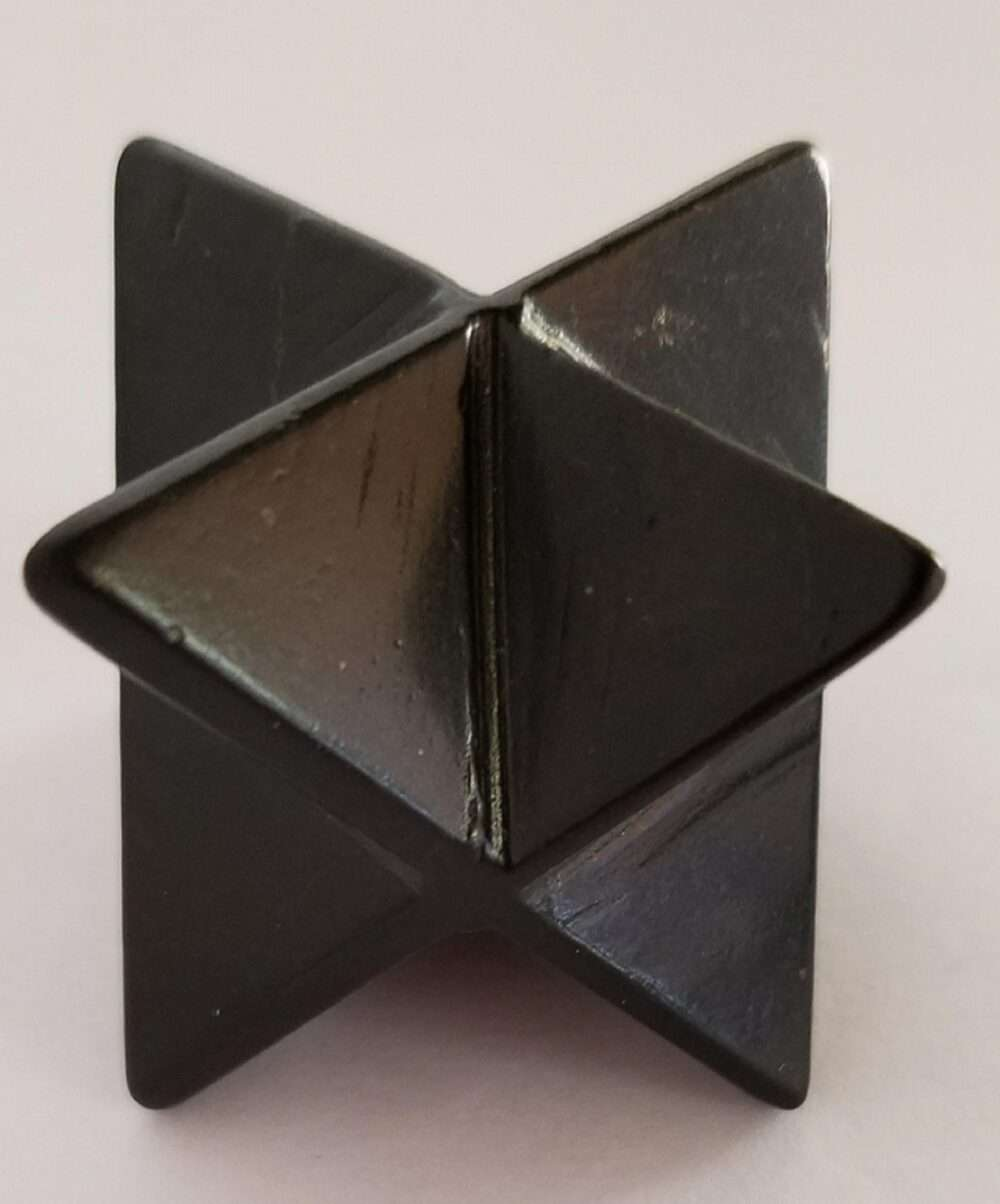
Type II shungite contains a lower proportion of carbon and more mineral material. Much of the commercially polished shungite used for spheres, pyramids, cubes, Merkabas, tiles, and carvings falls broadly within this middle-carbon range.
Its balance of carbon and mineral components makes it easier to cut and polish than very brittle elite material.
Lower-carbon shungite contains progressively larger proportions of silicate and other mineral material. These grades have been investigated for industrial uses including construction materials, fillers, composites, sorbents, and electromagnetic shielding products.
The fact that a specimen contains less carbon does not mean it is fake. Shungite naturally occurs across a broad range of carbon concentrations.
The carbon structure of shungite is one of the main reasons scientists continue studying it.
Carbon can organize itself in many different ways. Diamond, graphite, graphene, carbon nanotubes, fullerenes, soot, charcoal, and amorphous carbon are all dominated by the same element but have very different structures and physical properties.
Shungite carbon consists largely of disordered sp²-bonded carbon. At the nanoscale, researchers have observed small graphene-like sheets and stacks that are curved, folded, fragmented, and arranged in complex networks rather than forming the extensive ordered layers characteristic of crystalline graphite.
These conducting carbon regions occur alongside nonconductive or less-conductive mineral components such as quartz and other silicates. The result is a natural composite containing conductive and dielectric regions on extremely small scales.
This combination becomes particularly important when considering shungite’s electrical conductivity and interaction with radio-frequency and microwave radiation.
Yes, fullerenes have been scientifically reported in some natural shungite, but the popular explanation often needs qualification.
Fullerenes are cage-shaped carbon molecules, including the famous C60 molecule sometimes called a “buckyball.” Their laboratory discovery in the 1980s transformed carbon chemistry and ultimately contributed to the 1996 Nobel Prize in Chemistry.
Researchers reported naturally occurring fullerenes in Proterozoic shungite from Karelia during the 1990s, using techniques including mass spectrometry, X-ray diffraction, and nuclear magnetic resonance.
That finding helped generate enormous interest in shungite.
What should be avoided is the much broader claim that large percentages of every piece of elite shungite consist of free C60 or C70 fullerene molecules. Later structural research has produced a more complicated picture in which fullerene-like globules, curved graphene fragments, disordered sp² carbon, and other nanoscale structures contribute to shungite carbon.
Some modern work has reported that actual fullerene-like structures occur at very low concentrations compared with the total carbon content.
Shungite remains scientifically unusual without needing to exaggerate its fullerene concentration. Its broader carbon architecture may be more important to many of its physical properties than the amount of isolated fullerene molecules alone.
One of the easiest scientifically measurable characteristics of carbon-rich shungite is its electrical conductivity.
Conductivity varies dramatically depending on carbon content, mineral composition, carbon connectivity, and specimen structure. High-carbon shungite can conduct electricity much more readily than lower-carbon material because the conductive carbon regions form more continuous pathways through the rock.
Researchers studying Karelian shungite have measured static conductivity ranging from relatively low values to thousands of siemens per meter depending on composition.
Even more interesting is what happens at high frequencies.
At microwave frequencies, the effective or dynamic conductivity of some shungite samples behaves differently from their direct-current conductivity. This unusual frequency-dependent behavior has helped make shungite a subject of electromagnetic shielding research.
This is where discussions about shungite often become polarized.
Some sources claim shungite completely neutralizes all electromagnetic fields, while others dismiss any interaction between shungite and electromagnetic radiation as mythology.
Neither position accurately represents the research.
Electromagnetic shielding is a measurable branch of materials science. Researchers can transmit electromagnetic radiation toward a material and measure how much is reflected, absorbed, and transmitted through it. Shungite has been subjected to exactly this type of laboratory testing.
Peer-reviewed research has demonstrated measurable electromagnetic reflection and absorption by shungite in multiple radio-frequency and microwave bands.
One research program examined solid shungite plates across the 8–12 GHz microwave range. The researchers found that reflection and dynamic conductivity depended upon carbon concentration and the organization of conductive carbon and mineral phases within the rock.
Additional work studied ultrathin shungite plates in the 26–38 GHz range, frequencies extending into the millimeter-wave portion of the spectrum. Those experiments again demonstrated substantial reflection and absorption characteristics.
Other researchers have mixed powdered or modified shungite into polymers, mineral binders, coatings, and composite materials specifically designed for electromagnetic interference shielding.
In other words, there is legitimate experimental evidence that shungite can interact with and attenuate electromagnetic radiation.
That is a materials-science finding, not merely a metaphysical claim.
To understand the research, it helps to clarify what electromagnetic shielding actually means.
When electromagnetic radiation encounters a material, several things can happen. Part of the wave may be reflected from the surface, part may enter the material and be absorbed, and part may pass completely through it.
Conductive materials generally reflect electromagnetic radiation because mobile electrical charges respond to the incident electromagnetic field. Materials containing electrical losses can also convert some electromagnetic energy into extremely small amounts of heat.
Shungite is particularly interesting because it is not simply a uniform conductor like a sheet of copper. It is a natural composite containing conductive carbon structures together with dielectric mineral inclusions and microporosity.
Researchers studying thin shungite materials have found that both reflection and absorption contribute to shielding behavior.
The effectiveness changes with carbon content, structure, thickness, frequency, sample preparation, and geometry.
Research on shungite and shungite-based materials has covered a broad frequency range extending from kilohertz through microwave and millimeter-wave frequencies.
Scientific papers have reported work involving frequencies between roughly 100 kHz and 40 GHz, although different studies used different sample types and measurement systems.
Solid Karelian shungite has been specifically examined in the 8–12 GHz band, while another set of experiments examined 26–38 GHz radiation.
Those frequencies do not correspond exactly to every everyday source of electromagnetic radiation. Conventional Wi-Fi commonly operates around 2.4, 5, and increasingly 6 GHz, while cellular systems use numerous bands depending on carrier and technology.
The existing research nonetheless demonstrates a physical principle: properly configured shungite materials have measurable electrical and electromagnetic properties capable of affecting radio-frequency and microwave radiation.
This is where laboratory findings have to be interpreted carefully.
A material can possess genuine electromagnetic shielding properties without every object made from that material functioning as a complete shield.
A laboratory shielding experiment generally controls the frequency, specimen thickness, area, orientation, source location, receiver location, and geometry. In many shielding applications, the material covers the pathway between the electromagnetic source and receiver or forms part of an enclosure.
A small pyramid sitting several inches away from a router does not surround either the router or the person using it. Electromagnetic waves can simply travel around a small object.
Therefore, science supports saying that shungite has measurable electromagnetic shielding, reflection, and absorption properties under tested conditions. It does not currently justify promising that a particular decorative object will reduce a person’s total exposure by a predetermined percentage merely because it is present somewhere in the room.
That distinction is important.
It allows shungite to be presented accurately without either dismissing genuine research or making claims that the experiments did not test.
Carbon concentration has a significant influence on shungite’s electromagnetic behavior, but the relationship is more interesting than simply assuming that the highest-carbon sample must always perform best.
As carbon concentration increases, conductive carbon pathways become increasingly connected. Once enough conductive material is present, electrical current can move much more efficiently through the sample. Materials scientists describe this transition using concepts such as a percolation threshold.
Research on shungite has shown dramatic changes in reflection and conductivity as carbon content increases through certain ranges. At still higher concentrations, the response can begin to level off.
Mineral inclusions and microporosity also influence electromagnetic absorption, which means the natural carbon-mineral composite structure itself contributes to the behavior.
This is one reason researchers are interested in shungite not merely as a source of carbon but as a model for designing engineered conductive composites.
Some of the strongest evidence for practical electromagnetic applications comes from research on materials deliberately engineered with shungite.
Scientists have incorporated shungite into polymer composites, mineral materials, coatings, and other manufactured systems intended to reduce electromagnetic interference.
A 2021 study of ultrathin natural shungite plates found that plates only around 10–20 micrometers thick could provide significant microwave reflection and absorption characteristics. Researchers described their performance as comparable in some respects with much thicker synthetic carbon/polymer shielding composites.
More recent work has continued investigating finely dispersed shungite as a filler in radio-absorbing and electromagnetic shielding composites.
These applications belong primarily to electromagnetic compatibility engineering, where shielding is used to prevent unwanted electromagnetic signals from interfering with electronic devices, communications equipment, instrumentation, or information systems.
The research provides a strong scientific basis for saying that shungite has meaningful electromagnetic properties.
Another distinction is essential.
Research showing that a material attenuates electromagnetic radiation does not automatically demonstrate that using the material produces a specific health benefit.
Those are two different scientific questions.
The first can be measured through conductivity, transmission, reflection, absorption, and shielding effectiveness. The second would require appropriately designed biological or clinical studies examining defined exposures and health outcomes.
Most published shungite research has focused on materials science and electromagnetic engineering, not clinical trials involving people carrying stones or placing carvings beside beds.
Grounded Lifestyles therefore treats the EMF subject as a legitimate physical-material property while avoiding claims that shungite diagnoses, treats, prevents, or cures medical conditions.
Modern homes contain many electromagnetic sources, including Wi-Fi routers, cell phones, Bluetooth equipment, computers, televisions, smart appliances, cordless devices, and cellular infrastructure outside the home.
Because shungite has documented conductive and microwave-interaction properties, it has become common for people to place shungite spheres, cubes, pyramids, Merkabas, or rough pieces near electronics.
From a physical standpoint, placement directly in an electromagnetic path is more relevant to attenuation than simply having a small stone somewhere in a room. Surface area, thickness, carbon composition, distance, orientation, and frequency all influence what a material can do.
A polished shungite object can therefore be appreciated as a natural carbon material whose underlying electromagnetic behavior is supported by materials research, while expectations about whole-room shielding should remain realistic.
For many owners, this scientific interest exists alongside the metaphysical tradition of using shungite as a grounding or protective object around technology.
Electrical conductivity can provide a useful clue when evaluating shungite.
Carbon-rich shungite often conducts electricity, so a multimeter can demonstrate a measurable electrical pathway through many specimens. Elite shungite typically conducts particularly well compared with lower-carbon material.
However, conductivity should be regarded as a screening test rather than proof of authenticity.
Graphite, conductive manufactured materials, certain ores, and other carbon-rich substances can also conduct electricity. Conversely, authentic low-carbon shungite may show substantially lower conductivity depending upon where the probes contact the specimen.
The test is most useful when combined with provenance, appearance, density, texture, locality, and seller knowledge.
Authenticating shungite is more complicated than many online “home tests” suggest.
The best starting point is provenance. Material represented as Karelian shungite should come from a supplier capable of identifying Karelia, Russia, as the source and ideally providing information about the producing region or deposit.
Appearance is also useful. Ordinary polished shungite is generally deep black to dark gray with a dull to semi-metallic luster, while elite shungite tends to have a brighter metallic or silvery-black appearance and irregular natural surfaces.
Electrical conductivity can support an identification, particularly with carbon-rich material, but should not stand alone.
Hardness can provide another general clue, although natural variations in mineral content make simple scratch testing less definitive than websites sometimes imply.
Laboratory methods such as Raman spectroscopy, X-ray diffraction, electron microscopy, elemental analysis, or carbon-content testing can characterize the material much more reliably when scientific verification is required.
The popular “water float test” is not a dependable authenticity test. Whether a rock briefly floats can depend on trapped air, surface tension, porosity, specimen shape, and other variables rather than whether the material is genuine shungite.
Similarly, wiping a specimen with acetone does not prove it is authentic. That test may occasionally expose surface dyes or coatings, but an untreated black material that survives acetone is not automatically shungite.
Shungite varies because it is a rock rather than a single pure mineral, but commonly quoted physical characteristics include a black to dark gray color, dull to semi-metallic luster, and moderate softness compared with quartz.
Many commercial shungites fall around 3.5–4 on the Mohs scale, although the mineral components within a specimen can affect local hardness.
This makes shungite relatively easy to carve and polish into spheres, cubes, pyramids, Merkabas, beads, pendants, tiles, and other decorative forms.
At the same time, highly carbon-rich elite shungite can be brittle and may fracture more readily than some of the lower-carbon material commonly used for carving.
For more information about mineral hardness and proper interpretation of the scale, see our Mohs Scale guide.
Shungite’s use in water treatment also has a genuine scientific basis, but it deserves more nuance than many commercial descriptions provide.
Researchers have studied shungite as a sorbent for organic compounds, metals, and other contaminants. Its carbon-rich structure, porosity, mineral phases, and surface chemistry can allow certain dissolved substances to adhere to its surface.
Studies have reported adsorption of metals and organic compounds, and shungite-based sorbents have been investigated for environmental remediation and filtration.
However, natural shungite also contains minerals and trace elements of its own.
Research has found that tested shungite samples can release metals into water, including nickel, lead, cadmium, copper, chromium, zinc, and arsenic. Some concentrations exceeded drinking-water limits for periods during testing.
Other research continues to demonstrate useful sorption behavior while showing that composition, preparation, prewashing, and the specific material being filtered all affect performance.
For that reason, placing an unknown decorative shungite stone in drinking water should not be treated as equivalent to using a professionally designed and tested water-filtration system.
The scientifically interesting conclusion is not that shungite “purifies everything,” nor that its filtration properties are fictitious. It is that shungite is a genuine natural sorbent whose usefulness depends upon material composition, preparation, and the contaminants involved.
Beyond consumer interest, shungite has been investigated for a range of technological applications.
Its conductive carbon network and mineral matrix have encouraged research into electromagnetic shielding, conductive composites, electrode materials, sorbents, catalysts, water treatment, and advanced carbon materials.
Researchers have also studied modified or heat-treated shungite to improve specific properties. Processing can alter surface area, electrical pathways, carbon structure, and chemical reactivity, producing materials optimized for applications very different from a natural polished stone.
This research is useful for collectors because it demonstrates that shungite is not scientifically interesting merely because it has become popular in the crystal market. It was already an unusual natural carbon material worthy of geological and materials-science investigation.
Because both materials are carbon rich and conductive, shungite is sometimes compared with graphite.
Graphite consists of well-organized sheets of carbon atoms arranged in layered crystalline structures. Those sheets allow electrons to move relatively easily, giving graphite significant electrical conductivity.
Shungite carbon is much more disordered. Rather than extensive regular graphite layers, it contains much smaller curved, fragmented, folded, and stacked sp² carbon structures intertwined with mineral material.
This structural disorder is partly what makes shungite interesting. Its carbon network interacts with nonconductive mineral phases, interfaces, pores, and nanoscale structures in ways that differ from bulk graphite.
Graphite may be the simpler conductor, but shungite represents a more complex natural carbon-mineral composite.
Elite shungite is desirable because of its rarity, high carbon concentration, metallic appearance, and conductivity, but “better” depends upon why someone wants the material.
For a geological collector, elite material is attractive because it represents the carbon-rich end of the shungite spectrum and looks dramatically different from common polished material.
For a carved sphere, pyramid, Merkaba, or cube, middle-carbon shungite is often more practical because elite material can be fragile and difficult to work.
For electromagnetic engineering, performance depends on more than simply maximizing carbon concentration. Conductive pathways, mineral inclusions, microstructure, thickness, frequency, and geometry all contribute to shielding behavior.
Therefore, the highest carbon percentage should not automatically be interpreted as the ideal material for every application.
Shungite deserves a place in a mineral and geological collection even without any metaphysical or EMF interest.
It represents an extraordinarily old accumulation of carbon, preserves evidence about Earth’s Paleoproterozoic environments, and offers an accessible example of the structural diversity of natural carbon.
A display containing graphite, diamond, shungite, coal, and other carbon-bearing materials provides a striking demonstration of how one chemical element can occur in dramatically different forms.
High-carbon elite pieces can also be collected for their metallic luster and rarity, while polished forms showcase the material’s deep black appearance and unusual conductivity.
Long before scientific discussions about gigahertz frequencies became part of modern shungite marketing, the stone developed a reputation as a material associated with purification, grounding, protection, and environmental balance.
Contemporary crystal practitioners commonly place shungite near computers, routers, televisions, phones, workstations, or other electronics. Others carry it, meditate with it, include it in crystal grids, or use geometric forms such as pyramids, cubes, spheres, and Merkabas.
Within metaphysical traditions, shungite is usually associated with grounding, energetic cleansing, protection, stability, and connection with Earth energy. Its deep black coloration and ancient carbon composition contribute naturally to those symbolic associations.
These metaphysical uses should be understood on their own terms rather than presented as laboratory measurements. At the same time, shungite is unusual because some of the physical concepts that draw modern users to it—conductivity and electromagnetic interaction—really have been investigated scientifically.
The scientific research does not prove every energetic interpretation, but neither does discussing metaphysical tradition require ignoring the measurable physical properties of the material.
Readers interested in broader crystal and energy practices can explore our Crystal Healing Guide.
People who enjoy using shungite around technology commonly choose cubes, spheres, pyramids, Merkabas, slabs, or rough pieces.
From a decorative or metaphysical perspective, placement is a matter of personal practice. From an electromagnetic-material perspective, the important factors are much more specific: the amount of material, carbon content, frequency, orientation, thickness, surface area, and whether the material actually intercepts the electromagnetic path.
A small polished object therefore should not be described as producing a complete protective bubble around a room.
A more accurate way to think about it is that shungite is a conductive carbon-rich material with documented electromagnetic reflection and absorption properties, while the performance of any individual object depends on how that material is configured.
Shungite is relatively soft compared with quartz and many common gemstones, so polished pieces can scratch if stored against harder materials.
Clean decorative pieces with a soft dry or slightly damp cloth rather than aggressive chemical cleaners. Highly polished surfaces may gradually show fingerprints or light abrasion with repeated handling.
Elite shungite deserves additional care because thin or irregular specimens can be brittle.
Although shungite has been studied for water purification, decorative or collector specimens should not automatically be assumed suitable for drinking-water use. Mineral content varies from specimen to specimen, and scientific studies have shown that some shungite can release trace metals into water.
Shungite is an ancient carbon-rich rock or natural carbon-mineral composite best known from Karelia, Russia. It contains variable amounts of disordered carbon together with quartz, silicates, sulfides, and other mineral components.
Not technically in the strict mineralogical sense. Shungite is a carbonaceous rock containing a mixture of carbon and mineral phases rather than one crystalline mineral species.
The major Karelian shungite deposits are Paleoproterozoic and approximately two billion years old.
The classic and best-studied deposits occur around Lake Onega in Karelia, Russia, including deposits near Shunga, Zazhogino, Maksovo, and surrounding areas.
Natural fullerenes have been scientifically reported in some Karelian shungite. However, claims that every piece contains large percentages of free fullerenes overstate the current evidence. Modern research describes shungite primarily as a complex form of disordered sp² carbon containing graphene-like and fullerene-like nanoscale structures.
Yes. Many shungite varieties are electrically conductive, particularly high-carbon material. Conductivity varies dramatically with carbon content, mineral composition, and internal carbon connectivity.
A multimeter can demonstrate conductivity and can therefore provide one useful clue, especially with carbon-rich shungite. It cannot establish authenticity by itself because other conductive materials, including graphite, can produce similar readings.
Laboratory research demonstrates that shungite can reflect and absorb electromagnetic radiation and can function as an electromagnetic shielding material under controlled conditions. Its effectiveness depends on carbon content, thickness, geometry, frequency, and configuration.
Yes. Peer-reviewed studies have measured conductivity, reflection, absorption, and shielding behavior in natural shungite and shungite-containing composites. Solid shungite plates have been investigated in microwave ranges including 8–12 GHz and 26–38 GHz, while other work has examined broader radio-frequency and microwave applications.
Research does not establish that a small freestanding object creates complete room-wide shielding. Electromagnetic attenuation depends heavily on geometry and whether the shielding material actually intercepts the electromagnetic pathway.
Shungite has demonstrated shielding and electromagnetic interaction within radio-frequency and microwave ranges, including frequencies above those used by conventional Wi-Fi. However, performance measured in a laboratory sample cannot automatically be assigned to a small decorative object placed near a Wi-Fi router.
Elite shungite has higher carbon content and usually greater electrical conductivity, but shielding performance depends on more than carbon concentration alone. Thickness, microstructure, mineral content, geometry, frequency, and orientation also matter.
Shungite itself is primarily a carbon-mineral material rather than a strongly magnetic mineral. Some specimens can contain iron-bearing minerals capable of producing weak magnetic behavior.
Shungite has genuine adsorption properties and has been investigated as a water-treatment sorbent. However, natural shungite can also release metals and other elements into water, so an unknown decorative stone should not automatically be treated as a safe drinking-water filter.
Research has shown adsorption of certain dissolved metals under controlled conditions. Other studies have also documented metal leaching from shungite itself, demonstrating that water-treatment performance depends upon the specific material and how it is prepared.
Studies have reported antimicrobial effects associated with shungite and shungite-treated water, but the mechanism is complex, and in some experiments leached chemical elements may have contributed to the observed effect. This does not make untreated decorative shungite a substitute for established water disinfection methods.
Elite or Type I shungite is rare, very high-carbon shungite, typically characterized by a bright metallic or silvery-black luster and considerably higher carbon content than common commercial material.
It occurs in much smaller quantities than ordinary shungite, has unusually high carbon content, exhibits distinctive metallic luster, and is particularly sought after by collectors.
No. Floating can be influenced by trapped air, specimen shape, surface tension, and porosity. It is not a reliable diagnostic test for authentic shungite.
No. Acetone may reveal some artificial dyes or surface treatments, but a black material that does not react with acetone is not automatically authentic shungite.
Look for clear locality information, preferably identifying Karelia, Russia, and purchase from sellers who understand the difference between high-carbon elite material and common polished shungite. Provenance, appearance, conductivity, and seller knowledge together are much more useful than one simple home test.
Modern metaphysical traditions commonly associate shungite with grounding, protection, energetic cleansing, stability, and balancing environments influenced by technology. These associations belong to metaphysical practice, while conductivity and electromagnetic interaction are independently measurable physical properties.
Grounded Lifestyles sells authentic Karelian Shungite within our Mineral Specimens & Crystals collection. Our inventory can include polished shapes, collector pieces, and other Shungite forms, so the Mineral collection is the best place to see what is currently available. You can also browse the complete Grounded Lifestyles Shop for additional minerals, crystals, carvings, and natural-history specimens.
Shungite deserves more careful treatment than either exaggerated marketing or blanket dismissal. Its two-billion-year geological history, unusual disordered carbon structure, electrical conductivity, adsorption behavior, and experimentally measured interaction with radio-frequency and microwave radiation make it a genuinely unusual natural material.
Laboratory research supports the conclusion that shungite can reflect, absorb, and attenuate electromagnetic radiation under appropriate conditions, while the effectiveness of any individual object depends on carbon content, size, thickness, geometry, frequency, and placement. That leaves room to discuss shungite’s real materials-science properties alongside its traditional and modern use as a grounding and protective stone without claiming that a small carving creates a complete electromagnetic shield around its owner.
Grounded Lifestyles carries authentic Shungite from Karelia, Russia, as part of our Mineral Specimens & Crystals collection. Because our inventory changes as pieces sell and new material arrives, the Mineral collection is the primary place to find currently available Shungite alongside other unusual minerals and geological specimens. You can also continue through the complete Grounded Lifestyles Shop for crystals, carvings, jewelry, fossils, meteorites, and additional collector material.

At Grounded Lifestyles, our love for crystals began in the peaceful flow of Reiki and energy healing sessions — where we saw how natural stones could amplify intentions, restore balance, and bring comfort. But the more time we spent with these treasures, the more curious we became about their origins. That curiosity led us into the fascinating world of geology and mineral specimen collecting. We fell in love not just with the energy of crystals, but with the science and artistry of their creation — the intricate crystal structures, the vibrant mineral hues, and the wonder of holding a piece of Earth’s history in our hands.