Description
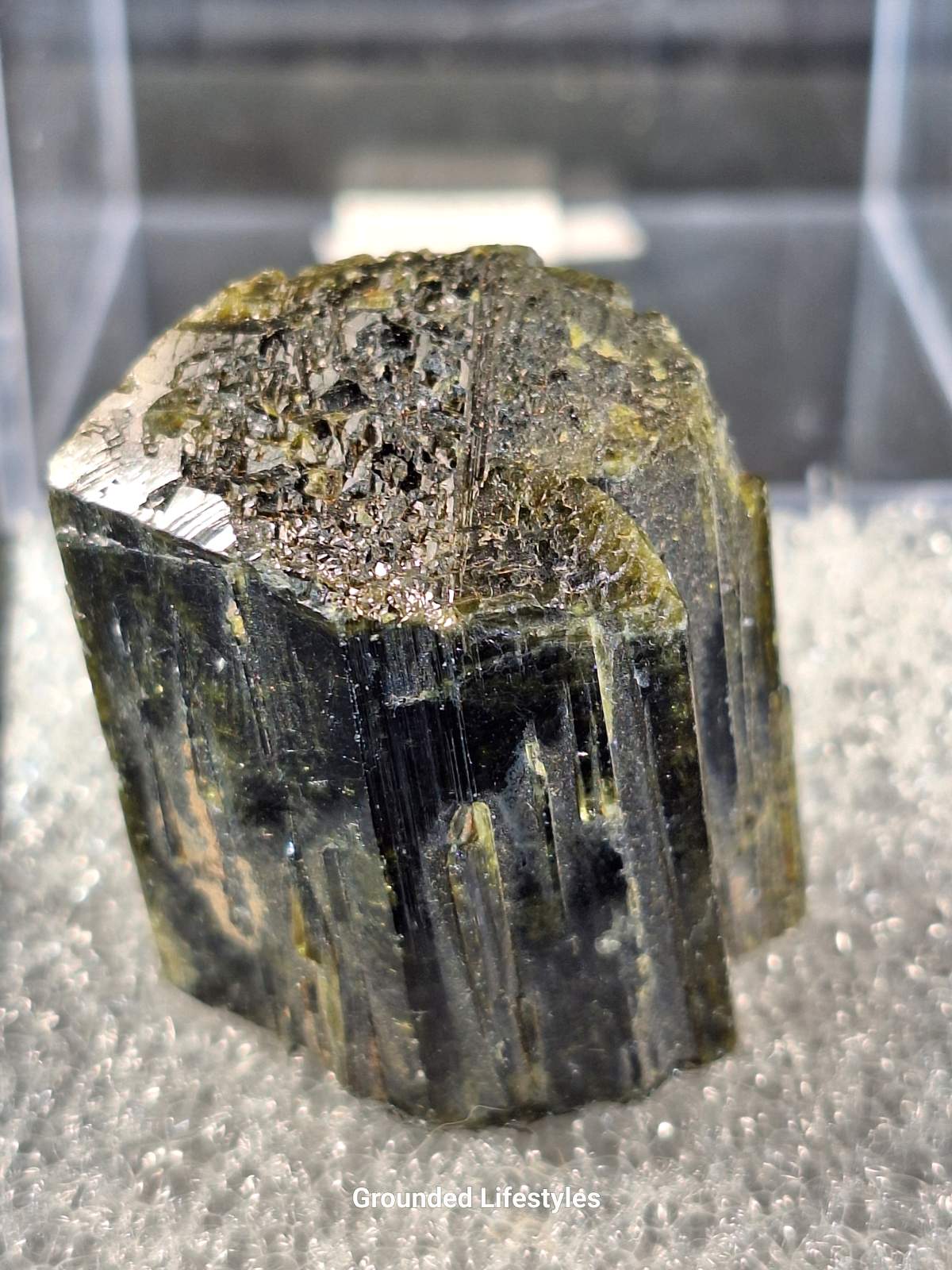
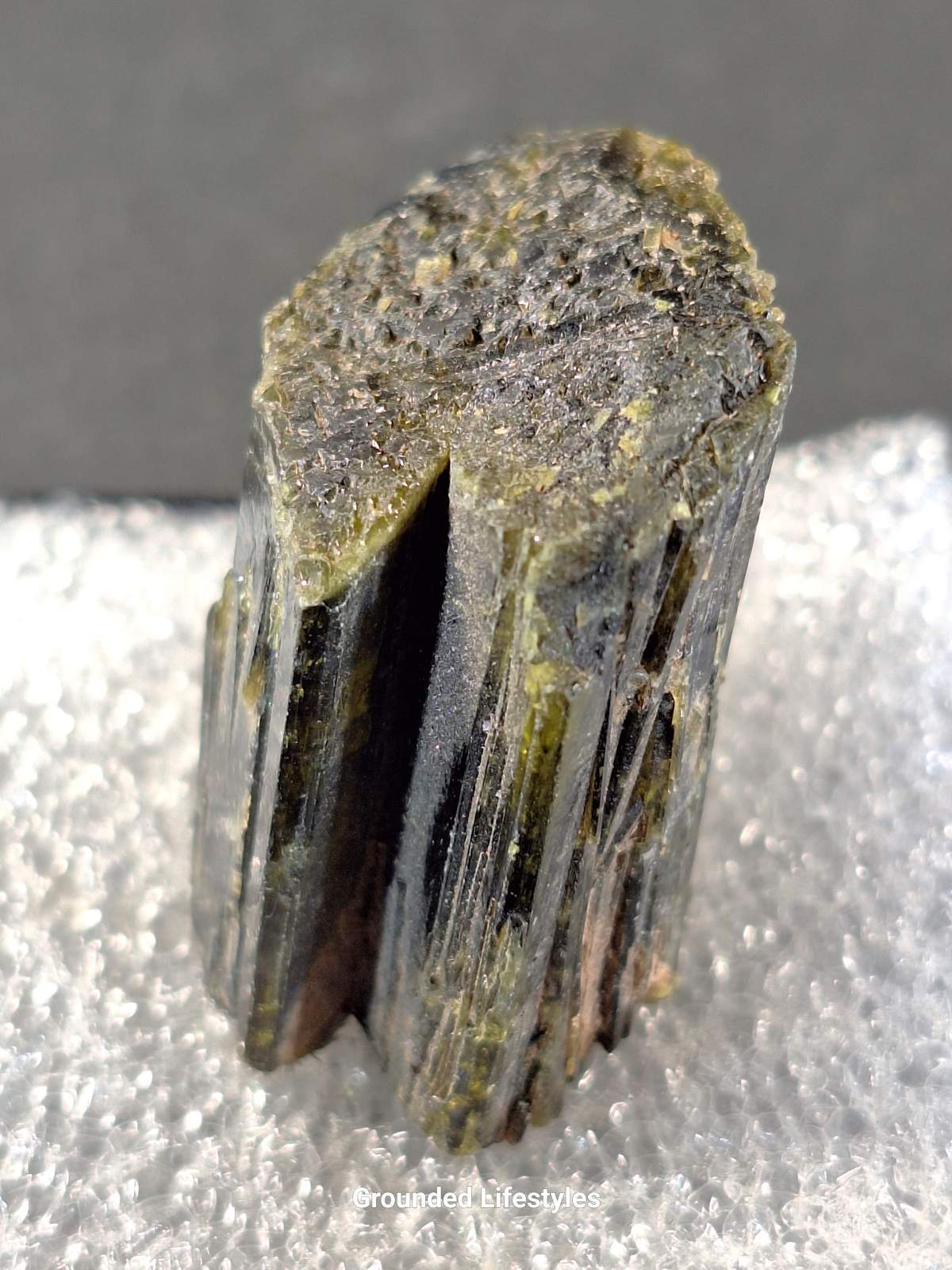
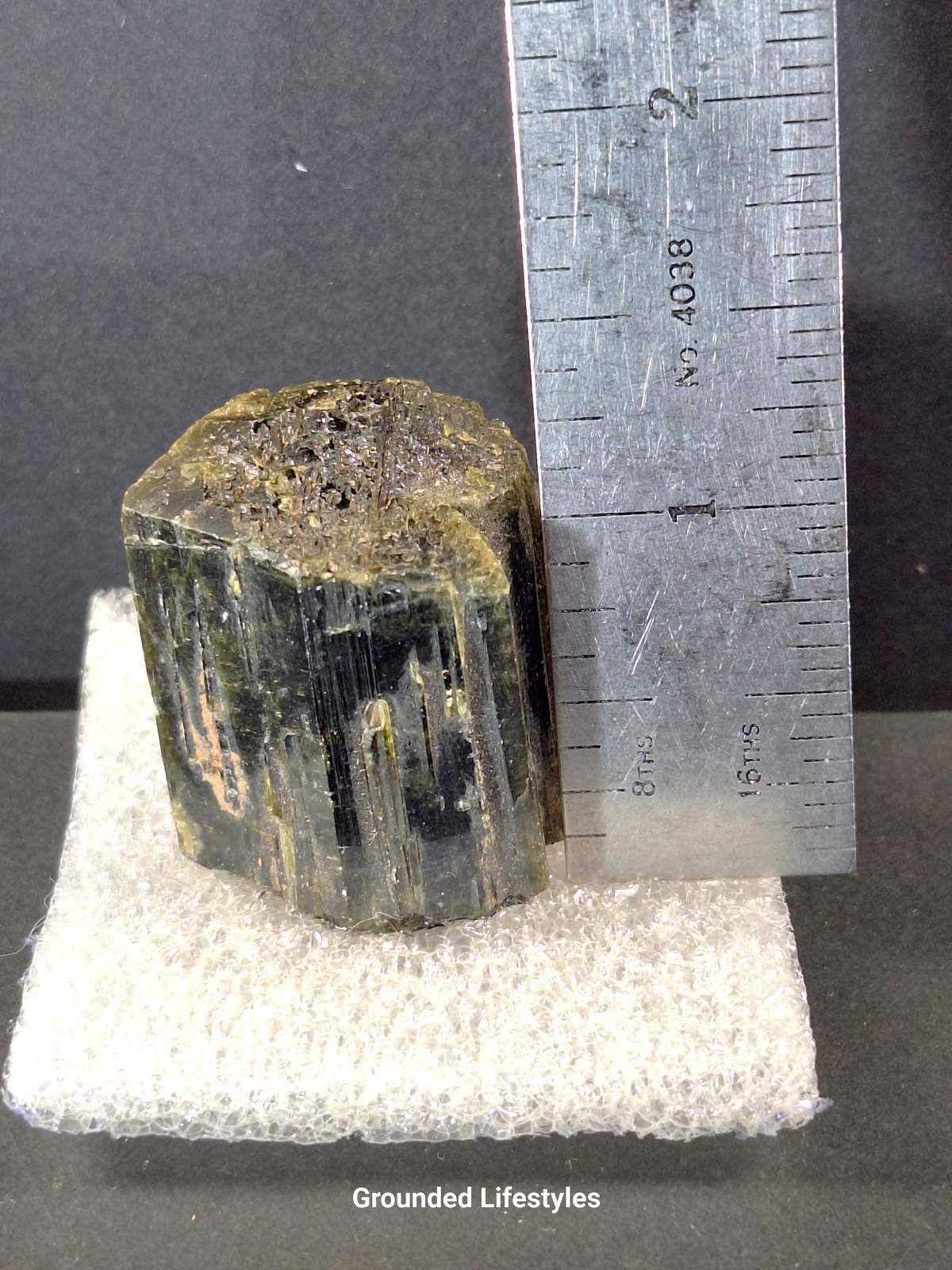
Natural Epidote crystal from Mexico comes from the Donald Wininger Collection and immediately stands apart from the smaller crystal clusters commonly seen in mineral collections. Measuring approximately 1.25 inches long, 0.75 inches wide, and 1 inch high, the specimen is dominated by a substantial prismatic crystal with a deep olive-green color that appears nearly black in normal lighting. Under stronger illumination, subtle green and yellow-green tones become more apparent along portions of the crystal.
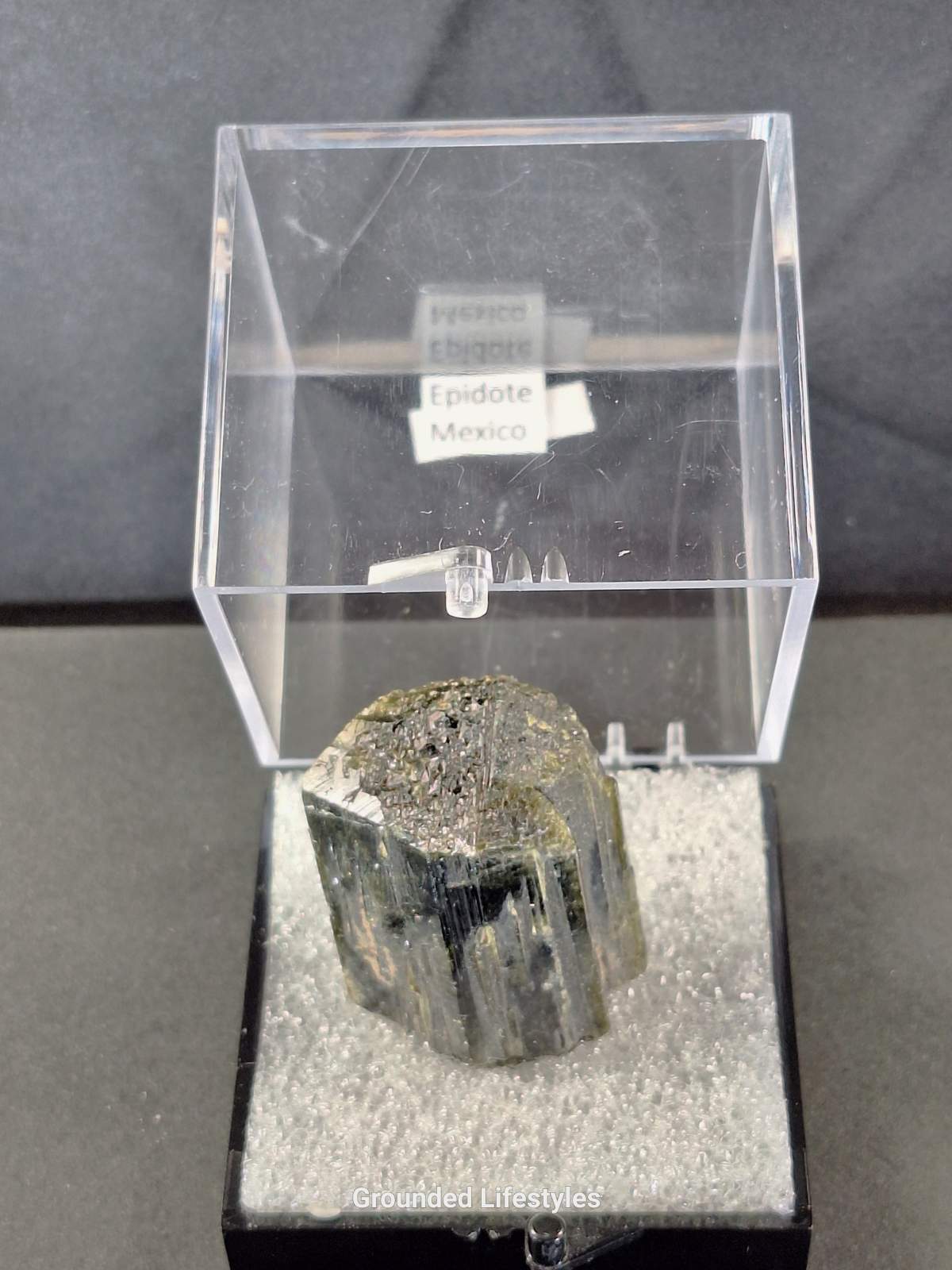
Its most noticeable feature is the crystal surface. Strong longitudinal striations run along the prism faces, catching the light and producing a surprisingly reflective luster. The upper portion shows complex natural crystal growth and an irregular termination, giving the specimen considerably more texture than a simple smooth prism. The specimen comes housed in the 2 × 2 × 2 inch Perky box shown.
Epidote is strongly associated with green, but that description covers an enormous range—from yellow-green and pistachio to olive, bottle green, brownish green and crystals so dark they appear black.
The color is closely related to Epidote’s iron content. Iron-rich material generally develops deeper green to greenish-black coloration, while changes in composition can produce lighter yellow-green shades.
That explains the appearance of this specimen particularly well. Its thick crystal body absorbs much of the available light, producing the nearly black appearance seen across the broad faces. Along thinner edges and more translucent areas, its underlying olive-green character becomes easier to see.
Mexican Epidote specimens with this type of dark coloration are documented. For example, older specimens from San Quintín, Baja California, are described as intensely dark green, striated and lustrous, while other Mexican localities have produced crystals ranging from pistachio to nearly black.
Mineral Information
| Property |
Information |
| Mineral |
Epidote |
| Formula |
Ca₂(Al,Fe³⁺)₃(SiO₄)₃(OH) |
| Mineral Class |
Sorosilicate |
| Crystal System |
Monoclinic |
| Mohs Hardness |
6–7 |
| Luster |
Vitreous |
| Color |
Dark olive-green to nearly black |
| Habit |
Thick prismatic/intergrown crystal |
| Notable Feature |
Strong longitudinal striations |
| Locality |
Mexico – exact locality unknown |
| Collection |
Donald Wininger Collection |
How Epidote Forms
Epidote tells a very different geological story from the Wulfenites we’ve been working with.
Rather than forming primarily through near-surface oxidation of metallic ore, Epidote commonly develops when rocks are chemically changed by metamorphism or hydrothermal fluids.
Hot mineral-rich fluids moving through fractures can react with calcium-, aluminum- and iron-bearing rocks. Under suitable temperature and pressure conditions, those elements reorganize into Epidote. It is particularly common in altered igneous rocks, metamorphic environments, veins and skarn deposits, where intrusive magma has chemically interacted with surrounding carbonate rocks.
Mexico contains several geological environments capable of producing crystallized Epidote. One well-documented example is the San Quintín skarn occurrence in Baja California, which has produced thick, terminated, dark-green crystals as well as parallel crystal intergrowths.
Metaphysical Properties
In modern crystal traditions, Epidote is associated with personal growth, persistence, optimism, transformation and moving forward with intention. Its rich green coloration is also traditionally connected with the heart chakra, renewal and one’s connection with the natural world.
These associations are traditional metaphysical interpretations and are not medical claims.
Display & Care
This specimen is particularly suited to display because the large crystal faces respond dramatically to directional lighting. A light placed slightly above or to the side can reveal the underlying olive-green color while highlighting the vertical striations.
Keep the specimen in its 2-inch Perky box when possible to protect its termination and edges. Epidote is considerably harder than Wulfenite or Calcite, but crystal edges can still chip from impact.
For routine cleaning, use a soft, dry brush and avoid aggressive chemical or ultrasonic cleaning.